THIS IS AN OPINION
We'd also like to hear yours.
Tweet us @ArkBusiness or email us
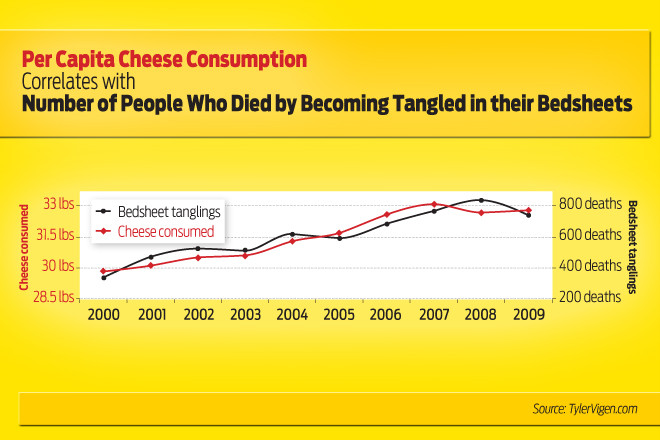
A Harvard law student named Tyler Vigen has a blog called Spurious Correlations in which he posts line graphs that seem to suggest a correlation between things that have no logical correlation. Like how cheese consumption correlates with deaths due to entanglement in bedsheets or how non-commercial space launches correlate with the number of doctorates in sociology that are awarded.
It’s nonsense, but it’s a reminder that mistaking correlation with causation is rampant. I recently wrote a column about the increase in suicides, and a commentator on the ArkansasBusiness.com website immediately correlated suicide with a “steady assault” on “Judeo-Christian values and faith” in the past quarter-century. Perceived correlation equals absolute causation, full stop.
As it happens, there has also been a proliferation of cellphones during that time and increased use of sunscreen. And the number of opioid painkillers being prescribed and abused has skyrocketed over the same period. Since Dr. Ricardo Cáceda, a suicide researcher at UAMS, said that about half of the suicidal patients he sees are using opioids, I’m thinking that one of these correlations is more likely to be causation than the others. But even that is just a guess.
Our incomparable online editor, Lance Turner, recently called my attention to British social commentator John Oliver’s “Last Week Tonight” segment on how “the media” butcher the reporting of scientific data. Depending on the report, he pointed out, coffee may reverse liver damage, prevent certain kinds of cancer and/or increase the risk of miscarriage — even if the father is drinking the coffee. So should we drink coffee or not?
Lance wanted me to see the John Oliver segment because he and I recently had lunch with John H. Johnson, a statistician and expert witness who was in Little Rock last month to talk about his new book at the Arkansas Literary Festival. His book is called “Everydata: The Misinformation Hidden in the Little Data You Consume Every Day,” and it should be required reading in high school and for every journalist and journalism student in the universe.
Using sentences and examples that even I can understand, Johnson and co-author Mike Gluck explain the way averages can be used and misused. One of my pet peeves is the auto insurance commercials that tout the average savings of policyholders who switched to the new company. Well, duh. They switched because they were going to save money. How many policyholders didn’t switch because they already had a better deal?
Johnson and Gluck remind us that outliers — data points that don’t fit with the others — can be valid (some kids really do graduate from college at 14) or bogus (Mark McGwire was using steroids) and can have a dramatic effect on averages. “It’s like adding cream to your black coffee. It’s still 95 percent coffee, but a few drops can change the appearance dramatically.”
They write about the problem with self-reported data. (Guess what! We overstate how much we exercise and understate how much we weigh.) They warn us to consider whether important data might be missing. That “NBC Nightly News” graphic showing the number of accidents involving big rigs didn’t say how many were caused by the truck driver, and that’s important data in determining how dangerous truckers are.
I predict that the use and misuse of data will reach a fever pitch between now and November. Polling data will be pushed and pulled and weighted and “unskewed,” and it still may not be right. Candidates’ records will be sliced and diced and presented in the most favorable (or unfavorable) way possible. We can either be smart, skeptical consumers of data or suckers. Take your pick.
 |
Gwen Moritz is editor of Arkansas Business. Email her at GMoritz@ABPG.com. |
 Sign up for Daily E-news