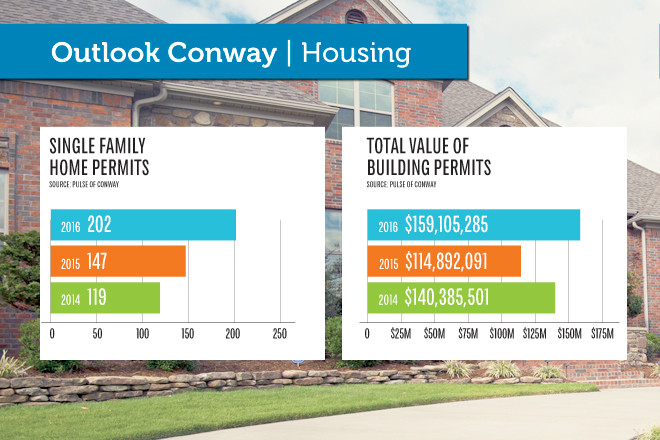
Conway’s reputation for high quality of life and years of rapid business growth has meant accelerated demand for new residential construction. This has put a squeeze on local developers and builders, pushed prices of lots and homes and challenged realty companies with tight inventory levels.
“In that $100,000 to $150,000 range there’s a 2.7 months’ supply of houses,” said Tracy Tidwell, broker/owner of ERA Real Estate. “A six-month supply is healthy; it’s not a buyer’s market, it’s not a seller’s market, it’s just a healthy market. When you’re down lower than three months’ supply of houses, people think it’s a seller’s market and it can be, but the buyers are also more expectant and more demanding. It’s just a very difficult market when you’re less than three months’ supply.”
In fact, according to Tidwell’s data, available homes in the $150,000 to $200,000 range are similarly hard to find, currently at just 2.9 months’ supply.
Developers and builders say that the current crunch can be viewed as a residual effect of the economic crisis of a few years ago from which the industry has been working to recover ever since.
“I would say from the development standpoint we’re not serving all the markets,” said Hal Creston with Rush Hal Development. “When the economy boomed, when we were building 400, 500, 600 homes here, we had starter homes, we had move-up homes, we had what I’d call mid-price new subdivisions and maybe one or two on the high end. Now everything’s kind of trended toward the high end, even the smaller homes on the smaller lots.
“I have people all the time want to come build a home and be $200,000 or under and be in a good part of town. Since the recession we’ve not been able to do the full market in Conway, but I also think that’s nationwide, not just here.”
In 2010, there were 223 permits issued for single family homes in Conway, averaging 2,700 SF and an average cost of $67 per SF. Five years later, 76 fewer permits were issued for, on average, 3,000-SF homes and cost per SF had ballooned to $82.47. Last year was the first since 2010 to break the 200-permit barrier, at just under $78 per SF.
The housing situation is having an impact across nearly all demographic sectors. Keller Johnson of Keller Johnson Construction has recently catered to Baby Boomers looking to downsize and even these qualified buyers are having their share of sticker shock.
“I think what a lot of people are finding out though downsizing is, they’re moving out of a 3,800-SF house thinking they’re going to put money in the bank and they’re realizing they’re going to buy a 2,300-SF house for the same money,” he said.
Some buyers are opting instead to purchase older homes in established neighborhoods that need some work, where such inventory is available, and investing what they save up front in renovation costs. This is particularly true among Millennials.
“There is such a huge trend on social media and HGTV on flipping houses and everybody thinks they’re going to be able to go in, find something a little more reasonable and that has really changed some things,” said Kim Tyler of the Tyler Group and president of Faulkner County Homebuilders Association. “People who can’t buy a brand new house for $185,000 or $220,000 get something that costs $110,000 and put $40,000 in it to get what they want.”
For now, many Conway-based developers and builders are finding an easier go of it in surrounding communities, particularly Greenbrier, but also Pickles Gap, Wooster and other points in the county and North Metro region. Prices are comparable, they say, and regulation is easier to navigate.
On the other hand, none of the professionals interviewed were sour on Conway; to the contrary most said a few common-sense changes to local codes is all it would take to get the industry moving again. And, as Mark Tidwell, owner and executive broker of ERA Team Real Estate said, there are signs that process has already begun.
“In talking with some people in the planning department and other people around, people are thinking of ways to bring affordable housing here,” he said. “It’s just going to take some more thought and more time, but it’ll happen.”
One new project is bringing much-needed downtown living options to meet the demand for the urban, walkable lifestyle in the heart of the city.
“There’s a lot of good things that are going on in downtown Conway and have been for a few years now, but downtown living in Conway is, to a large degree, nonexistent,” said Brent Salter, vice president of Salter Properties. “If you’re thinking of living in the core of downtown you can probably count the number of units that are down there by taking your shoes off.”
Salter’s company is soon to break ground on a multi-family project to help address the issue. Named J Lofts, the development will bring 21 units to the city’s core. The project will be three levels over ground floor parking and feature studio, one-bedroom and two-bedroom units. Salter said location itself is the primary selling point.
“I think the main amenity is downtown itself,” he said. “[J Lofts] is a very similar idea to what you see across the country. People prefer to be able to walk to work, walk to the things that they enjoy doing, whether that’s shopping or dining or parks or whatever it may be. We’ve already had phone calls from people wanting to put down deposits for these and it’s all Millennial professionals who work downtown and would prefer to live there as well.”
See more about Conway’s economic growth at Outlook Conway.
 Sign up for Daily E-news