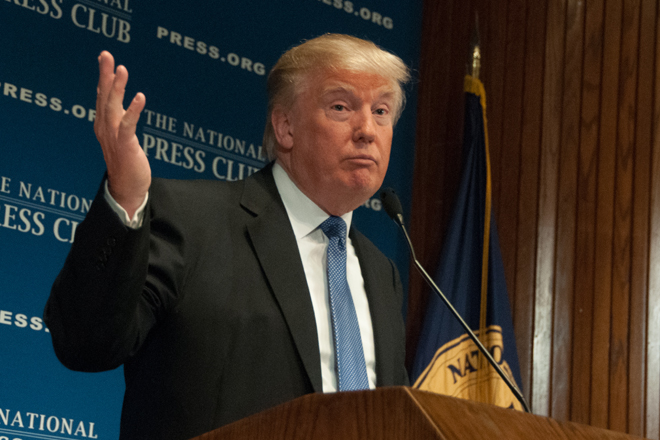
Donald Trump speaks to a 2014 luncheon at the National Press Club.
When President Donald J. Trump declared again last week that the “Fake News Media” is the “true Enemy of the People,” talk in our newsroom turned to a televised briefing early in the Trump administration, a moment business readers may find revealing.
White House Press Secretary Sean Spicer — remember him? — was delivering good news on the economy. Unemployment was down, and discouraged workers were rejoining the job hunt.
Spicer was then asked if the president had faith in the new unemployment data. Like Barack Obama’s birth certificate, the Bureau of Labor Statistics’ unemployment numbers had long been called phony by Trump. And the new, positive jobs data had come from the same source Trump previously accused of fakery.
“Yeah, I talked to the president prior to this and he said to quote him very clearly,” Spicer replied. “It may have been phony in the past, but it’s very real now.” Spicer was grinning, and several members of press corps laughed. (Nothing fake about this; the briefing was recorded.)
The message was clear: If a report looks good for Trump, to him and his administration it’s true. If not, it’s fake.
No successful business I know operates on this perception of reality. Do top CEOs dismiss research and financial data just because they’re challenging, embracing them only when they’re glowing? No, self-deception is a lousy business model. Folks may have financial or policy reasons to support Trump, but devotion to truth isn’t among them.
Trump is hardly the first president to quarrel with the press, of course. But he’s surely the first to label government statistics phony, then trumpet them as true as soon as they make for good press.
He’s also the first president to routinely call the American news media — or at least elements of it he dislikes — enemies of the people.
This sort of overstatement is typical of Trump’s larger-than-life style, an element he calls “truthful hyperbole.” Basically, he tells untruths to point to what he sees as a larger truth.
“We don’t have tariffs anywhere,” the president told the Wall Street Journal last week.
The venerable business paper promptly listed $300 billion in goods the Trump administration has placed tariffs on.
“I’m using tariffs to negotiate,” Trump says next in the interview, and it’s classic Trump.
After saying something blatantly untrue, he acknowledges its falseness as he moves on to the real message, which in this case was that not all of Trump’s threatened tariffs have been imposed.
To supporters, this rhetorical style lets Trump off the hook, but it also challenges reporters, who can’t simply ignore that the president has made a bizarrely untrue statement.
Trump employs “Fake News Media” as a term to discredit coverage he dislikes, but he’s really talking about the men and women who produce the news you see and read. And remember, most working journalists aren’t those heads that are constantly talking on cable.
They’re the folks who got the score right on your kid’s high school ballgame, who covered the city council meeting, or wrote about that local business deal. They produce stories about freeway pileups, tornadoes and bankruptcies that never stir a thought of fakery.
Put simply, the news isn’t fake.
Sometimes it’s wrong, sure, but worthy outlets prominently correct their mistakes. Just look at Page 4 of last week’s Arkansas Business.
In today’s tense atmosphere, Heide Harrell, past president of the Arkansas Chapter of the Public Relations Society of America, kindly passed along a letter to colleagues from Anthony D’Angelo, PRSA’s 2018 national chair.
In it, he condemns the murder of Washington Post contributor Jamal Khashoggi in a Saudi consulate in Istanbul last month and champions a free press at home and worldwide as “journalists and ethical journalism are under attack.”
Harrell, the immediate past chair of the PRSA’s Southwest District, told Arkansas Business she’s proud to be part of a group denouncing “the idea that journalists are the ‘enemy of the people.’
“They are your neighbors, mothers, fathers, sons, daughters, and most importantly, your fellow Americans. The practice of both journalism and public relations is founded on ethics and truth. The current discourse happening throughout our country is not only detrimental to the First Amendment, but is now threatening the lives of those who spend their careers reporting on the news you need to know.”
 Sign up for Daily E-news