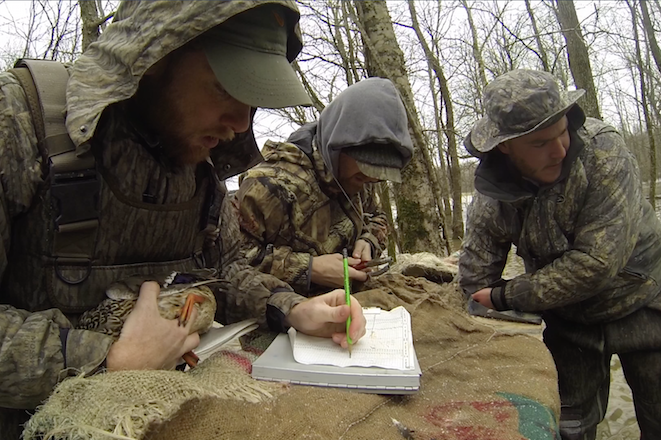
From left to right, Alan Humphrey, Chris Watt and Cody Williams, all graduates of the School of Forestry and Natural Resources at UAM. All now work full time in wildlife management.
A unique waterfowl research project by an ecologist at the Arkansas Forest Resources Center is being funded by a pair of Monticello businesses.
Maxwell Hardwood Flooring and Silvicraft, a pulpwood and saw timber dealer, are paying for the $20,000 per year project led by Douglas Osborne, who holds a Ph.D. in wildlife ecology and is an assistant professor working at the center. The project aims to measure the survival rates of ducks that made it through the hunting season, which in Arkansas begins Saturday.
Osborne’s research is a different spin on the usual duck banding practice. Typically, duck banding programs focus on waterfowl breeding grounds in the prairies of the northern Midwest and in Canada. But Osborne bands the ducks where they winter.
“Harvest rates are one of several factors that drive how we set harvest regulations for ducks,” Osborne said. “We’re potentially missing the mark by not banding waterfowl on the wintering grounds.”
More: Get more on Arkansas duck hunting in our annual magazine, Greenhead.
The Arkansas Forest Resources Center is part of the University of Arkansas System Division of Agriculture, and Osborne is on the faculty of the University of Arkansas at Monticello’s School of Forestry and Natural Resources.
In February, he’ll be in the third year of the study, which track return rates of banded mallards to the same wintering areas and measures survival rates of ducks. Osborne currently tracks mallards only; he plans to band all duck species wintering here next year.
“Landowners are interested in learning if the birds are coming back to the same wintering areas year after year and there is a community of folks who have chipped in money,” Osborne said. “They want to see a successful waterfowl research program here in the state of Arkansas.”
Wil Maxwell, the co-owner of Maxwell Hardwood Flooring, helped to come up with the idea for the banding program while hunting with Osborne and another friend.
“I brought up the lack of bands that we were harvesting — they’ve reduced over the years,” Maxwell said. “Doug did some research, and he found out that the federal government was banding significantly less ducks than they used to, so I said, why don’t we just band them?”
Maxwell said that he and the company decided to get involved because it was an original study and unusual to band this volume in the winter. Envisioned as a three-year project, Maxwell said there’s a possibility that the company will continue to fund it if Osborne continues.
“It had tremendous success last year, and we hope to have that much or more success this year,” Maxwell said. “The first year was difficult, but we banded I believe 851 mallards last year.”
According to Osborne, the UA System Division of Arkansas has the only waterfowl research program in the state, which is an which is important wintering area for more than 10 million waterfowl.
“The goals are to develop estimates of survival for mallards captured on the wintering grounds, evaluate return rates of mallards to the same wintering areas, and use band return data to investigate timing and distribution of migration,” Osborne said.
The U.S. Geological Survey coordinates the North American Bird Banding Program jointly with the Canadian Wildlife Service. Hunters play a role by collecting bands from harvested ducks and reporting the nine-digit band numbers to the USGS online at Reportband.gov. Osborne said about 60 to 80 percent of hunters take the time to do the reporting.
“Hunters typically want to know where their birds are coming from,” he said. “They’re getting better at submitting the data and the process is easier now than ever before.”
Osborne is also partnering with the Biodiversity Research Institute of Portland, Maine, for a study on mercury in duck blood.
Mercury in the blood of wintering ducks indicates exposure to contaminated water in the previous 20-30 days in the wintering grounds, he said. Osborne collects blood samples and sends them to the institute for processing. While samples have turned up low levels of mercury, none have given any indication for worry.
This research not only benefits the duck hunting community, it also affects the conservation and science industries, and Osborne hopes it continues.
“Arkansas is well known for its waterfowl hunting and thousands of non-residents visit Arkansas annually to hunt ducks and geese,” Osborne said. “Our program intended to use science to inform the conservation of waterfowl populations and waterfowl habitat, so that future generations of waterfowl hunters have a long-term sustainable population of ducks and geese to carry on the tradition of waterfowl hunting.”
The 2015-2016 duck season in Arkansas begins Saturday and runs through Nov. 29, then picks up again from Dec. 10-23 and Dec. 26-Jan. 31.
 Sign up for Daily E-news