Entergy Arkansas has agreed in a legal settlement with environmental groups to shut down coal-fired power generation at two sites in the state within 9-12 years, the utility and the Sierra Club said Friday morning.
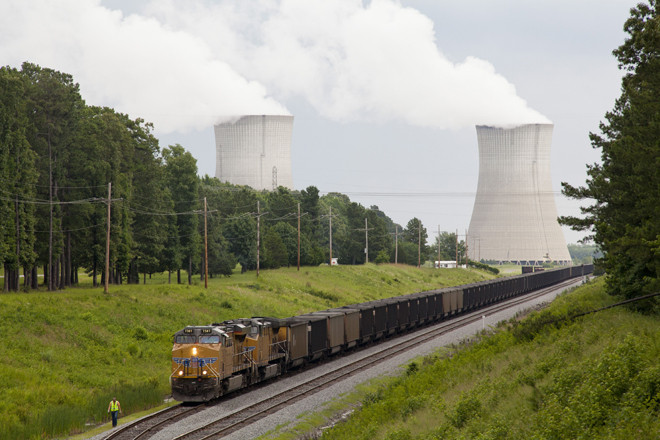
The settlement, which ends a federal lawsuit and other legal actions by the Sierra Club and the National Parks Conservation Association, requires Entergy to stop burning coal at its White Bluff plant in Redfield by the end of 2028 and at its Independence plant in Newark by Dec. 31, 2030. Environmentalists oppose the burning of coal for electricity creating, favoring renewable sources of generation.
The two Entergy coal plants, which each employ about 100 people, are heading into the twilight of their expected service, and the utility — like the entire electric power industry — has been trending away from coal-fired generation and toward natural-gas plants and renewables for several years.
“This is a big day for the environment, and a big day for clean air in Arkansas,” Glen Hooks, president of the Arkansas chapter of the Sierra Club, said in a telephone news conference. The two plants, Entergy’s only two coal generation units in Arkansas and two of only five statewide, provided about 10 percent of the utility’s overall power load. But Hooks said they have an outsize impact on the environment. “The more important numbers for us are the gigantic amounts of pollution that come from these plants,” he said, specifically mentioning sulphur dioxide and nitrogen oxide.
The closing date deadlines allow Entergy to “secure 50 years’ economic benefit” from the plants while dovetailing with plans to replace older generation facilities with new and more efficient resources. The company said the deal ensures continued long-term inexpensive power for customers and a “predictable transition for employees” of the plants. A company news release also hailed “an end to ongoing lawsuits over the use of coal at the plants.”
Beyond the operations at Newark and Redfield, the agreement calls for Entergy’s Lake Catherine 4 gas-fired plant to be replaced with newer high-efficiency facilities, part of what the utility called “an ongoing strategy to transform the company’s power generation portfolio” and alter its diverse resource mix.
The company uses utility-scale solar, low-emitting natural gas units and zero-emissions nuclear generation to provide a vast majority of its power. The settlement was filed in the U.S. District Court for the Eastern District of Arkansas.
Hooks called the two Entergy coal plants “some of the largest coal-burning units in the entire country that lack modern pollution controls.” He said the company had not complied with Clean Air Act provisions for years, and that smog-causing nitrogen oxide was causing health risks “not only to our state but also to the communities of Memphis and St. Louis.”
For Entergy Arkansas, the deal offers an orderly time frame. “These generating units in Arkansas, and our employees who work there, have been an important part of Entergy Arkansas for approximately four decades,” Laura Landreaux, president and CEO of Entergy Arkansas, said in a company statement. “This agreement allows for a reasonable transition to new energy resources by extending the life of the plants and associated jobs for another nine to 12 years while preparing for the future.”
Entergy said the Clean Air Act’s regional haze program, which Hooks accused the utility of defying, would have subjected both White Bluff and Independence to install $2 billion worth of emission controls technologies by 2021. This agreement, if approved by the courts, will avoid that prospect.
The company also agreed to:
-
Begin using only low-sulfur coal at the White Bluff and Independence coal plants starting no later than June 30, 2021.
-
Cease to use coal entirely at White Bluff no later than the end of 2028. Cease to use coal entirely at Independence no later than the end of 2030.
-
Continue to use only natural gas at the Lake Catherine 4 plant and cease operation of the plant by the end of 2027.
-
Maintain the option to develop new generating sources at the plant sites.
-
Pursue approval of 800 megawatts of renewable generating sources, with at least 400 megawatts brought to regulators no later than the end of 2022 and the remainder no later than the end of 2027. This includes the 181 megawatts of solar in Arkansas already approved by regulators.
Entergy Corp., the parent company of Entergy Arkansas, owns and operates power plants with approximately 30,000 megawatts of electric generating capacity, including nearly 9,000 megawatts of nuclear power. Entergy, which delivers electricity to 2.9 million customers in Arkansas, Louisiana, Mississippi and Texas, 13,000 total employees and annual revenues of about $11 billion.
 Sign up for Daily E-news