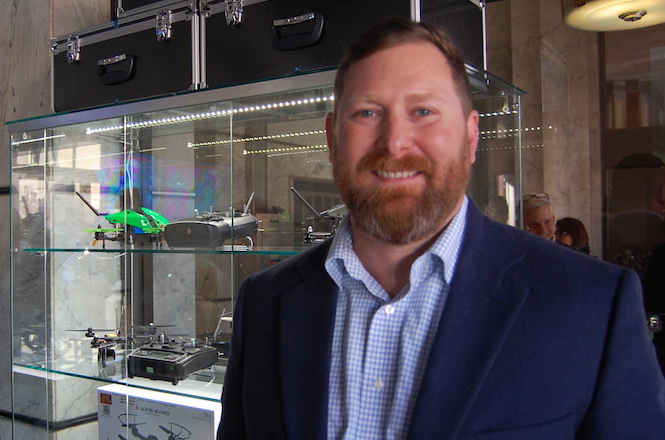
ArkUAV CEO Brad Fausett.
The FAA Reform & Reauthorization Act of 2012 required the Federal Aviation Administration to integrate unmanned aircraft systems — drones — into U.S. airspace by 2015, but that deadline has come and gone and the agency still hasn’t issued clear and final rules regarding commercial drones.
Currently, operation of commercial drones is illegal without specific FAA authorization. However, the agency has been granting what are called “333 exemptions,” allowing commercial operation of small — less than 55 pounds — drones on a limited case-by-case basis.
ArkUAV of Little Rock, which seeks to provide training, services and supplies for the use of unmanned aerial vehicles in industries including agriculture and energy, applied for an exemption in July. However, the company, which opened for business last summer, still hasn’t heard from the FAA despite the agency’s advice to apply 120 days before drone operation was planned, according to Brad Fausett, ArkUAV’s CEO.
The delay has left his business, which focuses on sensoring technology, “hemorrhaging money and not being able to bring any in,” Fausett said. “The thing is, nobody’s got this kind of technology in Arkansas on drones,” he said. “Nobody knows it better than we do.”
Using special sensors, his drones can take pictures of crops highlighting areas of damage, drop a GPS point on that spot and return to deliver a highly localized spray of pesticide, reducing pesticide loads in commercial fields by 90 percent, Fausett said.
A drone carrying LIDAR technology — light detection and ranging — can map a field for extremely precise leveling. Infrared technology can be used to detect problems in levees, drainage and drought.
But the FAA regulations “are a moving target,” Fausett said, and he has reached out to elected Arkansas representatives for help on learning the status of his request for a 333 exemption.
The situation is doubly frustrating, he said, because the business has received a loan guaranteed by the federal government — from the Small Business Administration — but is being thwarted, as he sees it, by another federal agency, the FAA.
In the meantime, ArkUAV is selling hobby drones, working with the University of Arkansas at Little Rock and eStem Public Charters Schools on developing curriculum for students and doing repairs of drones.
But, Fausett said, he’s confident that eventually his business will be cleared to operate drones commercially. “When we started this, the whole goal was to out-survive the mayhem of it all,” he said. “We want to be here in three years and be the drone specialists, the aerial robotics specialists in Arkansas.”
“There is a huge need for this,” Fausett added. “It’s going to take everybody awhile to get their arms around this market, and the mayhem will be over at some point. Let’s out-survive everybody.”
 Sign up for Daily E-news