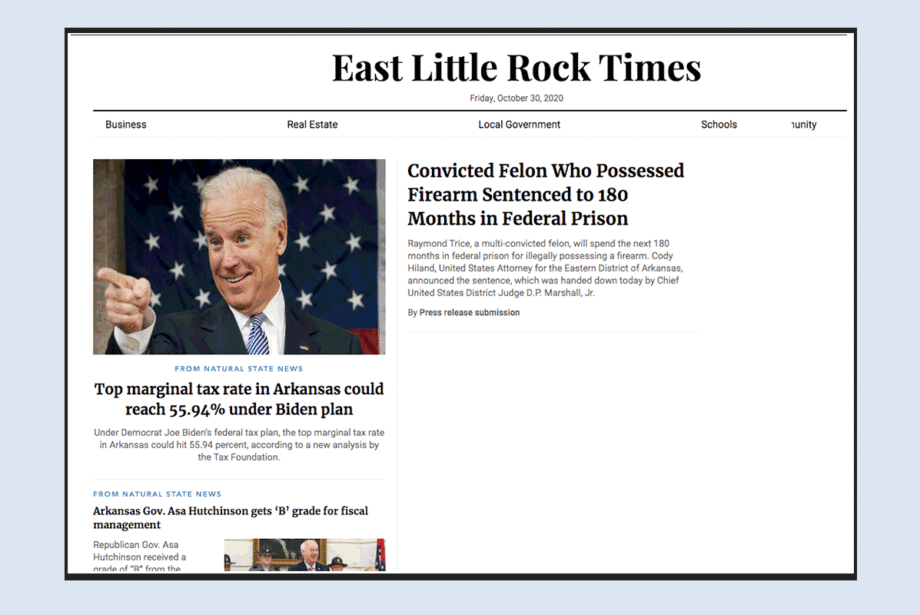
The North Little Rock Times, the Fayetteville Standard, the Fort Smith Times, the Lower Delta News.
Familiar and longstanding Arkansas news sources, right? Wrong. They aren’t.
Neither are the Benton Times, the East Little Rock Times, Hot Springs Times, Jonesboro Times, the NW Arkansas News, the NC Arkansas News, the Natural State News, the Pulaski Times, the SW Arkansas Times and the Upper Delta News.
All 14 are new properties of the Metric Media Foundation, which runs largely automated websites with no local reporters or editors, no local ad sales representatives, and no physical presence in the towns and regions they purport to serve.
They’re in a network of nearly 1,300 sites facing scrutiny after articles in The Guardian and The New York Times revealed them as purveyors of automated reporting and slanted news financed by political operatives and corporate interests.
The sites have cropped up as traditional local newspapers have failed or cut back drastically in the digital era, and the sites have adopted old newspaper names for an air of authenticity. The old North Little Rock Times ceased operations as a weekly newspaper in 2018, and the Fort Smith Times was a forerunner to today’s Southwest Times Record. One new website, not owned by Metric but by one of its associates, has the audacity to call itself Arkansas Business Daily, though it has nothing to do with our paper, the 36-year-old Arkansas Business.
The new sites don’t print blatantly false stories or spread conspiracy theories, but they hide their remote ownership and convey a false “local” presence.
Mike McNeill of magnoliareporter.com, who built an aggressive and news-breaking online operation in south Arkansas, said the recent focus on the robo-sites had galvanized a trade group he belongs to, the Local Independent Online News Publishers Association, or LION Publishers. “Our members reject the premise that local news is dying,” McNeill told Arkansas Business. “Newspapers are in hospice, but local online sites are in the prime of life.”
McNeill called the faux local sites “the latest incarnation of aggregation — or if you prefer — ‘pink slime’ websites.” Pink slime, a term first coined for filler in ground beef, refers to the websites’ low-cost automated story generation algorithms, which “scrape names or locations from emails and government, business, media and other websites to create what appear to be news articles.”
The technology works, up to a point, McNeill said, by scouring numbers from Securities & Exchange Commission filings, for example, to cobble together bare-bones business briefs. “People have tried to sell me an algorithm to automatically generate stories for every high school sports event in Arkansas. But there’s no original reporting.” An algorithm won’t tell you Pilgrim’s Pride is taking a hit because of price-fixing inquiries, or how the Magnolia Panthers won that football game in the last minute, he said.
“Some people who get their news from Google can’t differentiate between Magnolia, Arkansas, and Magnolia, Texas. The operators of these sites can’t either. They’ve never set foot in either location. … They have no physical presence in the community. They have no local employees. They have little or no news generated from the community. … They have no visible means of support, which ought to make readers suspicious. They’re likely trading content for cash and not letting their readers know that.”
LION Publishers Executive Director Chris Krewson said the new sites are troubling because they dilute the mission of local nonpartisan and independent publishing. “These publications don’t take the place of the professional newsgathering that’s being systematically cut across the nation; they exacerbate its loss by capitalizing cynically on the absence of trusted publications,” Krewson said.
He said that his membership had generally felt no impact from the sites so far, and that none of the new sites had applied to be members of his group. “I’m hoping people continue to largely ignore this effort at AstroTurfing the news.”
Efforts to reach the Metric Media Foundation were unsuccessful. Metric Media is part of a network of sites led by Brian Timpone of suburban Chicago, a conservative former television journalist and automated reporting guru.
Since his sites have no local advertising, they don’t seek to serve local businesses, McNeill said.
“They must survive on national ad server companies which primarily help national companies at the expense of local retailers. [The sites] also have a narrow focus, such as politics. Magnoliareporter.com is interested in politics, but we’re interested in other things, too, and our website reflects that.”
 Sign up for Daily E-news