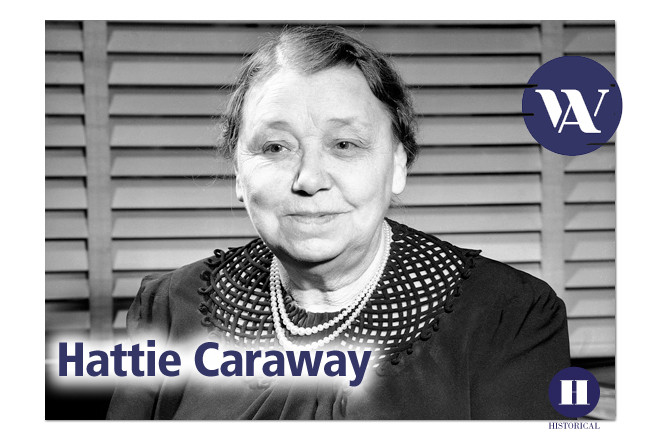
There are trailblazers, and then there’s Hattie Caraway.
Caraway’s name may not have the pop culture cachet of some of her fellow inductees, but the trail she blazed in the 1930s helped set the stage for some their significant contributions.
And Caraway, born Hattie Wyatt outside Bakerville, Tennessee, in 1878, certainly made her own contributions as a member of the U.S. Senate representing Arkansas from 1931-45. Caraway broke new ground as the first woman ever elected to the U.S. Senate, serving in the body for 14 years.
She was appointed by Gov. Harvey Parnell in December 1931 to serve out the term of her late husband Thaddeus, who died the previous November and had been a popular, long-time Arkansas legislator.
Following their marriage in Tennessee, the Caraways had settled in Jonesboro where Thad launched his political career.
Hattie was expected to simply serve out her husband’s term but decided instead to run for a full term and won a special election in January 1932. She became the Senate’s first elected female member and the second woman ever to serve there.
It’s said that her first observation upon entering the Senate chamber was, “The windows need washing.”
A Democrat, Caraway achieved notable milestones beyond her election. She became the first woman to preside over the Senate, the first woman to chair a Senate committee and the first woman to preside over a Senate hearing.
Her candidacy for a full term in 1932 was a surprise, with Caraway announcing it on the filing deadline for the Democratic nomination. Caraway told reporters, “The time has passed when a woman should be placed in a position and kept there only while someone else is being groomed for the job.”
Her eventual victory in the 1932 Democratic primary — which was then, and through the 1990s, tantamount to winning a general election in Arkansas — was aided by the endorsement of the charismatic “Kingfish,” the populist and sometimes controversial Sen. Huey P. Long from Louisiana.
Long, it’s said, was motivated by sympathy for Caraway’s status as a widow (which Caraway did not shy from using to her advantage), and perhaps more importantly by the opportunity to extend his influence in the state of his in-party rival Joseph T. Robinson. Long harbored presidential aspirations and wanted to prove his political mettle outside the borders of Louisiana.
Caraway supported Long’s legislative proposals while Long had been a political ally of her late husband, and a alliance was made. Nine days before the August primary, Long organized a caravan of cars filled with Louisiana state employees to canvas Arkansas on Caraway’s behalf.
Caraway and Long logged more than 2,000 miles and made 39 speeches (most of them by Long) to more than 200,000 people who came to hear them at county courthouses, town halls and city parks, where Long would portray Caraway as a champion of the poor.
“We’re out here to pull a lot of pot–bellied politicians off a little woman’s neck,” he was quoted as saying on the campaign trail. “She voted with you people and your interests in spite of all the pressure Wall Street could bring to bear. This brave little woman senator stood by you.”
In a seven–candidate primary, Caraway won with 45 percent of the vote, carrying 61 of the state’s 75 counties. In the general election, with Arkansas still a solid, one-party state controlled by the Democrats, Caraway defeated her Republican opponent by a near 9-to-1 margin.
Dubbed “Silent Hattie” because she spoke just 15 times on the Senate floor, Caraway adopted a Teddy Roosevelt-like stance of speaking only when necessary with well chosen words and not wasting taxpayers’ money on printing speeches in the Congressional Record. Caraway nonetheless was active in her 14-year Senate stint, winning re-election in 1938 over then-Congressman and future Senator John L. McClellan before being defeated in 1944 by J. William Fulbright, who would go on to his own long and distinguished run in Congress.
She chaired the Senate Committee on Enrolled Bills from 1933 to 1944 and served on the Agriculture Committee, an assignment she requested because of the importance of farming, flood control and river navigation to Arkansas, all areas overseen by the committee.
Caraway was a strong supporter of President Franklin D. Roosevelt’s New Deal legislation, and even seconded FDR’s nomination for re-election at the 1936 Democratic National Convention. But she wasn’t an FDR crony. “He fumbles,” Caraway once said of FDR, “but he fumbles forward.”
She differed with the president on many issues and sometimes joined her Southern colleagues in opposition to Roosevelt policies. In 1938, she joined a coalition of Southern senators voting against anti-poll and anti-lynching legislation on the grounds that it was unconstitutional. She also opposed the repeal of Prohibition.
Caraway had reservations about American intervention in World War II but backed Roosevelt’s declaration of war after the Japanese attack on Pearl Harbor in 1941. During her first term, Caraway secured $15 million for an aluminum plant in Arkansas as well as the first federal funding for an Arkansas college.
During her second term, Caraway voted several times against FDR when she sided with the farm bloc to override the presidential veto of the Bankhead Farm Price Bill, to restrict the administration’s use of subsidies to lower food prices and to readjust the price cap on cotton textiles.
She also helped prevent the elimination of a U.S. House seat from Arkansas to reapportionment in 1941, and was instrumental in the securing of Camp Robinson, Fort Chaffee, Japanese relocation centers at Jerome and Rohwer in southeast Arkansas, five air bases and defense ordnance plants.
Caraway worked on the Equal Nationality Treaty of 1934 extending to women rights they previously didn’t have, and in 1943 she became the first woman in the Senate to co-sponsor the proposed Equal Rights Amendment.
Following her loss to Fulbright in the 1944 Democratic primary, Caraway remained in Washington and was appointed to the U.S. Employees’ Compensation Commission and the Employees’ Compensation Appeals Board. She suffered a stroke in January 1950 and died later that year at her home in Falls Church, Virginia. She is buried next to Thad at Oaklawn Cemetery in Jonesboro.
Caraway is remembered not just as the first woman elected to the U.S. Senate. She was a champion for her constituents, those rural farmers and workers suffering through the Great Depression.
In May 1938, Caraway made one of her rare speeches on the Senate floor, addressing work-relief appropriations, and she made it count:
“My philosophy of legislation, and really in life, is to be broad-minded enough to consider human relationships and the well-being of all the people as worthy of consideration, to realize that all human beings are entitled to earn, so far as possible, their daily bread, and to try to prevent the exploitation of the underprivileged.”
 Sign up for Daily E-news