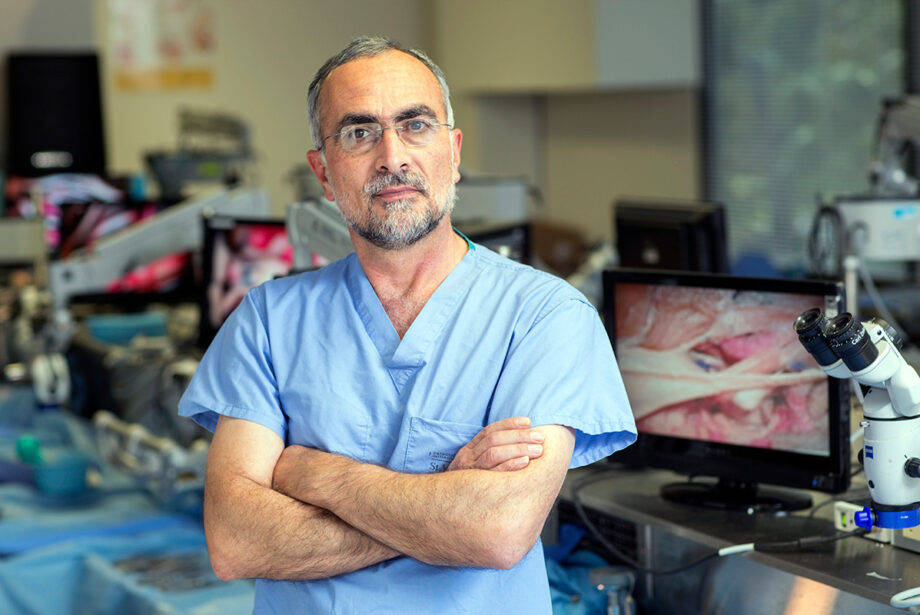
Dr. Emad Aboud
CHI St. Vincent, Arkansas Neuroscience Institute
Dr. Emad Aboud has come up with a concept that is the essence of preventive medicine.
1
The top percentile in which the Arkansas Neuroscience Institute ranks in the nation
38
States from which the institute’s patients have come
75
All of the counties in Arkansas, each of which has sent patients to the institute
Aboud is director of the microneurosurgery laboratory at the Arkansas Neuroscience Institute at CHI St. Vincent. Motivated to come up with a way to prevent patient deaths through better surgical education, he has devised the Live Cadaver Model, U.S. Patent No. 6790043, which is a revolutionary technique for simulating lifelike conditions in cadavers.
The Arkansas Neuroscience Institute is a comprehensive neurosurgery program incorporating all aspects of neurosurgery and the spectrum of neurological disorders. Aboud, with CHI St. Vincent since 2011, realized that advances in surgical techniques and treatment modalities required more effective training strategies and teaching techniques.
“This technique that I developed, the Live Cadaver, is the first and only method for surgical training that combines the real human anatomy with the lifelike conditions at the same time,” Aboud said.
The Live Cadaver Model simulates the human body in terms of bleeding issues, circulation and pulsating vessels, allowing residents and young surgeons to practice methods and techniques without endangering patients. Nurses and medical students can practice inserting needles into veins and catheters and lines into vessels, among other techniques.
Centers using live anesthetized animals for surgical training have started to use the Live Cadaver Model, Aboud said, providing less costly but effective training.
Military surgeons, paramedics and soldiers have found the model valuable for training to treat wounds and combat injuries and prepare them to save soldiers’ lives.
In October, neurosurgeons from around the world visited the institute to learn about the “Aboud Model” under Aboud and Director Ali Krisht.
“Innovations in health care can result in more convenient, more effective, and less expensive treatments for today’s time-stressed and increasingly empowered health care consumers.” — “Why Innovation In Health Care Is So Hard” by Regina E. Herzlinger, Harvard Business Review (Shared by Emad Aboud)
 Sign up for Daily E-news