THIS IS AN OPINION
We'd also like to hear yours.
Tweet us @ArkBusiness or email us
A friend has been using Facebook to share daily Shakespearean insults from the calendar he got for Christmas.
“You are a ruffian that will swear, drink, dance, revel the night, rob, murder, and commit the oldest sins in the newest of ways,” he posted a few days ago, a line from “Henry IV, Part 2.”
Another Facebook user replied, “That’s no insult!”
Lately, I’m not sure anything is an insult — at least nothing that is intended to be. Words hurled as put-downs seem to be promptly turned into slogans.
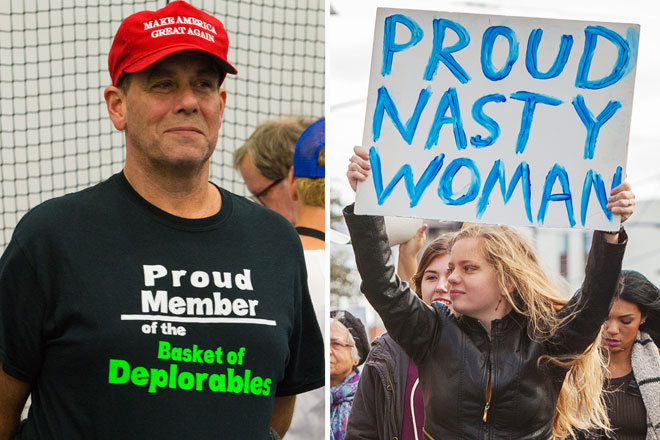
When Hillary Clinton said that half of Donald Trump’s supporters belonged in a “basket of deplorables,” it instantly became fashionable for his fans to refer to themselves as deplorable.
Similarly, many of Clinton’s supporters embraced his description of her as “such a nasty woman.” (That insult was itself a response to a more subtle dig by Clinton, who said her proposal for stabilizing Social Security would cause her own payroll tax to go up — “as will Donald’s, assuming he can’t figure out how to get out of it.”) “Nasty Woman” T-shirts became a cottage industry literally overnight.
American women, at least left-leaning ones, similarly adopted the dogmatic language used by Senate Majority Leader Mitch McConnell to explain why Sen. Elizabeth Warren was barred from finishing her speech in opposition to Senate colleague Jeff Sessions’ confirmation as U.S. attorney general. “She was warned. She was given an explanation,” McConnell said before delivering the words that launched a thousand memes: “Nevertheless, she persisted.”
Last summer I noticed that a number of Twitter users suddenly had multiple parentheses around their user names — like (((tedfrank))), the bane of class-action lawyers everywhere, or ((Charles Fishman)), the author of “The Wal-Mart Effect.” Eventually I learned what that was about. Parentheses — called, in this hateful use, “echoes” — had been used by alt-right and anti-Semitic websites to call negative attention to Jewish names.
It took a while for the code to escape from the deplorable underworld, in part because parentheses were hard for search engines to identify. But after an article by Cooper Fleishman and Anthony Smith for Mic.com outed the dog-whistle symbol, thousands of Jews and sympathetic non-Jews rushed to add echoes to their Twitter accounts.
Neutralizing insults is not really new, of course. My father, a product of Depression-era Van Buren County, called himself a hillbilly long before memoirist J.D. Vance made a fortune with his “Hillbilly Elegy.” In “Breaking Away,” the classic coming-of-age movie, the hometown heroes called their cycling team “Cutters,” the derogatory term for locals who worked in the limestone quarry.
“Breaking Away” was released in 1979, the year I graduated from high school in North Little Rock, which has its own pejorative nickname. You can take the girl out of Dogtown, but you can’t take Dogtown out of this girl.
Being the Dogtown daughter of a hillbilly might have prepared me for the disparagement that comes with being part of “the media” — words that some people seem to think are insulting enough. Does a month ever pass without the cliche “inky wretch” appearing on the editorial page of the Arkansas Democrat-Gazette?
President Trump has energized what’s left of the news industry by being cavalier toward facts in a way that is unprecedented in living memory. His tweeted attack on traditional news outlets, the ones our parents and grandparents and even great-grandparents depended on, as “the enemy of the American People” was as stunning as a slap in the face — for the few seconds it took to become a rallying cry.
Mike Wilson, editor of the Dallas Morning News, promptly ripped out a long ode to his colleagues. In addition to enemies covering things like high school sports, home prices and deaths, he wrote:
“We have enemies of the American people who cover the nation’s most powerful and important leader, bearing witness to everything he says. Enemies of the people understand the importance of choosing the right words because they know the damage the wrong words can do.”
And sometimes the wrong words turn out to be no insult at all.
My favorite insult is one of the dozens of perfect lines from “Casablanca.” The wormy profiteer Ugarte, played to perfection by Peter Lorre, says to Rick Blaine (Humphrey Bogart): “You despise me, don’t you?”
Bogart doesn’t even look up from his chess board as he replies: “Oh, if I gave you any thought, I probably would.”
 |
Gwen Moritz is editor of Arkansas Business. Email her at GMoritz@ABPG.com. |
 Sign up for Daily E-news