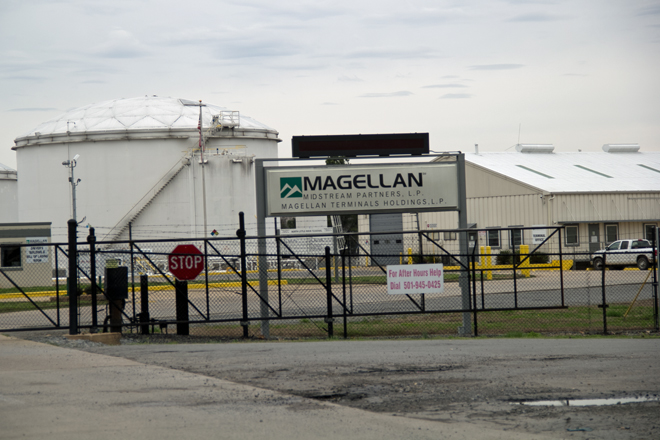
The Magellan Midstream terminal facility in North Little Rock.
Magellan Midstream Partners LP boasted a roster of Arkansas elected officials Wednesday morning in announcing the opening of a 210-mile extension of a petroleum products pipeline from Fort Smith to North Little Rock, and U.S. Rep. Bruce Westerman gave the proceedings an Olympic sheen.
Westerman compared the completion of the $200 million project, which has begun delivering gasoline and diesel to Magellan’s North Little Rock terminal, to the American team’s performance in the Summer Games going on now in Rio de Janeiro.
“I’ve been thinking about the great competitors and winners we have on the Olympic team, and I thought about this project and how it’s a winner,” said Westerman, who represents the Fourth District in western Arkansas. “I’m not sure at this stage if we shouldn’t just raise the flag and play the national anthem in the spirit of the Olympics.”
Westerman was joined on the podium by Gov. Asa Hutchinson and U.S. Senators John Boozman and Tom Cotton, as well as Lt. Gov. Tim Griffin. All emphasized the pipeline’s importance to central Arkansas’ fuel supply, as well as the long-term viability of Little Rock Air Force Base. Jet fuel is expected to start flowing through the pipeline to LRAFB and the Clinton National Airport early next year.
The pipeline, which includes about 12 miles of new pipe out of Fort Smith and some 38 miles of new pipe coming into North Little Rock from the north, makes use of about 160 miles of an existing pipeline leased from Spectra Energy Corp. of Houston. The existing pipeline previously transported natural gas.
Mike Mears, president and CEO of Tulsa-based Magellan (NYSE: MMP), said the Spectra pipeline had been thoroughly inspected and upgraded, and would be maintained on standards used for liquid pipelines. He said the $200 million pipeline extension will yield great benefits for central Arkansas, giving the area new access to fuel sources in the Plains. The pipeline has the capacity to transport 75,000 barrels of refined petroleum products per day.
“Most people don’t think about how gasoline gets to their local stations,” Mears said. “But pipelines are the safest, most efficient, lowest-cost, most reliable transport method for liquid fuels.”
Mears also announced that Magellan has signed an agreement with Enterprise Products, another pipeline company based in Houston, to connect its system to a pipeline north of North Little Rock to move fuel into West Memphis.
“It’s going to take a year or nine months to build that connection, but we’ll be extending the benefits of this pipeline to West Memphis and the east Arkansas market,” Mears said.
The pipeline effort employed more than 1,000 workers in construction, and the North Little Rock terminal has made connections with other local distribution sites, including the HWRT terminal across Central Airport Road, the JP Energy terminal down the street, Apex Oil and the Union Pacific Railroad, Mears said. The pipeline connects central Arkansas to fuel refineries in Oklahoma, Kansas and along the Texas Gulf Coast. Fuel began flowing through the extended pipeline on July 5.
Cotton said he was happy to help in “clearing out some bureaucratic underbrush” for the project, which he said would ensure abundant fuel for the Air Force base, “a strong driver for our local economy.”
Boozman praised the Army Corps of Engineers, the Cherokee Nation, the national guard and North Little Rock Mayor Joe Smith for their cooperation in the project, which he called an essential piece of infrastructure.
“These aren’t glamorous things, but they’re important,” Boozman said.
Griffin praised the triumph of a private enterprise project clearing regulatory hurdles, and Hutchinson described the pipeline as another example of economic development in a state that has attracted 54,000 new jobs and reduced the unemployment rate to an unprecedented 3.8 percent during his administration.
Mears said the public has little to fear from potential leaks in the pipeline, responding to a questioner who mentioned the petroleum pipeline spill in Mayflower in 2013.
“Safety is of paramount importance to the pipeline industry,” he said. “We hydrotested the pipeline, put water in it, pumped it up to high pressure to make sure we have good welds and don’t have any leaks. We typically run devices through the pipeline to check for corrosion or defects. We also have a real-time system monitoring this 24/7 from our control center in Tulsa. We have a leak detection system than can give us immediate notification, and we have a coordinated emergency response system too.
“But remember, pipelines are the safest method to transport petroleum products. The occasional incidents make the headlines, but pipelines deliver fuel 99.999 percent of the time without incident. They are orders of magnitudes safer than other transport methods, including trucking, and more environmentally friendly because you’re not using fuel for transport.”
 Sign up for Daily E-news