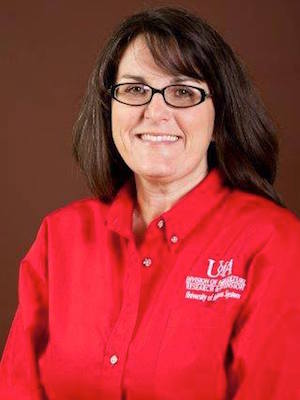
Melissa Beck
The annual Arkansas Women in Agriculture conference, which takes place March 10-11 at the Wyndham Riverfront Hotel in North Little Rock, provides participants an opportunity to network and attend seminars on a variety of topics, including risk management, farm technology and at-home veterinary techniques.
Melissa Beck, a 10 year member of the group, is about to begin the second year of her two-year terms as board president. Raised on a farm in Oklahoma, Beck has never left the agriculture industry.
“[Agriculture] is a lifestyle as much as it is a vocation, and I really like the lifestyle, and my husband is involved in agriculture,” Beck said. “I like being outside, I like working with the livestock, and I’ll go home and help my dad farm on occasion just because I enjoy being on a tractor …”
For the last 10 years, Beck has been a county agricultural extension agent. But she left that position in January to return to her farming duties in Nevada and Hempstead counties and write for various agriculture publications.
Arkansas Business talked with Beck about the upcoming conference, the state of agriculture and women working in the industry.
Arkansas Business: What difficulties or challenges do women in agriculture face?
Melissa Beck: I think that’s a little bit overblown. I’ve never been treated in any way except for with respect … There are certain things on the farm that I am just not physically capable to do in comparison to, say, like my husband. But I find ways to modify the task or overcome it. I use tools, I use a jack or a front-end loader on a tractor, or I just figure out a way to use my brain to compensate for my lack of physical brute strength.
I would say that agriculture is a perfect industry for women because of the flexibility that we have. If you’re in farming full time, you have a lot more flexibility. I didn’t work when our children were young, but I was still able to contribute to the family income because my husband worked off the farm and I was on the farm full time with our kids. So there are some advantages to having women involved on the farm.
AB: Are there misconceptions about women in agriculture?
MB: I think we’re getting well past that because, if you look at the enrollment at Fayetteville’s campus for example, in the animal science department it’s predominantly female. If you look at the graduation composite photos from all the veterinary schools in the country, they’re predominantly women.
I think we’ve made ourselves heard in agriculture, and I think we’ve gained the respect that is necessary for women to be successful in agriculture.
AB: What is the purpose of the Arkansas Women in Agriculture organization and conference?
MB: We are here to provide education and support to other women who are involved in agriculture. So what we do is, we have our annual conference, and we bring programming such as the Annie’s Project, … a program where women meet for six weeks with peers who are involved in agriculture. Women learn about the five areas of risk management and how to be better, more active business partners on their family farms.
We have regional events. This past fall we had a feral hog workshop in northwest Arkansas. There was another here in the south part of the state they had a workshop [on] various conservation practices.
We’ve done workshops for women on how to troubleshoot equipment; how to hook up to livestock trailers and how to drive them; how to back them up; how to repair little things that might go wrong. So we do some of that kind of training as well.
AB: What does the agriculture industry encompass that people may not realize?
MB: Arkansas’ agriculture is very diverse, with the forestry and livestock and row crops and fisheries and on and on. Horticulture even classifies as agriculture. And then you’ve got farmers markets and all these things that are involved. Everything from the research that’s done in this state by the universities, the extension service that provides that research, down to a level we can understand as producers, and then the farming operations.
A lot of research hospitals use animals in the process of getting things FDA-approved, and that’s part of animal science — of course veterinary science is included in that as a field that’s supportive of agriculture.
It’s huge because you also have … paper mills and lumber mills, and then you start thinking, well, you’ve got all these biofuels processing where they process our grains and turn them into biofuels and we buy back the byproduct of that industry and use those in livestock feed.
So, … it touches everyone’s lives. This is cliché, but if you wear clothes or eat, you are touched by agriculture every day.
 Sign up for Daily E-news