Stained glass companies, piano tuners and hymnbook purveyors may need a new advertising medium in Arkansas.
The Arkansas United Methodist newspaper, home for those ads for nearly 140 years, is no longer selling advertising as it launches into the digital age.
The final issue of the monthly newspaper came out this month. Published by the Arkansas Conference of the United Methodist Church, it has chronicled Methodist life in Arkansas since its founding as the Arkansas Methodist by the Rev. John W. Boswell of Morrilton in 1880.
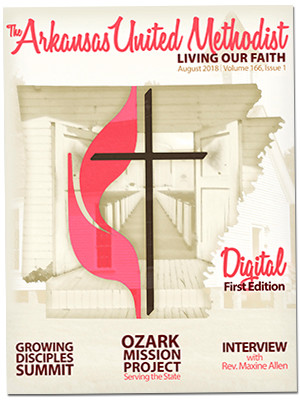
In August, it will be born again as an all-digital interactive magazine, Arkansas United Methodist: Living Our Faith. (A print version in magazine form will still go to about 200 subscribers, but no new print subscriptions will be accepted, and eliminating a 7,000-copy press run is expected to yield savings.)
“It was important to us not to leave out any part of our audience,” said Amy Ezell, director of the Center for Communication of the Arkansas Conference. However, “the number of subscriptions for the print publication were dwindling and an overwhelming majority of our audience uses email to communicate. It was a natural choice to update to an interactive publication that can be easily shared and is mobile-friendly.”
The timing was natural, too. “Our newspaper editor was retiring,” Ezell told Arkansas Business. “That’s a position we would have had to fill anyway, because there’s no way we’re going to discontinue Arkansas United Methodist.”
The editor, Jane Dearing Dennis, led the paper for 21 years and retired after returning for a stint as interim editor.
So Ezell hired Caleb Hennington, a Hamburg native and Arkansas State University graduate, as digital content editor. Once a page designer for The Saline Courier, he will oversee content, editing and layout for the new digital offering, which will land in readers’ email inboxes and on a website relaunched just last week, ARUMC.org.
“The conference decided to roll with the times, and God kept giving us all these directions for change,” said Ezell, a lifelong Methodist from Blytheville who helped a Jonesboro ministerial alliance respond publicly to the Westside Middle School shooting in 1998.
She took her current job in April.
“With our editor retiring, we wanted to find someone with experience in digital content, digital layout and editorial abilities. Of course we wanted writing skills, but in a more modern style that can incorporate interactive aspects and appeal to a modern audience.” They found all that in Hennington, she said. The conference has also hired a social media specialist, Day Davis, a University of Arkansas graduate from Monticello.
The ARUMC.org site was relaunched last week after being retooled by Jacob Turner, an intern and student at Hendrix College in Conway.
Ezell wants every issue of the publication to aim items at every age group, and offer “a feature or person from every district in the conference.”
She hopes to double the audience to about 14,000, another reason for the digital approach. “It’s also cost-effective. Printing over 7,000 copies and mailing them represented a significant cost.” The general subscription rate of $15 a year barely covered the postage. All paid subscriptions will be honored indefinitely, and a print-friendly link will be distributed to readers and churches that want physical copies, she said.
Ezell said the digital effort will allow the use of links to interactive features, videos and other content, offering a nimble way to promote the conference’s mission to “create vital congregations that make disciples of Jesus Christ.”
Still, tradition is strong.
Dennis was the last in a storied line of print editors, including Texarkana’s Georgia M. Daily, who in 1983 became the first layperson and the first woman in the job. One former editor, John S. Workman, became a cherished religion editor and columnist for the Arkansas Gazette.
When the first weekly Arkansas Methodist appeared in 1888, Thomas Edison’s latest project was the lightbulb and Annie Oakley was just starting to make headlines as a sharpshooter. In 1891, only 165 newspapers in America were issuing more than 10,000 copies a week; one of them was the Arkansas Methodist. Preachers doubled as subscription salesmen.
Bound volumes of the paper from 1888 forward, available at the libraries of Methodist-affiliated Hendrix and Philander Smith College in Little Rock, are being digitized now by the archive staff.
“We’re proud of our history, and we embrace it, but the future is digital,” Ezell said.
 Sign up for Daily E-news