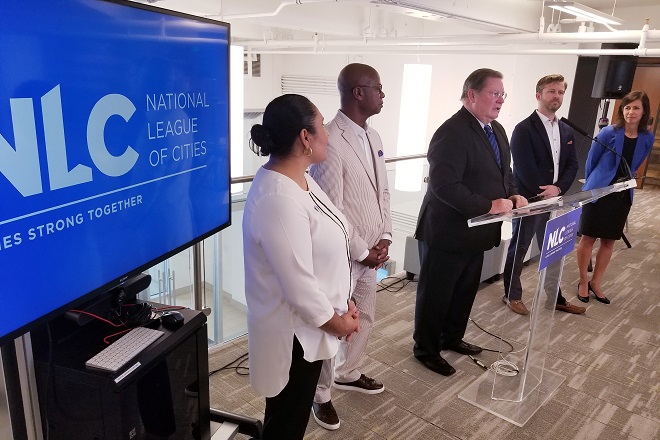
Little Rock Mayor Mark Stodola, president of the National League of Cities, speaks during the NLC's release of a report on automation and what cities can do to prepare for how it will affect the workforce. He is flanked by, from left, Irma Esparza Diggs, senior executive and director of federal advocacy for the NLC; NLC CEO and Executive Director Clarence Anthony; Brooks Rainwater, senior executive and director of NLC's Center for City Solutions; and FCC Commissioner Jessica Rosenworcel.
The National League of Cities has released a report on how automation is changing jobs and how cities can help the workforce adapt and prepare for job displacement.
Little Rock Mayor Mark Stodola, president of the NLC, and FCC Commissioner Jessica Rosenworcel unveiled the report Wednesday at the Little Rock Technology Park. The League of Cities, which represents 19,000 municipalities across the country, is wrapping up an annual board and leadership meeting downtown.
Brooks Rainwater, senior executive and director of NLC’s Center for City Solutions, said the report shows cities must be “proactive instead of reactive.”
“Many of these changes are already happening. We have the opportunity, if intentional, to create a brighter future. Cities must leverage strategic skills and pathways to bridge the gap for unemployed, displaced and dissatisfied workers,” he said. “Cities can utilize federal and local workforce development funding to promote inclusivity. Finally, cities can provide new strategies in workforce that support the workers. Cities need to be innovative; it’s what we do best.
“At the end of the day, this story is about people and what we need to do to ensure that every American has access to a fulfilling, good-paying job that puts food on the table,” he said.
The mayor, who announced in May that he won’t seek re-election, told reporters that NLC’s focus this year is “what the future of work is all about.”
“And why? Obviously because, as elected officials, we know that it’s one of the greatest challenges and opportunities that we have. And that’s to create an environment where people want to come and move their businesses, where they want to raise their children, and where they want to develop the jobs of the future,” Stodola said. “We know this workforce is changing, and we have got to be flexible with that.”
Stodola said that by 2030, every baby boomer will be over age 65. One in five will be of retirement age, leaving a significant impact on the middle-skills workforce, he said.
The mayor said cities need to take action now to help new people — through certification, apprenticeship and other educational programs — move to jobs that baby boomers are retiring from so that the cities avoid having a persistent skills gap.
Stodola also said cities must connect young people to the workforce, particularly those in in school. Those people need jobs too valuable to lose, and that will deter them from criminal activities, he said.
“That gig economy is what’s coming full force to us, and we have got to be aware of it. We’ve got to be ready for it,” Stodola added.
Rosenworcel also spoke about how important it is that cities invest in broadband infrastructure.
“I believe the future belongs to the connected,” she said. “No matter who you are or where you live, you need access to modern communications to have a fair shot at 21st century success.”
The FCC is working now to update and modernize how broadband is deployed, Rosenworcel said. She also said that, unfortunately, the idea that cities are resistant to invest in this type of infrastructure is dominating discussion in Washington and shaping debate at the FCC.
Rosenworcel described how the mayor of San Jose, California, didn’t let his city fit this description. He “built some relationships; came up with agreements that streamlined carrier access to poles to speed the way for 5G deployment in exchange for fair compensation; and secured funding … to make sure everyone could get access to broadband in the city,” she said.
The commissioner said the fastest and most reliable way to broadband deployment is having a community, like San Jose, that is on board with making necessary changes to move it forward.
 Sign up for Daily E-news