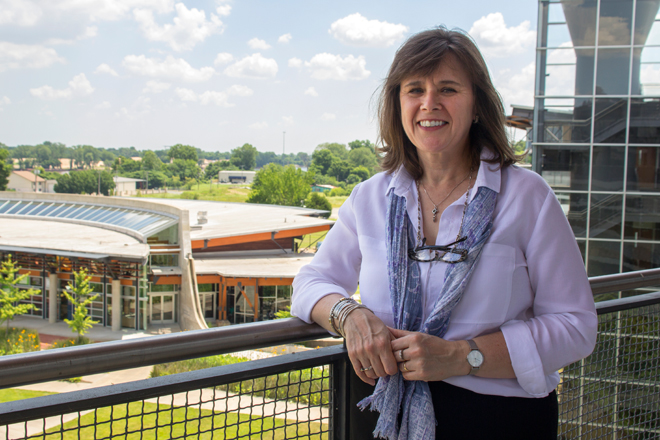
Hilary Haddigan is Heifer’s new chief of mission effectiveness.
A year after Heifer International CEO Pierre Ferrari told Arkansas Business about the nonprofit’s increased emphasis on measuring its impact, Heifer has created and filled a position to do exactly that.
Hilary Haddigan is Heifer’s chief of mission effectiveness, a role she assumed in April. She has worked at the global nonprofit, headquartered in Little Rock, since 1999. Since 2009, she has been overseeing Heifer’s planning and effectiveness efforts, developing indicators to help the nonprofit quantify just how effective its approach to ending poverty is.
Heifer provides livestock and other resources to rural farmers to not only alleviate hunger, but to allow them to sell surplus agricultural products to generate family income, which in turn helps families become self-sufficient.
Heifer’s emphasis on measuring impact reflects a trend in the entire nonprofit sector. And though many nonprofits are strengthening their efforts to measure impact, creating a position such as Haddigan’s is “actually a fairly unusual role even within the industry,” she said.
Proving success relies on “scientific methodologies,” Haddigan said. And Heifer, like other poverty-fighting nonprofits, is looking toward strategies such as randomized controlled trials to measure impact.
Randomized controlled trials, or RCTs, are probably most familiar to people in the context of medical research. In an RCT, the researcher randomly assigns the people being studied to either a control group or an experimental group. The experimental group is the only one to receive the intervention under study.
RCTs are the “gold standard” in measuring effectiveness, Ferrari said. “I’m out of the story business. I’m into the fact business,” he added. “If I don’t have the facts, I feel very uncomfortable.”
“Even those who give small amounts in gifts are asking for those facts,” said Haddigan, who reports directly to Ferrari. “It used to be that it was the big donors; now, it’s everybody.”
An article in the magazine Science recently reported on the results of an RCT involving economic development. Researchers studied people living on less than $1.25 a day in six countries, dividing them into control and experimental groups.
The researchers, citing Heifer among other nonprofits, wanted to study a “livelihood” approach, aid that seeks to promote self-employment and self-sufficiency.
The researchers combined “the transfer of a productive asset with consumption support, training, and coaching plus savings encouragement and health education and/or services,” a model similar to Heifer’s strategy.
The researchers found statistically significant cost-effective impacts. In other words, the “gold standard” of scientific research found that the approach worked.
One of the researchers was Dean Karlan, an economics professor at Yale University and president and founder of Innovations for Poverty Action, a group that seeks to find and promote solutions to global poverty.
“The work done by Dean Karlan did not include social capital work, which is something that’s strong to us and we want to kind of push that a little bit, but we do have a randomized controlled trial going on ourselves that is looking at that,” Haddigan said. That project is in Nepal.
“Social capital” consists of the institutions and relationships that allow a society to function, and Heifer works to improve social capital — values — in the communities in which it works. It’s touchy-feely, but it’s an important part of the Heifer approach, and Haddigan and Ferrari think it can stand up to rigorous examination.
There’s a demographic changing of the guard. “As the millennials come up they want to know what’s making change happen and what am I doing towards that,” Haddigan said. “Everybody wants to link it back to their part in it, so we’ve got to have the data that we can speak to what $1 does.
“In the end, the only reason we exist is because of the communities and the donors, and we’re making the linkage happen between them. We’ve got to be accountable to both sets of people.”
 Sign up for Daily E-news