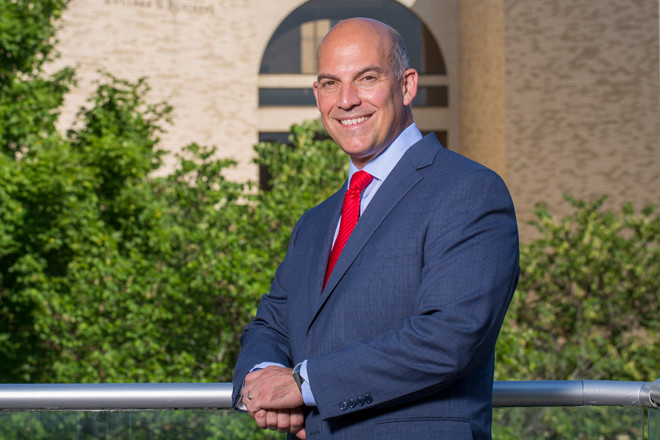
Two days before journalists reported that Wal-Mart planned to offer two-day delivery service — a retailing model pioneered by Amazon — Matt Waller addressed the importance of understanding retail logistics, e-commerce and the millennial shopper.
The effort has resulted in a robot bustling about on campus and plans for flying drones.
Waller is the new dean of the Walton College of Business at the University of Arkansas at Fayetteville, after having served as interim dean since June 1. He has a long history at the college — he started teaching there in 1994 — and deep experience in retail supply chain management and logistics. When the Department of Supply Chain Management was established in July 2011, Waller chaired it. And he’s co-editor-in-chief of the Journal of Business Logistics.
As soon as he was named interim dean last year, Waller said, one of his first acts was to visit Doug McMillon, CEO of Wal-Mart Stores Inc. of Bentonville. The two men discussed the new retail landscape.
“Especially for young shoppers, the digital and the physical shopping process has merged,” Waller said. “They are often using their smartphones while they’re shopping. Sometimes they’re ordering things while they’re shopping in a physical store.”
McMillon told Waller, “We really need students who understand how this will change supply chain management, logistics, product design, store design, shopping patterns, etc.”
The creation of the McMillon Innovation Studio on the UA campus is an outgrowth of that discussion. One aspect of that studio, which is part of the Walton College and the Center for Retailing Excellence, is a delivery robot provided by Starship Technologies, based in London and Estonia. It looks like “a cooler with wheels and an antenna,” Waller said of the robot, also called a land drone.
The Innovation Studio, the only U.S. research lab working with Starship, is using the robot to experiment with the fulfillment of online orders. The studio occupies a former convenience store at street level of the Harmon Avenue Parking Garage, which Waller said is the largest parking garage in Arkansas, with nine levels.
Robot Delivery System
Researchers are experimenting with a delivery model that uses the robot to deliver orders from the small-store format Walmart on Campus, which opened in 2011, to lockers in the garage.
“The idea is that the robot would go over to the Walmart on Campus, get fulfilled, take product to the locker in the parking garage and then it would be put in the locker,” Waller said. “And it would be going back and forth all day, fulfilling orders that way.”
Customers can then pick up those orders from the lockers as they enter the garage for their cars.
The college also wants to experiment with “final-mile delivery,” which would see the robot delivering to apartments and dormitories.
“When you look at a lot of these logistics problems that are created by the new shopping experience, you need expertise on the one hand from people like mechanical engineers and industrial engineers,” Waller said. “But on the other hand, you also need expertise from marketing and even accounting and finance in terms of calculating ROI and those kinds of things.”
“Because the Sam M. Walton College of Business is known as a leader in research and retail supply chain management, we’re putting a lot of effort into things like that,” Waller said. “I think we’re the only school in the country doing work like that. And of course the thanks go to Doug McMillon because he’s funded it.”
Robots are one subject for study by the College of Business; flying drones are another.
“What we’re doing with the robots, we originally planned to do with drones, and we realized, ‘You know, robots are probably going to be used first and more commonly,’ so we started there,” Waller said. “However, we certainly will use drones as well.
“There’s lots of policy and rules about using drones on campus, but we’re thinking about eventually parking them on top of the Harmon Parking Garage,” he said.
The college will need to get permission to fly drones on campus. “We do want to experiment with actually delivering product to dorm rooms and events using drones.”
Researchers’ current focus, however, is on the robot and some basic requirements, like ensuring it’s navigating the campus properly. To that end, students are mapping the campus and following the robot to study how it’s coping.
“Our campus is so hilly,” he said. “If it’s full of product, [the robot] might have trouble getting up some of the hills.” There’s also a lot of construction on campus, which the robot is having to learn how to move around.
“And we don’t want students to get on top of it and ride it, which is possible,” Waller said of the robot, laughing. “We haven’t had it happen yet, but when we’ve talked to students, a couple of students have said that they think that’s a possibility, that people might try to ride it.
“So we’re trying to figure out how can we socialize it in a way that would make students respect it and not want to ride it across campus.”
And that, Waller said, provides an opportunity for even psychology and sociology students to become involved.
(Related: Walton College of Business Scholarship Reaches Out to ‘Underrepresented’)
 Sign up for Daily E-news