The robust growth that has made northwest Arkansas an economic engine is also what concerns regional leaders.
No one wants to see northwest Arkansas — made up of Benton, Washington and Madison counties — slow down, but the expanding population has put stress on the region, nowhere more so than on its housing market. Northwest Arkansas’ population has increased by more than 100,000 in the past decade, surpassing 560,000 to become the nation’s 100th-largest metropolitan statistical area in 2022.
The region’s housing prices have experienced a similar trajectory. In the past decade, the average price of a home sold in northwest Arkansas has increased by more than 128%, compared with the national average of 29%.
In the two most populous counties of northwest Arkansas, homes continue to be pricey. In the second half of 2022, homes in Benton County sold for an average price of more than $400,000, while homes in Washington County sold for nearly $363,000, according to the Skyline Report, a report sponsored by Arvest Bank and conducted by the Center for Business & Economic Research at the University of Arkansas’ Walton College of Business.
Monthly rates for rental units have increased to more than $925.
Northwest Arkansas Home Sales
County |
Average Price, 2nd Half of 2022 |
Average Price, 1st Half of 2022 |
Benton |
$401,875 |
$403,829 |
Washington |
$376,018 |
$362,924 |
Madison |
$248,733 |
$238,463 |
Source: Center for Business & Economic Research at the University of Arkansas’ Sam M. Walton College of Business
Solving the scarcity of affordable housing is a priority of the Northwest Arkansas Council, a nonprofit organization of the area’s business, education and community leaders. The council created a workforce housing center in 2021 and hired Duke McLarty as executive director the same year.
At the council’s annual meeting earlier this month at the Momentary, Council CEO Nelson Peacock said the organization looked at how other cities dealt with rising housing prices and found no useful guidelines. So the council is using its housing center, since renamed Groundwork, to chart a whole new course.
“Of all the things we are talking about, this might be the most challenging thing that we have to do,” Peacock said. “There is no blueprint for this. Not one of [the other cities] could provide a blueprint of how you make sure you have attainable housing for your workforce in a fast-growing region like ours. It doesn’t exist.”
Big Emma Model
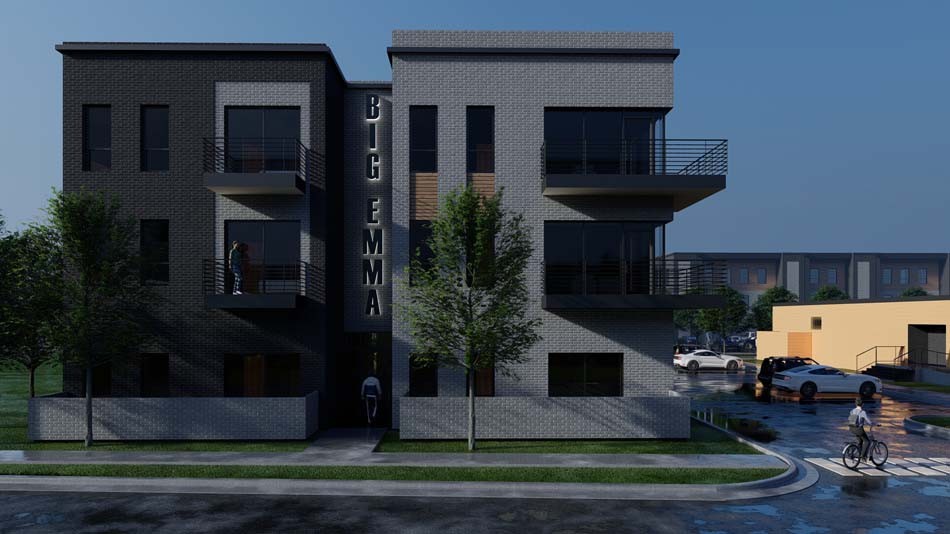
The council used its annual meeting to announce the Big Emma project, a 77-unit housing development in downtown Springdale that will devote 30 units to renters who make less than the region’s median income, which is $92,000 annually for a family.
McLarty acknowledged that creating 30 affordable units won’t make much of a dent in the region’s needs. He said the best estimates are that northwest Arkansas will require 80,000 new homes and apartments by 2040, when the region’s population is expected to reach 1 million, and 32,000 of those homes need to be affordable units.
“It is a drop in the bucket but we have to start somewhere,” McLarty said. “We have to introduce some density to parts of our region because naturally with a more dense product comes a more affordable unit type.”
The Big Emma project was made possible by a $6.7 million grant from the Walton Family Foundation. Tom Lundstrum, part of the group behind Big Emma, said high costs made the project infeasible until the foundation pitched in some money.
“The model down at Big Emma is a step forward,” Lundstrum said. “It is a piece of the puzzle. I honestly don’t know how a lot of people who work hard from 8 to 5 every day can afford what they have to pay for rents now. The numbers just boggle my mind.”
McLarty said it was important Big Emma gets started, which it is expected to do in August, because it gives the council a showpiece, an example of how affordable housing can be built through partnerships with developers and organizations like the Walton Family Foundation.
Also needed, officials say, is a reexamination of cities’ zoning laws that prevent or complicate denser housing builds.
“If those units get built, every new unit cuts to the overall affordability on some level,” McLarty said. “We are agnostic whether it is a rental product or a for-sale product. We are open to developers of all types.”
Simple Economics
Lundstrum said he and his partners made a quick decision to make Big Emma an affordable housing project because they want to invigorate downtown Springdale. He said the region’s housing market is a case of the “simple economics” of supply and demand; the building of houses can’t keep up with the number of people moving into the region.
“If you have 1,000 people a month moving into this area, and you’ve got 100 homes a month coming online, then you have a problem,” Lundstrum said. “You have more demand than supply and that means prices are going up. [Big Emma] is like spitting into the ocean. It’s just tough.
“You do what you can as fast as you can. Every little bit helps. It’s better than not doing it.”
Mervin Jebaraj, director of UA’s CBER, said northwest Arkansas is doing the right thing by trying to address the housing crunch before it becomes critical. Having cities and private developers initiate projects such as Big Emma are good ideas.
“That is the biggest thing the region can do directly [is] figure out what keeps people being able to build denser, more affordable housing where the jobs are in northwest Arkansas,” Jebaraj said. “Big Emma is not very many units, but there is a lot of land that cities are sitting on that is often in very prime locations and are just parking lots. They are underutilized as parking lots.
“All of those other communities got where they are by not taking care of the issue today. It is critical that we need to do something today. Ten years down the line is too late.”
McLarty said the region has to make housing more affordable for the workers who continue to flock to northwest Arkansas or there will be a time when they simply stop coming because they won’t be able to find a place to live. McLarty said he has already heard stories of teachers turning down job offers in northwest Arkansas because of housing costs. Earlier this month, the Bentonville School District proposed a plan to donate 9 acres of land to provide affordable housing for teachers.
“We are laying the foundation; real estate is a very long life cycle industry,” McLarty said. “The realization of what is being built today is going to dictate how we live in this region for the next 30 or 50 years. We have to lay that solid foundation.”
 Sign up for Daily E-news