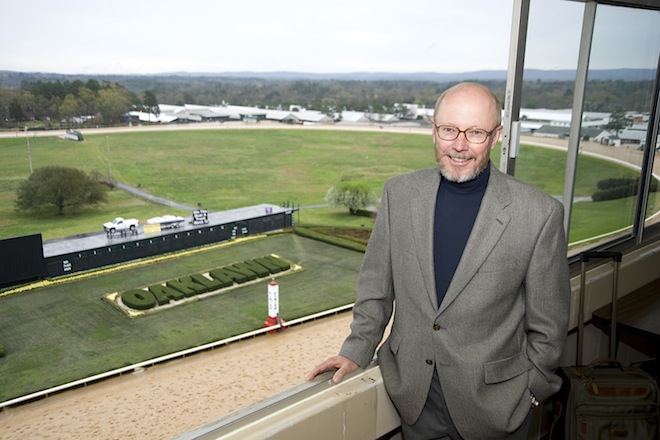
Eric Jackson, general manager of Oaklawn.
For an operation once pronounced dead, Oaklawn has some pretty strong vital signs.
In remarks at Tuesday’s Rotary Club of Little Rock luncheon at the Clinton Presidential Center, Eric Jackson, vice president of Oaklawn Racing and Gaming, detailed the fabled horse track’s 115-year, up-and-down history and sketched an immediate future that includes new construction and renovation billed as one of the largest hospitality investments in Arkansas.
From its roots in a pre-1900s Little Rock track called Clinton Park to the more than $100 million project set to start construction at the end of the current season in May, Jackson traced Oaklawn’s rise to become the state’s No. 1 tourism attraction.
“The most interesting company in Arkansas, Oaklawn Park,” Jackson said.
The construction and expansion will include 28,000 SF of gaming space; a seven-story, 200-room hotel; and a 14,000-SF, multi-purpose event center that will hold 1,500. Announced completion dates are January 2020 for the gaming expansion and late 2020 for the hotel and event center.
“Everything we’ve done, we’ve done for the horses,” said Jackson, acknowledging Oaklawn’s legacy that includes some of horse racing’s most notable competitors.
With sports betting also on the horizon, Oaklawn has come a long way from the track whose “obituary” was written in sports pages in 1998 — as the track battled for business with casinos in surrounding states — and was referred to as “Ghost-lawn Park.”
“We’re going to be fine. We’re going to get through this” Jackson said, recalling the prevailing mood in meetings during those dark times. “Then you’d go back to your office and drink heavily.”
Oaklawn fought back against the casino effect with the addition of electronic instant racing followed by electronic games of skill approved by legislation in 2005.
As purses improved thanks to the gaming revenues, so did Oaklawn’s fortunes. The Oaklawn Foundation, which has taken in close to $10 million, was begun in 2007 and construction and expansion projects to accommodate gaming were undertaken in 2008 and 2014.
The newest project was announced last year, after voters approved Arkansas Issue 4 to authorize casinos and sports betting in four counties, including Garland, Oaklawn’s home turf. The state racing commission and the legislature will have to grapple with the complicated rules regarding sports betting before it can begin, but Jackson sounded a positive note.
“It’s out of our hands,” he said, but he predicted sports betting could possibly begin in April.
The casino threat wasn’t the only challenge Oaklawn has faced in its 115 years, Jackson said.
After holding the first Arkansas Derby — which featured a “do-over” thanks to a disputed outcome — in 1891, Clinton Park fell on hard times made worse by storm damage suffered in 1905. That year’s season was moved to a new, glass-enclosed, steam-heated facility located in the little dairy community of Oaklawn, outside Hot Springs city limits.
Despite a successful first couple of seasons, Oaklawn only had racing five times during its first 30 years. It suffered several shutdowns, some of them thanks to a nationwide reform movement that frowned on gambling, among other pleasures of the day.
“If it had anything to do with fun we were against it,” Jackson said of the era’s national mood.
In racing’s absence, the track was the site of state fairs and a golf course that existed on what is now the track infield. But Oaklawn has held racing every year since an appeal to the governor, partly on the basis of jobs, got it reopened in the Depression year of 1935.
In 1956, the state passed Amendment 46, clarifying the legality of horse racing, while horses like Sunny’s Halo, the 1983 Arkansas and Kentucky Derby winner, helped raise Oaklawn’s profile. After a hardscrabble existence, things looked bright until the casino challenges from the bordering states began in the late 1980s.
“We lost about 50 percent of our business overnight,” Jackson said.
But, as it always has, Oaklawn found a way to persevere and thrive. Great horses like American Pharoah, the 2015 Arkansas Derby winner who won the Triple Crown, have helped, as well as Oaklawn’s willingness to adapt.
For the first time, the racing season will end in May this year — though the Derby will still be run well in advance of the Kentucky Derby — in hopes of maximizing good weather.
With $600,000 in purses up for grabs daily, 1,500 horses on the ground, the season underway and potential sports betting revenues in the near future, Oaklawn would appear poised to fend off the next challenge, whatever it may come from.
“Whatever we do, it will be done to enhance racing and maintain our place in American racing,” Jackson said.
 Sign up for Daily E-news