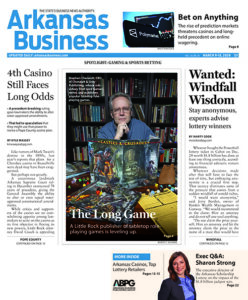
Dan Kirkpatrick
Dan Kirkpatrick has a stand-up desk, but not from some elite ergonomic designer. The huge hand cranks give it away.
“It’s a welding table, and my wife, Becky, found it,” Kirkpatrick said a few weeks ago at his Little Rock ad agency, Kirkpatrick Creative. “If a guy’s welding all day, he cranks it up and down.”
The appeal goes beyond rustic charm, which reminds Kirkpatrick of his youth in Booneville, baling hay and working in factories.
“We don’t have furniture here that’s handmade someplace in England,” he said. “We’re about industrial-strength advertising.”
Through 40 years in the Arkansas marketing world, Kirkpatrick has worked toward a slogan based on results: “Advertising that’s engineered to work.” His building at Second and State streets downtown reflects that aesthetic. Walls are glass, floors concrete, and the stairs are steel and exposed cable.
A leather-and-fur cap on display, found in the streets of St. Petersburg, Russia, speaks to Kirkpatrick’s heart as an artist. “St. Petersburg,” home to the Hermitage, “is on your bucket list even if you don’t even know it,” he said.
Kirkpatrick visited on a church mission trip in 2000, shortly after the fall of the Soviet Union, when the Russian Federation was newly born and only Mafia toughs drove imported cars. “It was scary, but talking with the people was a blast. They wanted to talk, because they’d never had an encounter with an American.”
The Hermitage drew him with a force like destiny, Kirkpatrick said. “To see the top three art museums in the world, you’ve got to go there, just as you have to see the Metropolitan in New York and the Louvre in Paris.”
Melding art and data-driven advertising has been Kirkpatrick’s life’s work. He used the philosophy to sell 69-cent tacos for Taco Bell — where he stirred the beans and worked the counters for a couple of weeks just to give himself ad insight — and he applies that sensibility now for dozens of law firms and equipment dealers.
“We take an engineered approach, because we do almost all retail advertising these days,” he said. “We test everything. You apply analytics and see who’s buying. Then you back that out to develop the creative work for it.”
He knows what makes law firms’ phones ring. “When does the advertising work best? Which TV shows? How much does a phone-call lead cost?” Don’t look for his law firms’ ads on “Ellen,” for example. A $54 spot on the “Steve Harvey Show” drew 12 times the response as a $400 ad on “Ellen,” he found.
Kirkpatrick’s son Michael helps with those kinds of numbers, toiling down the hall on analytics. “He worked for Dillard’s for a few years, and they’ll stamp that on your DNA.”
Art and numbers have been in Dan’s own bloodstream since he got a Ouachita Baptist University degree in business and commercial art, a “schizophrenic” combination in the 1970s, he said. He soon applied for a job with Pat Snyder of Frazer Irby Snyder, and the Little Rock ad man offered hard advice. “You can do this, but you have a terrible portfolio,” Kirkpatrick recalled Snyder saying. “Either find some other field or go back to school.”
So he went to the Memphis Academy of Art, living in West Memphis. “I stayed an Arkansan, by gosh.” There were drawing, painting, craft courses and art history classes “ad nauseam,” Kilpatrick said. “We drew everything by hand; this makes me a relic, but if you wanted Helvetica bold at 36 points in a headline, you drew that. We learned typography through calligraphy.”
By the time he left, the rampant inflation of the 1970s was crushing the ad industry. “Some firms talked to me, some laughed at me, but nobody wanted an untested art director.” He took some solace from Larry Stone, now CEO of Stone Ward. “He said he couldn’t hire me, but that I did great work,” Kirkpatrick said. “That meant so much.”
So he walked into the 300 Spring Building downtown and rented a space for $140 a month, then hung out a shingle. The accounts he chased could fill a dozen columns, and he still gets a grin seeing an old No. 1 logo on the back of a Russell Chevrolet. Laughter rolled at the memory of an outsider’s suggested tagline for selling Mexican food in Arkansas: “Oy vey, Mama, that’s a good taco.”
But the key thing for Kirkpatrick at age 64 is this: He’s still at it, and still happy. “My philosophy is to create inside the box,” he said. “Artists don’t like boxes, but it’s good when the parameters of that box correctly define what your client needs. In this business, you design inside of that box, or you repair to Eureka and throw pots.”
 Sign up for Daily E-news