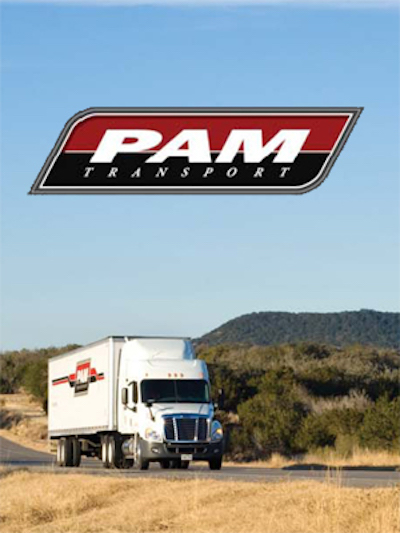
PAM Transport Services Inc. of Tontitown reported second-quarter income of $3.9 million, down from $7 million in the same quarter a year ago.
Revenue was up to $111.5 million from $108 million last year. Fuel surcharge revenue continued to feel the effects of lower fuel prices as it dropped to $12.6 million from $17 million a year ago.
Earnings per share was 61 cents, down from 94 cents in the same quarter of 2015.
CEO Dan Cushman said the growth was a reflection of PAM’s expansion of its fleet and its Dedicated and Mexico divisions. The expenses of that pushed down income even as revenue rose.
“Our lower margins are not necessarily the result of less profitable freight selections but are primarily related to an increase in our normal operating costs, which cannot currently be passed on to customers, and to entry costs as we expand into new markets we wish to add to our service profile,” Cushman said in a news release.
PAM reported 84,540 total loads were delivered by its truckload division in the second quarter of 2016, an increase from 77,903 in the same quarter of 2015. Revenue per truck increased to $3,545 per week in the second quarter of 2016 compared to $3,420 per week a year ago.
PAM’s logistics division saw revenue increase to $12 million in the quarter, compared to $11.5 million in the same quarter a year ago.
Cushman said the company spent an additional $1 million on driver recruiting and retention programs in the second quarter. It spent $1.5 million in the first quarter, but Cushman said he expects the costs to diffuse throughout the rest of the fiscal year.
The expenses were worth it, Cushman said, because PAM was intent on growing in markets underserved by the company. A highly competitive market meant lower rates, Cushman said, but the also gave PAM a chance for entry.
“[W]e decided to push ahead with our growth objectives in order to obtain market share in certain markets where we have not historically had a strong presence,” Cushman said. “We believe this positions us for exponential improvement when the general freight market rebounds and capacity begins to tighten, but also provides us with the flexibility to downsize quickly should a freight recovery take longer than anticipated. This approach has allowed us to grow revenues and expand our market representation.”
 Sign up for Daily E-news