


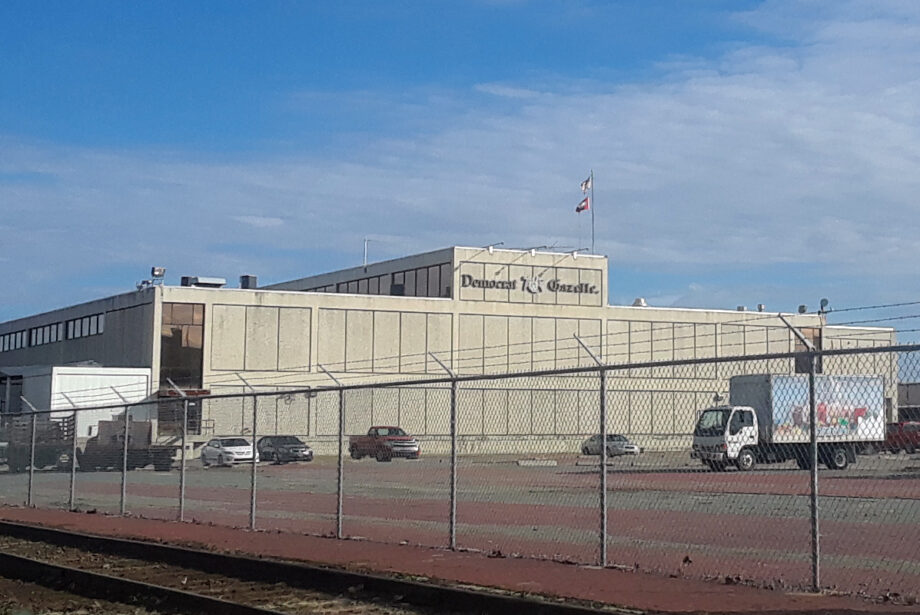
The Arkansas Democrat-Gazette printing facility at 301 Byrd Street in Little Rock.
“So just how do daily newspapers make money these days?”
It was a good question, from a neighbor who works in media and marketing. He figured I’d know the answer because I spent 30 years in daily newspapering before joining Arkansas Business, a weekly. I’m all too familiar with a business model disrupted by the internet.
Disrupted with extreme prejudice.
Carrick Patterson, the former Arkansas Gazette editor whose father and grandfather ran the paper, put it this way: “The old model was essentially building a very expensive factory to process expensive newsprint paper and send tons of it out daily by an expensive transportation system only to be looked at once and thrown away.”
Daily papers need a new model, he said. Otherwise, he predicted, “they’ll disappear as we now know them.”
When I was at the Arkansas Democrat-Gazette two decades ago, ads occupied at least 35 percent of printed space, and profits flowed in. The Jan. 19 edition, by contrast, had just two dozen display ads filling less than 15 percent of the paper. (There was a 12-page ad insert for Belk.)
The Democrat-Gazette, an invaluable asset to the state and the flagship of Walter Hussman’s privately held Wehco Media, doesn’t reveal its financials. But more than half of its revenue still comes from ads. Like other papers, it asks readers for more financial support these days, and paid circulation could surpass advertising as the main revenue producer within two years. Classified ads bring in some cash, but not as much as they once did, and not as much as display ads.
Layoffs and tactics like consolidating printing operations have helped keep Wehco’s newspaper division “moderately profitable,” in the words of Lynn Hamilton, the Democrat-Gazette’s president and general manager. Hamilton has acknowledged the pain of laying off many good people since 2009, “a necessity” in times of continuing ad declines, he said after Wehco dealt out 86 pink slips in October.
The chain also economizes on materials, including paper. Wehco’s Texarkana Gazette downsized its print product by an inch in length and a half-inch in width last week. Its pages now mirror the size of the Democrat-Gazette, allowing sister papers to be printed in Little Rock. Wehco announced last month that it will also print the El Dorado News-Times, the Camden News and the Banner-News of Magnolia in Little Rock, following an industry trend of consolidating printing.
The Guardian, one of Britain’s last major broadsheets, switched to a tabloid format this month, also saving on newsprint. The New York Times reduced its page footprint a decade ago and phased out a printing plant in New Jersey. Those changes saved the paper $40 million a year, including $12 million just from the reduced page size. Wehco’s savings will be many scales smaller, of course, but the idea is the same: Companies are innovating, cutting costs even as they seek more revenue from readers.
The Denver Post has given up its downtown headquarters, moving into a new newsroom at its printing plant in suburban Adams County. Columnist Chuck Plunkett wrote that “the watchdogs can no longer afford the rent.” He also mentioned a new business strategy “that should help keep us in notebooks and pens and on the job.” Starting this month, The Post is asking online readers to pay. If they keep employing ad-blocking software, they’ll have to buy a print or digital subscription. The Democrat-Gazette has employed a paywall since the early days of the digital era, giving unrestricted views only to subscribers.
Matt DeRienzo, writing this month in Editor & Publisher, argues that daily editors looking to lure subscribers must reconsider their “mile-wide, inch-deep” approach to news. They should offer content that’s “so relevant and valuable to readers that they indeed will pay for news.” Know your readers and look out for their well-being, he advises.
Editor Gwen Moritz has long taken that approach at Arkansas Business, which beefed up subscription numbers by restricting web views and emphasizing the print product last year. Publisher Mitch Bettis told a recent industry gathering in Puerto Vallarta, Mexico, that print subscriptions have hit a decade high since metered page views and a web embargo were introduced.
Granted, weekly niche publications can tailor their products for readers more closely than a general-interest daily ever could. Subscribers don’t look to Arkansas Business for police coverage, sports scores, comics or weather, for example.
But print isn’t dead; it just needs to be poked awake. Sometimes readers do, too. They pay for almost everything else they consume. Why should news be any different?
 Sign up for Daily E-news










