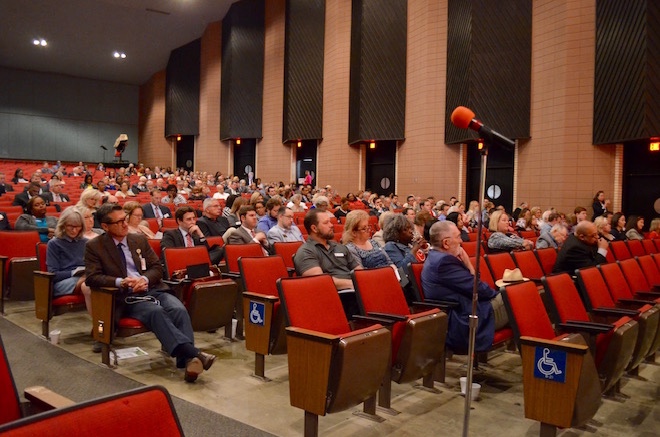
The Arkansas Delta needs more doctors, and passage of Gov. Asa Hutchinson’s “Arkansas Works” plan for Medicaid expansion is crucial, attendees of “The Arkansas Delta: Why It Still Matters” conference were told Thursday.
The conference, sponsored by Simmons Bank and held at the Pine Bluff Convention Center, brought together policy leaders, business owners, educators and others to discuss how the region can be managed amid population declines. The event included panel discussions on health care, education, agriculture and economic development.
Arkansas Court of Appeals Judge Raymond Abramson served as the moderator for the health care panel. Panelists were: Dr. Becky Hall, East Helena director for the University of Arkansas for Medical Sciences; Bo Ryall, president and CEO of the Arkansas Hospital Association; Al Sliger, president of Community Health Centers of Arkansas and executive director of the Mid-Delta Health Clinic; and Dr. David Lupo, chief of staff at the Jefferson Regional Medical Center.
Ryall said he expected Arkansas Works to be authorized during this week’s legislative session by a majority vote, but acknowledged that the more difficult battle over the state’s hybrid Medicaid expansion, also known as the private option, will take place during the fiscal session next week.
The state House and Senate voted in favor of the plan Thursday morning, with final votes set for Friday. But both votes — 70-30 in the House and 25-10 in the Senate — fell short of the three-fourths majorities required to reauthorize the Medicaid expansion during the fiscal session.
The three-fourths threshold is 27 votes in the Senate, and Ryall said Thursday he knows nine or 10 senators who oppose Arkansas Works.
The business community is lobbying for Arkansas Works to be approved and funded because it means insurance for 250,000 people and jobs, Ryall said.
Ryall said the private option has helped citizens, hospitals and doctors, and that The Stephens Group, an independent consultant hired by the Legislature to find out how much the program costs, has determined that the private option pays for itself.
Lupo agreed. He said Arkansas Works is “critical” and “it would be devastating if it didn’t pass.” He said many more health care providers now accept Medicaid because of the private option.
Medically Underserved
Hall began the discussion by citing a report published by the Arkansas Department of Health that said 17 counties in the state — most in the Delta — have a life expectancy 10 years shorter than that of the western part of the state, mostly due to chronic and preventable diseases.
Hall said the study “broke my heart.”
“If the Delta counties were taken out of Arkansas, the health statistics in Arkansas would rise drastically and, to me, this is a travesty,” she said.
Hall said the Delta is medically underserved, with one primary care doctor for every 3,000 people, one dentist for every 2,900, and one mental health worker for every 1,200.
Sliger said the Delta also needs mid-level health professionals, including nurse practitioners.
Hall said more dollars should be directed toward wellness programs, a move she said could mean another five to seven years of good health for the Delta’s population.
Lupo said education is key to solving those issues. He said that, not only should patients learn to take responsibility for their own health care, but that the Delta’s young people should be educated so that they develop an interest in health care professions early on.
He said rural residency programs should be expanded in the Delta, and “it’s all about developing relationships” with big hospitals and others.
Lupo was asked about the new osteopathic medical school at Arkansas State University in Jonesboro and responded that the Delta must embrace it. He said a goal of that school’s administration is to produce primary care doctors for the Delta.
Lupo and Abramson agreed that incentives should be offered to encourage health care professionals to come or stay in the Delta. Hall said she didn’t know whether tax incentives might be available to encourage the opening of new practices in the region.
The panel was asked how a lack of mental health services should be addressed.
Lupo repeated that alliances with big hospitals and other health care providers should be developed, along with incentives. He said a community could pay for a student’s medical schooling in return for that student practicing in that community for four years.
The panel was asked if current efforts have made a positive impact. Hall said obesity rates had improved in Helena since UAMS launched an exercise program and that once obesity is under control, other chronic disease statistics will improve.
The panel was also asked why many mental health professionals and specialists don’t accept Medicaid patients. Sliger said reimbursement rates are still inadequate compared to what private insurers offer, and the shortage of doctors contributes to that issue, too. The floodgates have opened, he said, and physicians have struggled to meet that increase in demand.
 Sign up for Daily E-news