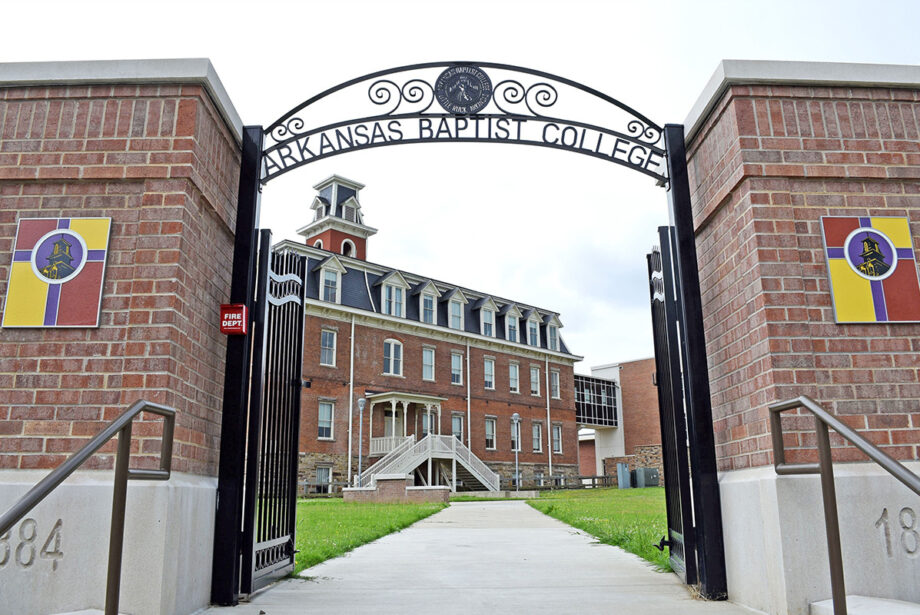
Members of the Little Rock business community have rallied behind Arkansas Baptist College to see it through another financial challenge.
The 2016 hiring of Joseph Jones as the 14th president of Little Rock’s Arkansas Baptist College was supposed to be a new chapter in its turnaround story. The historically black college had survived dire days to see its campus modernized in a multimillion-dollar redevelopment and its enrollment reinvigorated to record numbers during the past decade.
Jones was hired to build on that success by solidifying academic advancement at the private liberal arts college. Instead, his brief tenure marked the return of an all-too familiar specter: financial instability. During the 15 months he served as president, operational conditions deteriorated from copacetic to crisis mode.
A workout plan to rebuild enrollment and restore fiscal order began after the board of trustees fired him in December.
“If we would’ve left him on another month, I believe the school would’ve closed,” said Richard Mays Sr., a member of the Arkansas Baptist College board of trustees.
When Jones took over as president on Sept. 1, 2016, fall enrollment stood at 832. A year later, the headcount of students had plunged to 529.
For a school that needed an enrollment of 766 to maintain fiscal equilibrium, a 36 percent drop was a catastrophic event.
With each student representing $12,500 in combined spring and fall semester revenue, the enrollment swing gutted the college’s budget by $3.7 million. Without sufficient reserve funds to weather the storm, bills started going unpaid again and staff layoffs ensued last year.
The college’s short-term survival was in question, and Jones provided no realistic solutions to the board of trustees, according to Mays.
The board lost trust in Jones, who had interviewed so well and looked like such a promising hire on paper.
Jones was a fellow at the American Council on Education and founded the Social Justice Institute at Little Rock’s Philander Smith College, where he graduated in 2000.
He also holds a doctorate in political science from Clark Atlanta University. Before joining Arkansas Baptist, he was a visiting professor of political science at the University of Arkansas at Pine Bluff.
Over time, Arkansas Baptist trustees became convinced Jones lacked candor, distorted the college’s true condition and overstated his ability to fix things.
“That was the primary issue,” Mays said. “Jones felt like he knew best, and he wasn’t candid about the financial situation. Transparency is required.
“He told us he wasn’t the first to miss payroll here, but he’s the first I’ve been in contact with who misrepresented the facts.”
Under Jones’ direction, money that should’ve gone to tax withholdings for staff payroll was redirected elsewhere to juggle paying bills. This ongoing issue combined with false assurances by Jones that the matter would be corrected proved to be a deal-breaker for the trustees.
“It’s one thing to go for 45 days” without paying federal tax withholdings, said one Arkansas Baptist College insider. “It’s another thing to go for several months.”
Arkansas Baptist College, Little Rock
| Fall Enrollment | |
| 2011 | 1193 |
| 2012 | 1082 |
| 2013 | 1003 |
| 2014 | 855 |
| 2015 | 956 |
| 2016 | 832 |
| 2017 | 529 |
What Happened?
The disastrous enrollment slide on Jones’ watch is attributed to a pair of bad decisions.
Jones unsuccessfully tried to diversify the base enrollment by attracting traditional college-bound students sporting scholarship-worthy ACT scores.
He also curtailed recruitment of Arkansas Baptist’s bread-and-butter students: high schoolers who could only get into college through open enrollment.
Traditional students didn’t come to the college in sufficient numbers to offset the loss of marginal and at-risk students.
The decision by Jones to deviate from the college’s historic mission produced severe financial consequences and led to his departure.
Jones said he resigned. The board of trustees said he was fired for cause.
According to Mays, the parting of the ways began with the board giving Jones verbal notice of its intention to terminate his employment.
In response, Jones offered to resign.
“We were going to accept his resignation if we could reach an agreement,” Mays said. “But after we got into this conflict with him demanding money, the board decided to terminate him for cause.
“Now it’s all about money. He gave the impression that that wouldn’t be an issue, but he’s taken a different attitude now.”
Jones has threatened to sue for financial damages. Mays finds that stance a bit much to take since he says it was Jones who financially damaged Arkansas Baptist College through his flawed decisions.
“It almost seems hypocritical to go there,” Mays said. “It would’ve been to his benefit not to make this a public dispute.”
Asked to give his account of what happened on his watch, Jones declined. “It’s a little complicated for me because I’ve hired a lawyer,” he said. “I’m trying to give them an opportunity to make things right.”
Mays said the board of trustees is still perplexed about why Jones veered away from a formula for success put together by his predecessor, Fitz Hill.
“During the interview process, he said he was going to build on that,” Mays said. “I don’t know what happened there. He had an unusually hostile reaction toward Dr. Hill.”
Hill is credited with leading the college on a roller-coaster ride to stability with the support of the local business community.
The starting point for that 10-year ride was 2006 when Arkansas Baptist College was on the brink of closing its doors with an enrollment of about 128 students, $2 million of debt, endangered accreditation and facilities badly in need of upgrade.
When Jones was hired, the plan was for Hill to continue working with the college in an unpaid position to recruit at-risk students.
However, early into the job, Jones instructed Hill to stop recruiting. With that, the college lost its top recruiter and his missionary zeal for spiritual and educational outreach.
It created an operational hole that Jones was unable to fill through his own efforts.
“There were certain issues he didn’t even want to consult the board about,” Mays said. “Any input by the board interfered with his judgment.
“He wanted to be autonomous to make critical decisions about the college. His position was that he knew best. He wanted to do it his way.
“It was his way or the highway. It was his first leadership opportunity at this level, and his lack of experience showed.”
Howard Gibson, a former administrator at Arkansas Baptist College, is serving as interim president while a search is conducted. Gibson served as the college’s chief academic officer, dean of the School of Business and director of the Scott Ford Center for Entrepreneurship & Community Development.
Supporters of Arkansas Baptist College are confident that financial order can be restored quickly with a return to what worked.
Fitz Hill is back helping recruit students through relationships he began building during his days as a college football coach. The network of clergy, teachers and parents extends from Arkansas to urban communities around the nation.
“I want to see the college succeed,” Hill said. “I want to help kids who don’t have opportunities elsewhere. This is an educational ministry to me.”
The business community that supported Hill’s vision when he was president remains committed to backing Arkansas Baptist College. That ongoing financial support is expected to see the college through its current crisis.
The fiscal turnaround should begin this summer, thanks to a change in federal policy regarding financial aid.
The U.S. Department of Education reinstituted its summer Pell Grant program after doing away with it in 2011. That’s a big deal for Arkansas Baptist College, where 94 percent of its students are Pell Grant recipients.
The change for low-income, degree-seeking students opens new academic opportunities for summer classes along with income opportunities for the college.
Mays is optimistic the mission of reaching out and pulling up can be a financially self-sustaining one at Arkansas Baptist College.
“We’re moving in the right direction,” he said. “If Dr. Jones would’ve worked with that, we wouldn’t be in this situation.”
 Sign up for Daily E-news