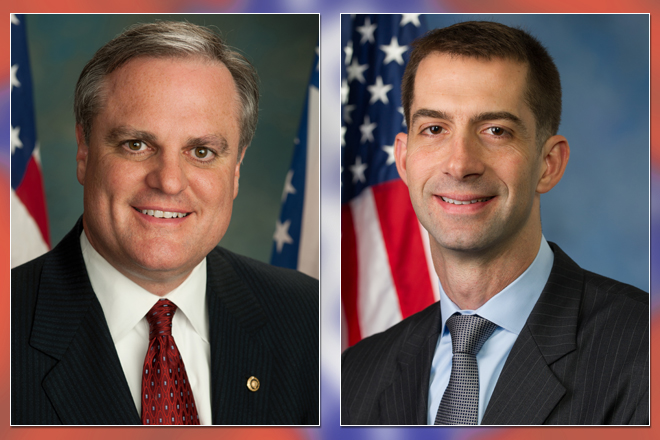
Sen. Mark Pryor, D-Ark. (left), and Rep. Tom Cotton, R-Ark.
A USA Today/Suffolk University poll released Wednesday shows tight races for U.S. Senate and governor in Arkansas.
Results of the complete poll of 500 likely voters, conducted Sept. 20-23, is available here. USA Today’s story on the poll is available here.
Among the results, incumbent Democrat Mark Pryor leads Republican Tom Cotton in the race for U.S. Senate, 45 percent to 43 percent. Republican Asa Hutchinson leads Democrat Mike Ross in the race for governor, 43 percent to 41 percent.
Below, Arkansas Business political columnists Robert Coon and Blake Rutherford give their first impressions on the poll results:
As with any poll, we want to be certain that demographic breakdowns make sense. There are some ways this poll categorizes the geographic sample that are slightly curious, but be that as it may, I think there are some telling aspects to this poll.
Overall, I think Democrats have to be encouraged by this, but that’s particularly true for Mark Pryor.
It’s not just that Pryor has very a slight edge; voters are beginning to associate to negative attributes toward Cotton, whose favorability rating is 5 points lower than Pryor. But perhaps more jarringly, when asked what voters associated with Cotton’s name, they selected “dislike him/general negative mentions” and “dishonest/untrustworthy/crook” more than any other (for Pryor “Like him/general positive mentions” led all others).
In the final month of this campaign, I suspect undecided voters may make judgments less on specific issues and more on emotional elements like personality. If that’s the case, the Cotton campaign cannot be encouraged by the attitudes this poll illuminates.
Certainly, this year was never going to be one where Democrats were going to win races by wide margins, so the fact that they are competitive in all races polled has to be a promising sign, particularly since a bulk of the spending down-the-ballot is just now beginning.
Specifically, Democrats have a slight lead in the important race for attorney general, and, surprisingly, they lead the lieutenant governor’s race well beyond the margin of error: 6 points.
I’ll admit that the pulse to that race has felt differently than this poll suggests, but John Burkhalter has been up on television, so maybe his message caused the landscape to shift slightly. I really can’t say. It is also interesting that the Libertarian candidate, Chris Olson, is polling at nearly 5 percent. Could that be factor come November?
I suppose if any particular Democrat would be discouraged by this data, it’s Mike Ross. Sure, he’s down less than two points in the governor’s race, but what’s troubling is that when voters were asked about the importance of issues, education polled at 5 percent and well behind many others, including jobs. If voters have jobs and the economy top of mind, how does that bode for Ross, who narrowly defined his candidacy around education?
Unsurprisingly, the poll continues to show that voters oppose President Obama and the Affordable Care Act by wide margins. But Republicans, particularly Cotton and gubernatorial candidate Asa Hutchinson, who have the most to gain from the negative attitudes towards the president and the ACA, continue to struggle with how best to use this to their advantage, if that’s even possible at this point (I tend to think the pure I’m-voting-against-Obama segment of the electorate has made up their minds).
But it’s one poll. There will be many, many more. The percentage of undecided voters remains significant in down ballot races, and in the contests for U.S. Senate and governor they’re apparently still fluid. There’s still a lot of time left, as they say.
On the heels of a poll of Arkansas races released yesterday by PPP – a Democratic polling outfit, which despite its partisan affiliation is decidedly reliable – today’s USA Today/Suffolk poll paints a somewhat different picture.
PPP, which interviewed 1,453 likely voters Sept. 18-21, showed leads for Republican Asa Hutchinson in the governor’s race (44/38) and U.S. Rep. Tom Cotton the U.S. Senate race (43/38).
USA Today/Suffolk, whose survey dates overlapped with PPP’s, found a smaller lead for Hutchinson in the governor’s race (43/41) but a lead for Democratic U.S. Sen. Mark Pryor (45/43) in the U.S. Senate race.
Though the margin is smaller, from a consistency standpoint the USA Today/Suffolk poll, like the vast majority of polls to date, shows Hutchinson ahead of Democrat Mike Ross in the governor’s race.
Several recent polls in the U.S. Senate race have shown that race to be closer, with margins in the 1 to 3 point range. I think most political observers recognize that both of these races will be close all the way through Nov. 4, and that small shifts in voter preference between the candidates are expected as we head toward Election Day.
Beyond the two premier races, I’d start by saying that polling is scientific, but it’s not foolproof. My general approach to polling is not to jump on one particular poll to assess the status of a race or the popularity of an issue, but to look at the pattern of polling over time to determine movement and trends.
In a vacuum, the USA Today/Suffolk poll is undoubtedly encouraging to Democrats in a number of ways, with Pryor (slightly) leading and razor thin races for secretary of state and attorney general. I’d also expect Democrats to jump onto the lieutenant governor’s race results, which showed a lead for Democrat John Burkhalter. But the the results for that race are so drastically different than the PPP poll’s numbers yesterday (which had U.S. Rep. Tim Griffin up 6 points), that I think latching on to those results would be premature.
But there are a few things that don’t track from a comparison standpoint.
First, self-identified Independent voters only make up 27 percent of respondents in the USA Today/Suffolk poll, a number I find to be low. (Comparatively, the CNN/ORC poll from early this month had an Independent sample of 40 percent). The significance of possibly under sampling independents is notable.
Within the cross tabs of the USA Today/Suffolk poll, Independents are more closely aligned with Republicans on a number of responses, including several issues, Obama approval and the governor’s race preference.
Also worth nothing: the USA Today/Suffolk poll produced the smallest overall sample size of late, meaning higher margin for error in the responses. I’m not arguing that their results aren’t legitimate, but just when comparing polls over time, that’s an important factor to examine.
Blake
As always, Robert raises some interesting points about the poll’s methodology, which is why we have to be careful about reading too much into any one poll. The sample size is small, which more than one of our readers have pointed out. The trends are what matter, and I think it’s clear from everything we’ve seen over the course of the last few weeks, these races are going to be very close.
In the race for Senate, not only was I struck by the negative attitudes voters are attaching disproportionately to Cotton, but also that, despite disapproval of the Affordable Care Act (37/55), Pryor seems to be doing well with voters who put health care at the top of their issue preference (25/20).
Pryor also outpaces Cotton on jobs (29/15). Right now, these are the two most important issues to voters, so, again, more good news for Pryor’s campaign.
Cotton has a sizable advantage in the area of foreign policy/terrorism (23/10), and I have to think his campaign will continue to trumpet the issue (although I’d probably find a way to do that outside the tired context debate parameters). It’s not unwise; voters care about it, particularly considering the conflicts abroad.
In the gubernatorial race, it is clear that Hutchinson’s northwest Arkansas base is driving his positive showing in this particular poll. In that part of the state, he leads Ross 49/36. But in the other two regions, Ross is ahead, 45/37 (central) and 46/39 (delta/east). I’m not surprised by this, of course, and it shows just how much of an advantage GOP candidates from that part of Arkansas have in statewide races. And it probably goes without saying that Ross needs to close the gap by a few points there if he wants to ultimately prevail.
We continue to asses whether Obama will be a negative influence on Democrats. Interestingly, this poll shows that just over one-third (37 percent) of respondents said Obama would be a factor in November. When we also consider that less than one-third (31 percent) of Arkansans feel the state economy has gotten worse (compared to 65 percent who feel it has stayed the same or gotten better), the GOP advantage is not nearly as sizable as we may have once believed it to be.
And don’t go to sleep on the fact that Gov. Mike Beebe, a Democrat, has a 65 percent approval rating. It may have a correlation to favorable voter attitudes about the Democratic Party brand come November.
Robert
Now that I’ve had a little more time to dig into the guts of the poll, a few additional tidbits stick out.
In line with a number of previous polls, in the U.S. Senate race, Cotton continues to lead with men, and Pryor with women. This also mirrors the Congressional generic ballot preference, where men prefer the Republican candidate (45/40) and women the Democratic candidate (44/38).
But notably, the gender gap is not present in the race for governor. Hutchinson leads Ross among men (44/40) and holds even with Ross among women (42/42). Given the gender split that is evident in other areas of the poll and Ross campaign’s heavy focus on education (as Blake noted), his campaign’s inability to take the lead among women has to be frustrating, if not worrisome.
Another interesting difference between the Senate and governor’s race results in the USA Today/Suffolk poll is how the candidates fare among age categories.
In the Senate race, Cotton trails with younger voters (those 18-35 and 36-45) and the over 75 category, but leads Pryor in the 46-55, 56-65, and 66-75 age categories. Conversely, in the governor’s race, Hutchinson leads among voters age 36-45, 46-55, and 56-65, and trails Ross with the youngest (18-35) and oldest categories (66-75 and 75+).
That 36-45 age group, where Hutchinson leads but Cotton trails, could be the key group that Cotton needs to secure to get the win.
I’ll once again note that this poll has a relatively small sample size – only 500. That means that not only is the margin of error higher than most of the other polls to date, it’s more difficult to break down the poll’s subcategories. That’s because, as the universes shrink, the margin of error grows exponentially.
(Robert Coon is a partner at Impact Management Group, a public relations, public opinion and public affairs firm in Little Rock and Baton Rouge, Louisiana. You can follow him on Twitter at RobertWCoon. His opinion column appears every other Wednesday in the weekly Government & Politics e-newsletter. You can subscribe for free here.)
(Blake Rutherford is vice president of The McLarty Companies and previously was chief of staff to the Arkansas attorney general. You can follow him on Twitter at BlakeRutherford. His opinion column appears every other Wednesday in the weekly Government & Politics e-newsletter. You can subscribe for free here.)
 Sign up for Daily E-news