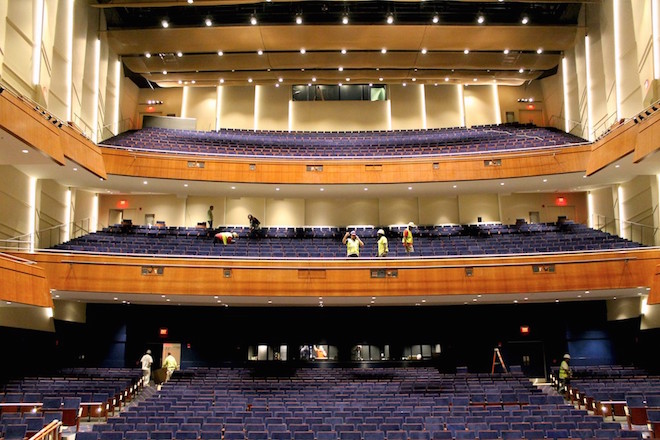
The renovated interior of the Robinson Center.
The Robinson Center’s 28-month, $68.6 million renovation and expansion concluded with a grand reopening event Thursday.
The Little Rock Convention & Visitors Bureau led the effort, which it said ended on time and on budget. Polk Stanley Wilcox of Little Rock partnered with Ennead Architects of New York to design the project, and CDI Contractors of Little Rock partnered with Hunt Construction Group of Dallas to serve as general contractors and construction managers.
Some of the major changes to the facility include:
-
A new ballroom and outdoor terrace overlooking the Arkansas River.
-
A complete reorganization of the back-of-house support areas.
-
Performance hall improvements including more acoustic volume, improved sight lines for all patrons, increased lobby spaces and restroom facilities and new box seating along the side walls.
-
Restoration of the exterior of the building.
The grand reopening event included Gov. Asa Hutchinson, Little Rock Mayor Mark Stodola, Maestro Philip Mann of the Arkansas Symphony Orchestra, Ed Payton of Celebrity Attractions’ Broadway Theater Series and Miss Arkansas Savannah Skidmore.
“Please understand how important this is for Arkansas,” Hutchinson said; he recalled seeing Mikhail Baryshnikov perform and attending the memorial service for Daisy Bates at Robinson. “It is an asset for all of the people of Arkansas and it will continue to be so.”
The governor said the arts, entertainment, culture and quality of life the building represents also contributes to the success of the state’s economy.
Stodola said more than 6.2 million of the 28 million people who visit Arkansas each year are coming to Pulaski County, representing 22 percent of the state’s tourism activity and travel expenditures of $1.8 billion.
State tax dollars from tourism total about $69 million with tourism also generating more than $31 million in local taxes, he said. He added that 25 percent of the travel spending in Arkansas comes from Pulaski County.
The mayor also said Little Rock has a 2 percent hotel tax that goes toward parks and tourism, which amounts to about $3 million a year.
“In addition to the wonderful arts and culture this represents, it represents a great opportunity for the growth of our city economically, and for that I think it’s a very wise expenditure,” Stodola said.
Stodola said Robinson would be “the envy of many, many conventions and conferences that are going to want to be here, wonderful parties, weddings. I can only imagine the wonderful kinds of things that are going to be held in our wonderful conference center that fronts the river.”
He touted the additional women’s restrooms, which were tripled in number, and the additional dressing rooms. He complimented the architects on combining the classical look of Robinson with a more modern art deco design.
“Today, really, is an opportunity to focus on what I call the heart and soul of our city, which is the arts and culture that this building signifies and represents,” Stodola said. “We are turning Little Rock into a real cultural center place, not only for the state and the region, but for the entire nation.”
He added that the architects believe the project will win national awards.
The mayor said the center held memories for many people. Elvis Presley recorded the first rendition of “Hound Dog” on May 16, 1956 at Robinson. Duke Ellington, Ray Charles, Nat King Cole, Mae West, Willie Nelson, Jerry Seinfeld, Bob Hope, the Beach Boys and John Legend have also performed there.
The official closing of the building took place on July 1, 2014. The project was funded by a 2 percent advertising and promotion tax.
Warren Simpson, chairman of the city’s Advertising & Promotion Commission from 2013-15, said planning began well before the closing, about five years ago. He said he hadn’t been in the building since the day crews first started tearing down parts of it, and “I’m sure I’m as wowed as you are; this is a pretty amazing transformation.”
Capi Peck, the current A&P Commission chairwoman and incoming city board member, also spoke at the reopening.
“This is what can happen when we all work together. This is a community project,” she said. “It’s just simply amazing. I’m so proud that we’ve invested in this grand old lady for the future generations. It’s such an important and historic icon, and I think it will truly improve the quality of life for all of us and attract visitors as well.”
In March, the LRCVB added a 5,800-SF outdoor terrace to the project. The addition cost $332,479 and was funded through a combination of owner’s contingency funds and cost savings related to construction efficiencies, according to the city.
“When working on a construction project of this magnitude, with many unknown variables regarding the structural integrity of a 76-year-old building, we are exceedingly grateful that we did not encounter significant unforeseen conditions and very indebted to the team of architects, engineers and construction professionals that have worked on this project,” LRCVB President and CEO Gretchen Hall said.
The Arkansas Symphony Orchestra’s Opus Ball will be the first event to kick off Robinson Center’s reopening on Saturday. The gala event, which was already sold out in July, helps raise money for ASO’s music education program, which works to sustain music education opportunities for students in Arkansas through the Arkansas Symphony Youth Orchestras, the ASO Arts Partners and other training programs.
Stodola offered a brief history of the building at the reopening. He said it was finished in 1939, two years after its namesake, Sen. Joe T. Robinson, died.
Warren Lenin, who was mayor in 1904, had the idea then to build a municipal auditorium. What would become the Robinson decades later was supposed to be part of the new city hall. However, a lawsuit halted the use of public funds for the auditorium project, Stodola said.
Another mayor, Richard Oberman, started the process of constructing the auditorium after the creation of President Franklin D. Roosevelt’s New Deal. Then Mayor Satterfield promised it would be finished even though the city ran out of money several months into his administration, Stodola said.
He also said the city retained or replicated many of the original 1939 fixtures and accoutrements, some of which are being fabricated from old photos. The stage was also dropped 31 feet to ground level, so that large scenery pieces could be moved in from trucks via an expanded loading dock outside. Exterior features were restored as well.
Hall touted the “two faces” of the building, the front with its familiar Greek-style columns, and the modern glass-encased back of the building overlooking the river.
Pinewood from the original stage floor was repurposed as the floor and one wall of the patron lounge; the building will be LEED-certified for energy efficiency; built-in concession stands were added; and meeting rooms were also relocated to overlook the river, she said. The rooms were named to honor Little Rock residents who had made lasting contributions to the arts, Hall said.
She also thanked the Stella Boyle Smith Trust for donating a sculpture of two ballerinas, which is displayed at the base of Robinson’s front steps with another sculpture to be donated by Margaret Clark, adding that there is a beautiful connection between the center and the DoubleTree Hotel, which was also remodeled recently.
“I feel this design truly pays homage to our past while addressing all of our needs for the future,” Hall said.
Mann of the Arkansas Symphony Orchestra spoke as well.
“This hall is not just our instrument as an orchestra, but it’s a place where Arkansans of all ages and every background can come together collectively and communally and share beautiful experiences together,” he said.
 Sign up for Daily E-news