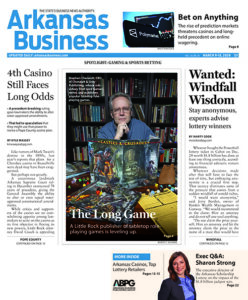
Roger Collins is a graduate of Rice University and a former CPA who joined Harps Food Stores 30 years ago as chief financial officer. He was promoted to vice president in 1995, the year Harps Cash Grocery purchased a 10-store chain and started growing. He became president and CEO in 2000 and has expanded the store count to 78 in Arkansas, Oklahoma and Missouri. He was also instrumental in selling the company to the employee stock ownership plan 15 years ago.
Roger Collins also appears in the Retail category of this week’s Power List.
You’ve discussed being the local competitor of the world’s largest retailer. The disadvantages are obvious, but what advantages do you have in such a competitive situation?
I think competing with Walmart has forced Harps to be better. We have to both be creative with our strategy and drive down the costs of our operation. While differentiation from Walmart is important, we must be careful to generate a return on points of difference.
How do you approach decisions like opening or closing a store? Are you entirely data-driven, or are there other factors?
The decision to open a store at Harps is primarily based on analytics. The projected volume is impacted by population, demographics, potential growth and existing competition, as well as other considerations. This projected volume is evaluated and compared with the cost of the investment when computing a projected return. Because of the saturation of our market with Walmarts, we must contemplate the likelihood of a new Walmart and/or other competitors, like a Kroger.
What do you look for when hiring members of your management team? Is experience in the grocery business the most important qualification?
The most important qualification for hiring or promoting a person into our management team is his/her character, followed closely by his/her leadership skills. I believe we can teach a person the necessary operational skills, but we must have someone who will fit with our culture and value system.
What is the most misunderstood thing about the grocery business?
Price is important, but people care about quality, service, friendliness, cleanliness and engagement with our employees. Harps can be successful if we are great in providing those qualities.
Sometimes mistakes can be our best teachers. What was the biggest business mistake you’ve made during your career and what did you learn from it?
For many years we thought closing a store was a sign of failure and weakness. However, we learned there are times when competition forces you to close a store. Spending additional money in remodeling a store that will never be successful is detrimental to our employee-owners. Sometimes stores should be closed.
What was the smartest decision you made?
Personally, the smartest decision I made was to insist on buying stock in Harps when I joined the company in 1986. Harps was a family-owned business and I asked to become the first non-family stockholder. Don Harp agreed to let me become a stockholder when I started my job as vice president of finance.
The best corporate decision in which I played a role was to sell the company to our employee stock ownership plan in 2001. Since that time, we have allocated over $100 million to the accounts of our employee-owners; thus they share in the equity of our company and have a vested interest in Harps’ continued success. Having employees who care that customers shop at Harps is a competitive advantage.
 Sign up for Daily E-news