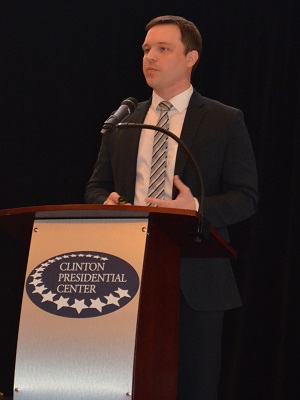
Jared Henderson, Executive Director of Teach for America in Arkansas, speaks to the Little Rock Rotary Club Tuesday.
Children from low-income homes have more needs but the same potential as those from middle-class or affluent homes and should receive an equitable education, Jared Henderson, executive director of Teach For America in Arkansas, told the Little Rock Rotary Club on Tuesday.
The nonprofit is working to address equity in education, he said, by recruiting teachers from more than 300 universities and colleges, companies, the armed forces and professional organizations to work in the neediest schools.
TFA trains them, facilitates their hiring and placement for an initial two-year commitment and works to retain teachers past that commitment.
The nonprofit selects the top 10 to 12 percent of about 40,000 applicants a year. They receive a stipend of $3,000 to $5,000 a year and get relocation assistance, he said.
Henderson said the group serves as unique role models: 50 percent of TFA teachers are people of color, almost 50 percent grew up in low-income homes, and 33 percent are first-generation college graduates.
In Arkansas this year, TFA placed 350 teachers in schools statewide. Fourteen are in the Little Rock School District, he said.
That’s important because, not only was the LRSD taken over by the state two years ago for being in academic distress, 27 percent of Arkansas’ kids live in poverty, and the state is 48th in the percentage of adults with an associate’s or bachelor’s degree, Henderson said.
He also called the odds of children from low-income homes across the nation attaining education beyond high school “frighteningly low.”
“Our system — and I’m speaking nationally here — is basically failing poor children,” and TFA is working to change that, Henderson said.
He cited multiple challenges facing students, including being exposed to fewer books in the home; parents stretched thin by working harder and in multiple jobs; and having fewer educated role models.
But he also dispelled what he called “myths” about the equity problem. Henderson said he and TFA have learned that parents care about their children, most kids want to learn, and thousands of schools are successfully educating poor children.
While it might seem that children from low-income homes dislike or are disinterested in learning, that’s only true on the surface, Henderson said. Instead, their needs aren’t being met and they feel that they can’t learn.
“When they feel like they can’t be successful in an endeavor, they’ll act out or check out or both,” he said. “It becomes easy after a while, especially when you get to those in high school, to blame those kids or lower expectations or do both. And, when we do either, we will probably fail.”
Henderson said people have to believe it is possible to reach those children, and they must act aggressively to do so.
TFA teachers aim to do that, and more than two-thirds of the nonprofit’s alumni continue working in the education field after their two years is through, he said. About 80 percent continue to work with children directly in education and other fields, including social work.
In Arkansas, 90 of the teachers have continued with TFA beyond their two years and remain in the classroom, Henderson said. Two are former Arkansas Teacher of the Year Award recipients.
Another 20 are school administrators, while a few more work in government and nonprofits like What’s Next Pine Bluff and The College Initiative, he said.
Henderson said that over the past five years, the number of people entering the education field in Arkansas by any route has dropped by 40 percent. One way to improve that figure, he said: raise the profile of teachers, so that people who go into that field believe they will be respected.
Henderson was also asked about TFA’s work with charter schools.
He said TFA in Arkansas works with KIPP Public Charter Schools. Twenty percent of TFA’s teachers are placed at charter schools and 80 percent go to traditional public schools.
KIPP works well because its mission addresses equity and is outcomes-focused, Henderson said.
Charter schools have greater freedom in hiring, he said, but they might also hire too quickly and their more liberal hiring policies are a “mixed bag.”
Asked about new U.S. Education Secretary Betsy DeVos, Henderson said TFA is waiting to see what she will do.
He said the federal government can have a lot of impact in the classroom with legislation like No Child Left Behind and because it controls dollars, but Congress recently passed the Every Students Succeeds Act that essentially had them taking “a step back.”
Henderson said he hopes the states will have more control over education going forward.
He also said, in response to a question, that he supports vocational education. But Henderson warned that schools must make sure low-income students aren’t relegated to that track at an early age.
Henderson added that he’d love to see Arkansas become a game-changer in providing an equitable education to kids here.
“We are in the bottom five in almost every metric you want to put on the table in education … We’re going to have to do something bold,” he said.
 Sign up for Daily E-news