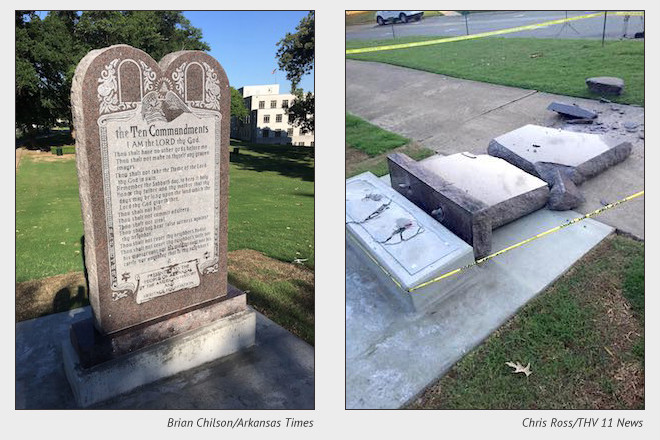
The Ten Commandments monument at the Arkansas State Capitol after it was placed on June 27, 2017, and how it appeared on the next day.
THIS IS AN OPINION
We'd also like to hear yours.
Tweet us @ArkBusiness or email us
The installation of a Ten Commandments monument at the state Capitol has never registered high on my personal concern-o-meter. I doubt its enthusiastic supporters were motivated by either historic commemoration or devotion to a God who has never seemed overly fond of graven images, but I’ll let the courts figure out whether it rises to the level of unconstitutional establishment of a favored religion. I just can’t get worked up about it.
After it was installed last week, it crossed my mind that it wouldn’t be long until it was vandalized. There are people walking around among us who get their yuks by pushing over gravestones, so a controversial new monument seemed like a ripe target for hooligans.
I did not, however, expect the thing to survive only a matter of hours before being plowed into by a car, deliberately and live on Facebook. Someone would have to be crazy to do that.
Exactly.
Michael Tate Reed, the 32-year-old man from Van Buren who broadcast himself driving into the monument, is mentally ill. I’m not diagnosing him. I’m not libeling him. I’m just telling you what he told the Tulsa World in a lengthy email in 2015, a few months after he was arrested for doing the very same thing to a Ten Commandments monument on the grounds of the Oklahoma Capitol.
Reed does not appear to be — as one of my regular readers suggested in a particularly ugly email — “an atheist, Satan worshiper, Jew hater, Christian hater, secular-fundamentalist, Islamist terrorist or Young Democrat.” Instead, Reed described himself as “a born-again Christian who speaks in tongues, and I Love God, Jesus and the Holy Spirit. I love going to church, and I love reading the Bible.”
He was a student at Victory Bible College in Tulsa when he started having vivid dreams and hallucinations and hearing voices. While driving home from Kentucky, under the influence of some kind of pills, a voice told him that he needed to use his car to stop other cars. “The voice told me the cars were all carrying meat that was infected with the spirit of Michael Jackson and it was a killer virus.” He resisted the urge, driving into the median instead and spending 10 days in jail.
You’d think that sometime between the Oklahoma City massacre and the bomb threats against Jewish Community Centers earlier year, we would have learned not to make assumptions about perpetrators. But last week, Arkansas lawmakers — just like politicians in Oklahoma in 2014 — were suggesting that Reed’s act was a political statement. There may be some political component to his psychosis, just as there seems to have been a religious component, but this was not the politics talking any more than it was the religion. It was the illness.
Which brings me to something that is blowing the top off my concern-o-meter: the side effects on health care access of the Republican tax-cut bill currently called the Better Care Reconciliation Act. (You thought it was a health care reform bill? You haven’t been paying attention, have you?)
After Michael Reed got back from Kentucky, but before he rammed the monument in Oklahoma, his family had him admitted to a mental health facility somewhere in Arkansas for 30 days, according to the World’s report, which included this detail: “Reed was to have a monthly shot for his antipsychotic treatment, but it was $900 after insurance benefits were applied. He was able to get two shots but then could no longer pay. He tried to stay stable with the therapy and the other medications.”
I wish I knew more. I wish the World had drilled deeper into the kind of insurance Reed had at the time and what medicine he was prescribed. (Several psychotropics fit the monthly injection description.) We do know that this young man has been for several years having psychotic breaks of the kind that make him think he needs to drive his car into things, and the cost of keeping him between the ditches has been out of reach.
Treatment for mental illness and substance abuse are “essential health benefits” under the Affordable Care Act. They may not be if Republicans fund their tax cuts through stripped-down coverage. It will return a few dollars to households earning in the $250,000 range and much more to the ultra-wealthy. But it won’t do a thing to keep the next guy from driving his car into whatever the voices tell him to.
A letter to the editor of the Arkansas Democrat-Gazette last week alerted me to the fact that one man’s biggest worry is the number of American women who watch Oprah Winfrey’s show. I wish my concern-o-meter could be calmed by the news that the thing I fear ended six years ago.
 |
Gwen Moritz is editor of Arkansas Business. Email her at GMoritz@ABPG.com. |
 Sign up for Daily E-news