


1. Scandalous Corruption
Public corruption ranked No. 9 on last year’s list of the top business stories. At that point only three Arkansas lawmakers had been implicated in criminal abuse of the state’s General Improvement Fund, and only one had been convicted.
What’s more, the nexus of the GIF scandal with a Missouri Medicaid fraud case involving Preferred Family Healthcare of Springfield was only just starting to emerge.
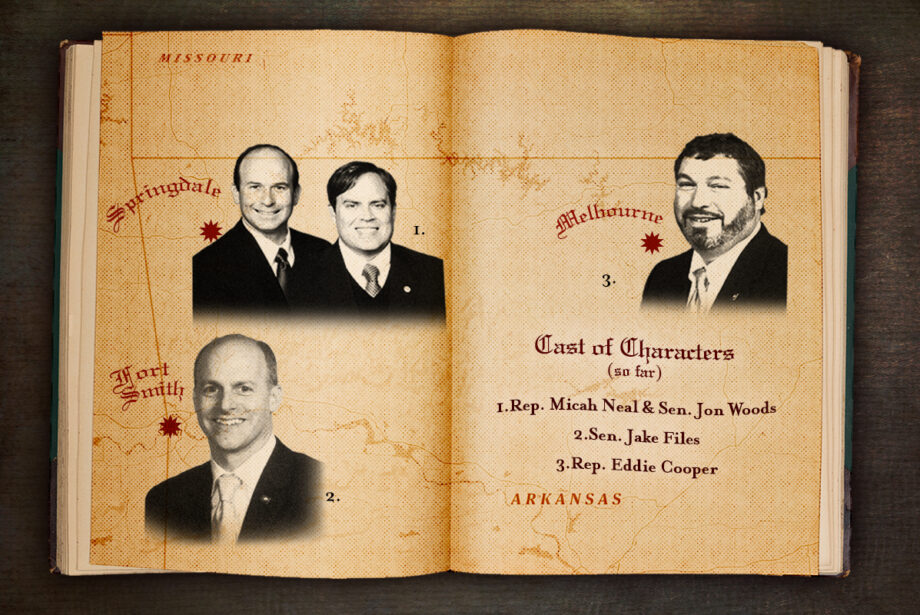
What a difference a year makes. Now the bipartisan count of former Arkansas legislators convicted in federal court of corruption between the two cases is up to five: former Reps. Micah Neal and Eddie Cooper and former Sens. Jon Woods, Jake Files and Henry Wilkins IV.
Jeremy Hutchinson, who has been implicated but not charged in the Missouri case, resigned from the state Senate after pleading not guilty to a separate federal indictment for fraudulent abuse of campaign funds.
And that’s not all. Four more Arkansans have been convicted of either paying legislators kickbacks on GIF grants (former Ecclesia College President Oren Paris III and his lobbyist friend Randell Shelton) or participating in Medicaid fraud (Jerry Walsh, former director of South Arkansas Youth Services in Magnolia) or both (Milton R. “Rusty” Cranford, lobbyist and Preferred Family Healthcare executive).
And even that’s not all. Four more PFH executives or contractors have been convicted of embezzling money generated by the Medicaid fraud. And three more Arkansans who worked for PFH — Robin Raveendran, Helen Balding and Vicki A. Chisam — have been charged in Arkansas state court for alleged roles in defrauding the Medicaid program.
Files, whose abuse of GIF money was separate from the rest, got an 18-month sentence, which he began serving in August.
Neal, the first to plead guilty and agree to cooperate with federal prosecutors, was sentenced to a year of home detention followed by two years of probation. Woods, against whom Neal testified, was sentenced to more than 18 years in prison by U.S. District Judge Tim Brooks, who concluded that the Springdale Republican had “serious criminal thinking issues.” He began serving his sentence in September.
Paris, the former Christian college president, drew a three-year sentence in federal prison, and Shelton six years. Both reported to the federal Bureau of Prisons in October.
Wilkins is scheduled for sentencing on Jan. 30; Cooper’s sentencing has not yet been set. Cranford has not been sentenced, but he’s been in custody since February after prosecutors persuaded a Missouri judge that he was a flight risk who had tried to hire a hit man.
Hutchinson is scheduled for trial in July.
2. Voters Approve Casinos
The passage of Issue 4 on Nov. 6 finally cracked the door open to full-bore casino gambling in Arkansas. By a margin of 54-46, voters said yes to bringing blackjack, poker, roulette and other live Vegas-style table games to Garland, Crittenden, Jefferson and Pope counties.
On-site sports betting is on the menu as well.
The amendment enables the Oaklawn Jockey Club Inc. in Garland County and Southland Racing Corp. in Crittenden County to expand their electronic-gambling racinos and become full-fledged casinos.
On Nov. 19, Oaklawn announced a $100 million expansion to its Hot Springs operations to include a 200-room high-rise hotel, a 14,000-SF event center and 28,000-SF gaming area. The target completion date for the gaming expansion is January 2020 with the hotel and event center to be completed in late 2020.
Southland has yet to announce any casino plans in connection with its West Memphis operations.
In the weeks leading up to the Issue 4 vote, the Quapaw Tribe was the first player to announce its casino plans with a Jefferson County venture. Through its Downstream Development Authority, the tribe intends to develop a Pine Bluff casino modeled after its Downstream Casino Resort in Oklahoma.
The project would have about 350 hotel rooms, five to seven restaurants, an entertainment facility and spa built around a gaming area estimated at 70,000 to 80,000 SF.
The development also will feature museums devoted to the history of the blues and to Native Americans and African-Americans in the Jefferson County area. The Quapaw Tribe invested nearly $3.8 million to promote passage of Issue 4.
The Arkansas Racing Commission, tasked with overseeing the issuance of casino licenses, already has received letters of support for the Quapaw proposal from Pine Bluff Mayor Shirley Washington and Jefferson County Judge Booker Clemons.
Obtaining similar letters of support for a Pope County casino, linked with the Cherokee Tribe, are proving to be dicey.
While voting 60-40 against Issue 4, the electorate there also approved a measure to have a further say in the matter. The ordinance requires local officials to get voter permission before providing letters of support for a casino. Without that official support, no casino license.
The move sets up a special referendum scenario before casino gambling will be allowed to come to Pope County.
3. Trade War Reverberations
The effects of the ongoing trade war between the United States and China have caused different reactions in different industries important to Arkansas’ economy.
The Trump administration implemented a 25 percent tariff on steel imports from China, which responded with sharp retaliation against U.S. products, including agricultural ones. While the U.S. steel industry has supported the trade war, farmers are much less supportive.
MaryEmily Slate, vice president and general manager of Nucor Steel Arkansas, said the imposed steel tariffs are keeping China from undercutting the existing market by dumping cheap steel. Nucor, the country’s largest steel producer, is on pace to surpass its record profits of $1.8 billion in 2008.
Nucor employs 1,800 workers in Arkansas and two scheduled plant expansions could add another 300 jobs.
“There is so much misinformation regarding how the tariffs are impacting the economy; the steel tariffs aren’t about protectionism,” Slate said. “It’s really about establishing a fair and level playing field to compete on.”
For Arkansas soybean farmers, the trade war has left many in a potentially disastrous limbo. Arkansas produced 178 million metric tons of soybeans in 2017 and sold one-third of that to China; since the tariff war, soybean sales to China have dropped 97 percent.
The high production of soybeans continued but with a major market closed, farmers have seen prices drop significantly and secondary markets haven’t made up the sales. The Trump administration promised a $12 billion subsidy to help farmers out.
“We need that tariff dropped,” Brad Doyle, a Weiner farmer and a national director of the American Soybean Association, said last month. “We want fair trade. Just give me what my beans are worth. They were worth $10. Because of retaliation now they are worth low $8s.”
An August report by Jonas Crews and Ross DeVol for the Walton Family Foundation said it appeared China “surgically targeted” manufacturing and agricultural products from middle America to place pressure on the Trump administration to end the trade war.
“The impact of China’s recent retaliatory tariff increases on the American Heartland will likely be substantially worse than on the rest of the country,” the report said.
4. Coal Declines; Solar Shines
Arkansas’ electric utilities swapped black carbon for bright sunshine, dipping below 50 percent in reliance on coal for power generation in 2018.
And plans call for coal to stay on the shelf.
“No new coal, I think we can make that declaration,” said Andrew Lachowsky, vice president of planning and market operations for Arkansas Electric Cooperative Corp., noting an industrywide turn toward renewables and low-cost natural gas generation.
The state’s electric co-ops still use coal for more than half of their power, but it provided just 47 percent of total state power in September, the U.S. Energy Information Administration reported. Gas generation was 28 percent; nuclear power 17 percent, all from Entergy’s Nuclear One at Russellville; hydroelectric, solar and wind renewables together made up about 7 percent.
Entergy, with 700,000 customers in Arkansas, got just 4 percent of its electricity from coal plants this year, down from nearly 20 percent a decade ago. Southwest Electric Power Co., serving 120,000 meters in west Arkansas, gets 45 percent of its power from coal, and that total is falling.
“We have RFPs out now for more solar resources, and we’re looking to do these about every year,” said Kurt Castleberry, Entergy Arkansas’ resource planning chief.
Sued by environmentalists, Entergy agreed to shut down its two coal plants — in Redfield and Newark — by the end of 2030, even though Arkansas Attorney General Leslie Rutledge threatened the settlement with a suggestion that abandoning coal could cost ratepayers. Entergy’s cost modeling says otherwise.
Entergy is tapping the state’s largest solar array, the 88-megawatt Stuttgart Solar, operated by Nextera Energy Resources. The companies are partners in an even bigger array, a 100-megawatt Chicot County project to go on line in 2019.
AECC, whose wholesale power reaches 500,000 Arkansas homes and businesses, plans to buy power from a 100-megawatt system near Crossett and get 100 megawatts of wind power from a turbine project in Oklahoma. A 100-megawatt source can power about 1.5 percent of Arkansas’ meters.
Companies like Entegrity, Today’s Power Inc. and former Lt. Gov. Bill Halter’s Scenic Hill Solar, all of Little Rock, and Seal Energy Solutions of North Little Rock had a big year installing solar projects at businesses, schools, government facilities and even farms.
They say a pending Public Service Commission decision could set the tone for solar next year. The utility regulators are setting rates for the state’s “net-metering” customers, who create their own power. Advocates say a favorable return for these few solar customers — up 56 percent from 633 to 988 in calendar 2017, the last year of available data — is crucial for spurring sales to customers who use their energy savings to pay for their rooftop systems.
5. Marijuana Slow-Walk
Medical marijuana got closer to becoming a reality this year for Arkansans, who legalized it more than two years ago, but still no cigar.
The Arkansas Medical Marijuana Commission awarded licenses in July to the five cultivation facilities allowed in the state. The winners are Bold Team LLC, Natural State Medicinals, Osage Creek Cultivation, Natural State Wellness Enterprises and Delta Medical Cannabis Co.
Bold Team plans to build its facility in Woodruff County. Natural State Medicinals is headed for Jefferson County, and Osage Creek is coming to Carroll County. Both Natural State Wellness and Delta Medical will set up shop in Jackson County.
Bold Team and Natural State Medicinals expect to have the drug available for dispensaries as soon as April. The others say theirs will be ready later in the summer.
In addition, at a Jan. 9 meeting, the commission expects to announce the scores given to applications for the 32 dispensary licenses available. An outside consultant was hired to review dispensary applications after the commission’s handling of the cultivation licenses faced criticism that included a legal challenge and a bribe allegation.
Two companies that weren’t selected to grow marijuana sued the commission, claiming its scoring of all 95 applications was arbitrary and capricious.
Pulaski County Judge Wendell Griffen agreed and in March halted the awarding of licenses by ruling the licensing process unconstitutional.
The lawsuit also alleged that two commissioners, Dr. Carlos Roman and Fayetteville lawyer Travis Story, had conflicts of interest due to their relationships with Natural State Medicinals owner Dr. Scott Michael Schlesinger and Osage Creek owners Jay and Mary Trulove, respectively. Both companies won licenses.
But the Arkansas Supreme Court reversed and dismissed Griffen’s ruling in June.
That same month, Roman accused rejected applicant Natural State Agronomics of trying to bribe him. He said he didn’t accept the bribe, but he gave the business his second-highest score — higher than the scores it received from the other four commissioners.
Then, in October, the Arkansas Democrat-Gazette reported on a secret video recording of a meeting between Roman and Natural State Agronomics owner Ken Shollmier.
The video doesn’t show a bribe offer or solicitation, but it shows that commissioners could identify applicants despite redactions designed to prevent bias. It also shows Roman giving the owner a copy of the highest-ranked application, which Roman said was the same redacted copy available to the public.
In other marijuana-related news, MediPays of Little Rock may be the only business willing to bank medical marijuana businesses with a product called Abaca and offer a cashless option to patients called MediPays. The company has partnered with a yet-to-be-named bank in Arkansas and is already operating in Oklahoma, where medical marijuana was approved by voters in June and was available for sale in October, thanks to far less stringent regulation.
6. Walmart E-commerce
Walmart Inc. — the updated corporate name adopted in February by the Bentonville retailer formerly known as Wal-Mart Stores Inc. — made a big splash in the e-commerce sector when it bought Jet.com for $3.3 billion in 2016.
Turns out that was just a prelude to a really big deal in May: the $16 billion acquisition of at least 77 percent of Flipkart Group of India. The purchase of the e-commerce platform gives Walmart a frontline position to India’s 1.3 billion potential customers.
Walmart CEO Doug McMillon said the acquisition was part of the company’s “strategic and thoughtful” portfolio management. It also kept e-commerce rival Amazon from making the same acquisition.
“We are making big changes, and they are the right changes to deliver long-term growth,” McMillon said at the company’s annual business meeting at the Hammons Convention Center in Rogers.
“Walmart and Flipkart will achieve more together than each of us could accomplish separately to contribute to the economic growth of India, creating a strong local business powered by Walmart,” said Judith McKenna, president and CEO of Walmart International. “As a company, we are transforming globally to make life even easier for customers, and we are delighted to learn from, contribute to and work with Flipkart to grow in India, one of the fastest-growing and most attractive retail markets in the world.”
Walmart wasn’t done. Later in the year, the retailer bought Eloquii, a fashion brand focused on plus-sized women’s apparel, and Bare Necessities, an online intimate apparel brand.
Those two acquisitions, combined with 2017 acquisitions of online brands ModCloth, Bonobos and Moosejaw, are part of Walmart’s online strategy to compete with e-commerce juggernaut Amazon.
eMarketer estimated that Amazon would account for nearly 50 percent of all online sales in the U.S. in 2018, while Walmart would have approximately 4 percent. In its third-quarter earnings report in November, Walmart said its e-commerce sales had grown by 43 percent in the quarter after a 40 percent jump in the second quarter, but it still isn’t quantifying online sales with dollar signs.
“We had an exciting year,” McMillon said. “We’re moving faster, getting stronger, and we have good momentum across many parts of the business. This is a dynamic time to be in retail, and opportunities are emerging to serve customers in new ways so we are moving with speed to bring them to light.”
7. Baptist Health Expansion
Baptist Health of Little Rock expanded its footprint to northwest Arkansas in 2018, while its strategy in Conway attracted scrutiny from Arkansas lawmakers.
In early July, Arkansas Business broke the news that a deal was in the works between nonprofit Baptist Health and Sparks Health System, which was owned by publicly traded Community Health Systems of Franklin, Tennessee.
Later that month, Baptist announced it was buying Sparks, which included the 492-bed Sparks Regional Medical Center in Fort Smith, the 103-bed Sparks Medical Center in Van Buren and affiliated physician clinics in western Arkansas and eastern Oklahoma. The financial terms of the deal, which closed Nov. 1, had not been publicly disclosed as of last week.
Baptist Health renamed the medical centers Baptist Health-Fort Smith and Baptist Health-Van Buren. The transaction increased the number of Baptist hospitals in Arkansas to 11, the most of any company in the state. The sale left Community Health Systems with six hospitals in Arkansas.
Meanwhile, state lawmakers took a hard look at the contract between the University of Arkansas for Medical Sciences and the hospital that Baptist Health opened in Conway in September 2016.
In January, members of the Legislature’s Joint Performance Review Committee quizzed UAMS about its contract to provide coverage for emergency room and orthopedic services at Baptist Health-Conway after Conway Regional Health System’s President and CEO Matthew Troup raised competitive concerns.
Troup said the contract is unfair because UAMS, a taxpayer-owned teaching hospital, is helping to supply doctors, who are hard and expensive to recruit, to a business that chose to enter a well-served market. “It turned UAMS from an educator into a competitor,” Troup said.
UAMS said it has 165 contracts across the state and is willing to work with any hospital. It also said it uses the money generated from providing clinic procedures to support its educational mission.
At a meeting of the JPRC earlier this month, co-chair Rep. Mark Lowery, R-Maumelle, said he was considering legislation that would require UAMS to collaborate with any hospital that wants a similar partnership to provide physician services.
Also during the recent meeting, Conway Regional’s chief development officer, Lori Ross, told members that the hospital was considering lobbying for legislation and legal action.
8. UAMS, CARTI Tackle Financial Issues
Both the University of Arkansas for Medical Sciences and CARTI Inc. laid off workers in their efforts to curb looming financial shortfalls in 2018.
UAMS’ financial problems surfaced in the fall of 2017 when, months into the fiscal year that started July 1, a deficit that had been budgeted at $39.2 million was on track to balloon to $72 million.
Even more troubling was an operating reserve for the UAMS campus that had dwindled from $167 million in mid-2011 to $47 million on March 31, 2018.
UAMS’ deficit was linked to depreciation being included as an expense, UA System President Don Bobbitt said. But with declining revenue, eventually “it actually ceases to become a paper loss,” he said. “It becomes a real loss.”
To restrain the deficit, UAMS said in January that it was slashing about 600 positions, 258 of them filled. A month later, UAMS, which employs more than 10,000 people, announced it was eliminating another 125 positions.
Top management also got a shakeup. Dr. Cam Patterson, who was hired a year ago from New York Presbyterian Hospital’s Weill-Cornell Medical Center, started his job as UAMS chancellor in June.
In the meantime, Mark Kenneday retired as vice chancellor for campus operations; Dan Riley resigned as associate vice chancellor for clinical finance; Dr. Pope Moseley resigned as executive vice chancellor and dean of UAMS’ College of Medicine to return to research; and Dr. Peter Emanuel submitted his resignation as director of the Winthrop P. Rockefeller Cancer Institute at UAMS.
The staffing cuts helped UAMS reach a bottom line deficit of $15.6 million for the fiscal year that ended June 30, which is an improvement from the deficit of $19.9 million the previous year. A balanced budget for fiscal 2019, which started July 1, was adopted.
Meanwhile, CARTI, of Little Rock, also saw a transformation during the year. Adam Head, who became the cancer treatment institute’s president and CEO in September 2017, told Arkansas Business in April that CARTI “was not on a sustainable trajectory.”
His turnaround plan involved a massive restructuring and culture change. In April, CARTI announced it had eliminated 22 positions, with 17 of the positions occupied. The staffing changes were expected to save $1.4 million annually.
Six of the employees who lost their job had worked directly with Dr. Brad Baltz, the highest-paid oncologist, who was fired in March.
The strategy seemed to work. For the fiscal year that ended June 30, CARTI reported an operating net income before depreciation of $529,000 compared with a loss of $5.8 million the previous fiscal year. Net revenue grew by 14 percent to $189.1 million.
“We knew we needed to make progress and we needed to make progress fast,” Head said in October.
9. The State of Health Care Costs
Arkansas’ state government undertook two major — and controversial — initiatives in 2018 to try to get a handle on health care costs
The first was a work requirement for some of the Arkansans eligible for the state’s unique approach to expanding Medicaid. Originally called the “private option” because it used federal Medicaid expansion funds to buy private insurance from the exchange set up under the Affordable Care Act, the program was renamed Arkansas Works.
The federal government in March approved, over activists’ objections, a work requirement that applied to about 65,000 of the 250,000 people receiving insurance through the program.
The difficulty in enforcing compliance was apparent from the time the first group of enrollees was required to start reporting through a website on June 1. Three straight months of noncompliance results in cancellation of a person’s private health insurance, and the Arkansas Department of Human Services reported that the number of accounts closed for noncompliance had reached almost 17,000 by the end of November.
By then, alternative call-in reporting had augmented the online system.
Decried as the realization of work requirement opponents’ worst fears, the need to keep track of beneficiaries and their eligibility has also been defended for its cost savings. Unlike traditional Medicaid or Medicaid expansion in other states, which pays only for medical services actually provided, Arkansas Works pays a private insurance carrier a monthly insurance premium for every enrollee. Arkansas Works premiums cost $109.6 million in September and had fallen to $97.2 million in November, after the first two rounds of enrollees were dropped for three months of noncompliance.
The second newsmaking health care initiative was the Arkansas Pharmacy Benefits Manager Licensure Act, a pioneering law regulating the middlemen who negotiate with drug manufacturers on behalf of insurance companies.
Shepherded through a special session in March by Rep. Michelle Gray, R-Melbourne, and Sen. Ron Caldwell, R-Wynne, the law was a response to vocal outrage from pharmacists who experienced a dramatic increase in the number of prescriptions they were asked to fill at a loss.
Beginning Jan. 1, PBMs operating in Arkansas must be licensed and will be subject to new requirements, including adequate reimbursements to pharmacists, and new restrictions, including outlawing “gag clauses” that had limited the information that pharmacists were able to share with patients.
As of last week, three PBMs had applied for licenses in Arkansas, according to the Arkansas Department of Insurance. AID was investigating 17 complaints about reimbursement levels.
10. A Year of Strange Tales
2018 was filled with unusual cases in Arkansas Business, from a New Jersey businessman who sent a single fax that led to a $12.5 million judgment to the questioning of the fairy-tale founding of a women’s apparel company in Fayetteville.
In January, Arkansas Business reported on settled lawsuits that questioned the founding of the women’s clothing company Lauren James Enterprises Inc.
The founder of the company, Lauren Stokes, had said she was pregnant and on doctor-ordered bed rest when she began drawing dress designs to pass the time. After her son was born in 2013, her husband, Lance Stokes, suggested she leave a nursing career for fashion design.
Over four years, Lauren James Enterprises blossomed into a $13 million Southern women’s lifestyle line with national reach.
But Chelsea McShane of Fayetteville, who previously was in business with Lance Stokes, accused him of sharing with his wife the clothing designs that McShane had created, according to a 2014 lawsuit, Lance Stokes denied the allegations in court filings and the case reached a confidential settlement in 2016.
Trouble continued for the company in June 2018 when First Security Bank of Searcy sued it for defaulting on a more than $300,000 business loan.
As the lawsuit was pending, a newly formed company, LJ Apparel LLC, said it was owed money from Lauren James. LJ Apparel said it was holding a foreclosure sale of all of Lauren James’ assets in August.
The bank called the foreclosure “a sham transaction not conducted in good faith” and added LJ Apparel as a defendant to the lawsuit. That case is still pending.
In August, Eugene Kalsky, owner of Gen-Kal Pipe & Steel Corp. of Mount Laurel, New Jersey, told Arkansas Business how a single fax sent to M.S. Wholesale Plumbing Inc. of Russellville led to a $12.5 million judgment against him and his steel pipe distribution company.
The 2017 judgment was the result of a class-action lawsuit filed over Kalsky’s failure to use specific language in its opt-out notice on fax advertisements.
Kalsky didn’t hire an attorney after he was served with the complaint, which accused him of violation of the federal Telephone Consumer Protection Act.
Since no attorney represented Kalsky or Gen-Kal, the plaintiff’s request for class certification sailed through without an objection and was approved by Pope County Circuit Court Judge Ken Coker Jr.
The judgment forced Kalsky’s business into Chapter 11 bankruptcy and his home in New Jersey was almost sold to satisfy the judgment. The case has been appealed to the Arkansas Court of Appeals.
In November, Arkansas Business also described the deteriorating personal and professional life of Monte Johnston, a 48-year-old Springdale businessman with several lucrative companies.
In 2015, the first in a series of public allegations of domestic abuse surfaced against Johnston. In 2016, the Arkansas attorney general’s office filed a consumer protection lawsuit against Johnston’s Automatic Auto Finance Inc. of Springdale and related companies.
The attorney general’s suit and four felony charges tied to domestic abuse are pending in Washington County Circuit Court. Johnston has pleaded not guilty to the criminal charges, which are set for trial in January, and denies the allegations about his companies.
 Sign up for Daily E-news









