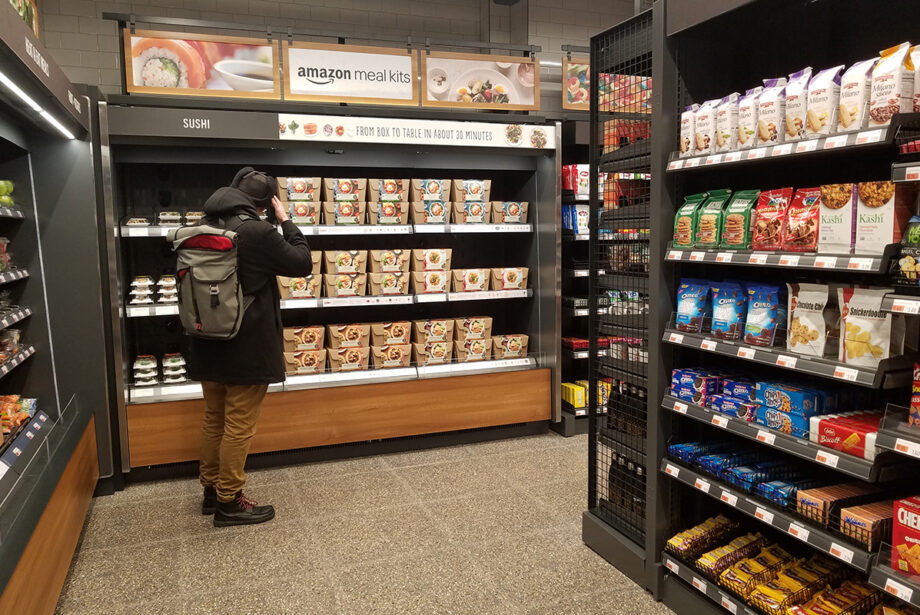
A customer shops at an Amazon Go convenience store in Chicago last month.
THIS IS AN OPINION
We'd also like to hear yours.
Tweet us @ArkBusiness or email us
Retail, consumer and business publications and consumer gurus who offer online musings are full of predictions for 2019. “Top 10 Predictions,” “5 Must-Know Trends,” “The Year Ahead.”
Business consultants who prognosticate usually offer guesswork. But what we’re looking for is a simple and safe bet. That’s why we’re holding ourselves to just two predictions. Well, they’re really not predictions because they’re already in the works. So this is more of a review. Out on a limb, we’re not.
The top two observations are the coming proliferation in 2019 of Amazon Go and Alibaba Hema. The category is cashier-less retailing. Think of technology-driven vending machines, the original cashier-less experience. You decide what you want, make the selection, pay and receive the product.
Same idea with Amazon Go and Alibaba Hema. No one else has to be involved. It’s kind of relationship-building between you and a brand. The brand’s equity and its physical location at retail should have the power to drive the transaction without a salesperson involved. But that’s a whole other column.
Consumer research services are trumpeting the benefits of the expanding technology, a technology that has been around for several years now. A recent “Research Brief” by CB Insights lists the somewhat obvious but nevertheless cogent benefits of what the technology can do for the changing consumer marketplace and retailers’ role in it. (CB Insights is a business of analysts and network of executives advising on growth, competition and technology, through what it calls an “intelligence platform.”)
The benefits of “unmanned retail,” as it is called, include new points of sale in the form of kiosks, some in non-retail venues, promoting brands, handling transactions and scheduling deliveries; lower overhead costs after sales and cashier jobs are eliminated, much as self-checkout has allowed at the Kroger up the street (which often has lines of shoppers waiting to self-checkout, even when a cashier lane is open); collecting consumer data through online checkout via a smartphone app, coupled with a combination of shelf sensors and in-store shopper tracking; and more efficient retail management by localizing product inventory and merchandising based on individual store cum consumer data. Retail nirvana.
So how does it work? A number of technologies support non-human-assisted retailing, including artificial intelligence in the form of machine vision, which tracks shoppers after they scan a code on their app-enabled phones. Machine vision not only tracks shopper movement, but also the movement of products. This cashier-less approach to cost-reduction retail includes facial recognition that matches consumer images to shopper profiles. Through facial recognition, the store knows who you are and where you are in the store. And what products you are looking at and, of course, purchasing.
Other technologies include shelf sensors, mentioned above, radio tags on products and quick response and bar codes shoppers scan into their phones.
A pause here is probably warranted: Does all of this make you a little nervous? Facial recognition, shopper tracking, phone apps that are always on your phone and your phone is always on you? No hovering store clerk. But “they” are watching!
Amazon opened a year ago this month its first Amazon Go store using this technology. It’s an on-the-go food and beverage vendor, and also stocks personal care items. Consumers simply download the Amazon Go app onto their phones, go to the store, shop and go. Go. Go. Go. But there are a couple of assistants on hand to point out product locations and to check IDs for liquor purchases.
In China, there are Alibaba Hema stores. So far the conglomerate has 65 of them. Their technology and consumer experience is a bit ahead of Amazon’s. In a Hema store, a consumer can order food at the in-store restaurant and have it delivered, order other products for 30-minute delivery, check out automatically similar to Amazon, and scan any product to see where it was made and what it’s made of.
Ready or not, all this is coming. It’s simply an extension of familiar changes over the years from self-service gas to self-checkout grocery stores, experiences that have come to feel normal. We’ll see how all this new stuff feels this coming year.
 |
raig Douglass is a marketing and research consultant and serves as executive director of the Regional Recycling & Waste Reduction District in Pulaski County. Email him at Craig@CraigDouglass.com. |
 Sign up for Daily E-news