Tyson Foods Inc. of Springdale on Monday reported an 88 percent increase in a key measure of profit as its prepared foods and chicken segments continued to show growth a year after its multibillion-dollar purchase of Hillshire Brands.
The publicly traded meat processor (NYSE: TSN) reported net income attributable to Tyson of $258 million, or 63 cents per share, up from $137 million, or 35 cents per share in the same quarter last year.
Revenue reached $10.5 billion, up from $10.1 billion in the same quarter last year.
For the full fiscal year, the company reported net income attributable to Tyson of $1.2 billion, or $2.95 per share, from $846 million, or $2.37 per share. Revenue was $41.4 billion, up up 10 percent from $37.6 billion.
Shares of Tyson were up more than 9 percent Monday to about $47.70.
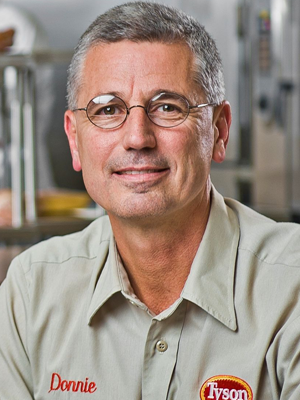
“Our business model is working,” Tyson CEO Donnie Smith said. “The Prepared Foods segment had a very strong performance in the first full year of Tyson and Hillshire coming together. The Chicken segment had an outstanding year. Pork produced solid results. Beef experienced a tough operating environment most of fiscal 2015, but the other segments more than made up for it.”
The company expects another record year in fiscal 2016, forecasting earnings per share of $3.50 to $3.65. It expects about $41 billion in sales.
In an earnings release, Smith noted the company’s strong performance under tough conditions.
“Fiscal 2015 was an important year for Tyson Foods, because it proved that our house of brands gives us the ability to produce record sales and earnings in less than optimum conditions, all while successfully merging two large companies,” Smith said.
For the full year, only Tyson’s prepared foods and chicken segments recorded increases in sales volume. Beef, pork and Tyson’s “other” category noted volume declines from the previous year.
For the year, Tyson said the beef sector was dogged by decrease in supply, which drove up fed cattle costs, and disruptions in the export market. Tyson’s pork category recorded a sale volume decline after divesting its Heinold Hog Market business in the first quarter of the year. Adjusting for that, sales volume actually increased by 3.5 percent for the full year on higher demand.
For the full year, prepared foods posted operating income of $588 million, up from a loss of $60 million in the previous year. Adjusted sales volumes and average sales price grew as a result of the company’s Hillshire Brands purchase. That merger also resulted in about $322 million in synergies during the fiscal year, and executives expect the company to see a $500 million in additional synergies in fiscal 2016.
Among Tyson’s other segments, chicken posted the biggest number, about $1.4 billion, up 55 percent from $883 million. Beef posted a loss of $66 million, down from operating income of $347 million last year. The pork segment came in at $380 million, down 16 percent from $455 million last year.
In a Monday morning conference call, Smith attributed some of the fourth-quarter beef loss to timing, noting an immediate reversal shortly after the quarter closed. He expected to make up the loss over the next year or more, and said despite the timing, Tyson wouldn’t have done anything differently.
“Had the quarter ended a couple of weeks earlier, our earnings would’ve been higher,” he said.
Smith also said Tyson will slightly shift its China strategy to become “more consumer-focused” and will continue trying to grow its “small but great” India business while looking for innovative ways to fuel future “big growth.”
Last week, Tyson said it will invest more than 100 million yuan — $16 million — in China next year as it aims to become the biggest player in the fresh meat market there. Tyson will use the money “to expand product categories, sales channels and marketing activities,” according to Shanghai Daily.
“China has been a difficult operating environment,” he said. “I still think we’ll be anchored in chicken but we may expand and offer a more wide range of products like you see from us here in the U.S.”
Smith said Tyson will continue to sell food-service items but needs to broaden its portfolio in China.
Smith noted Tyson’s Thursday announcement that it will close prepared food plants in Chicago and Wisconsin next year, letting go roughly 880 workers.
“The toughest thing we ever have to do is close a facility,” he said. “A decision to close a facility entails many factors and we consider them in enormous detail.” The two plants slated for closure are aging facilities whose product lines can easily be absorbed by other plants, Smith said.
“There was an overwhelming case that these two plants needed to be closed,” he said.
 Sign up for Daily E-news