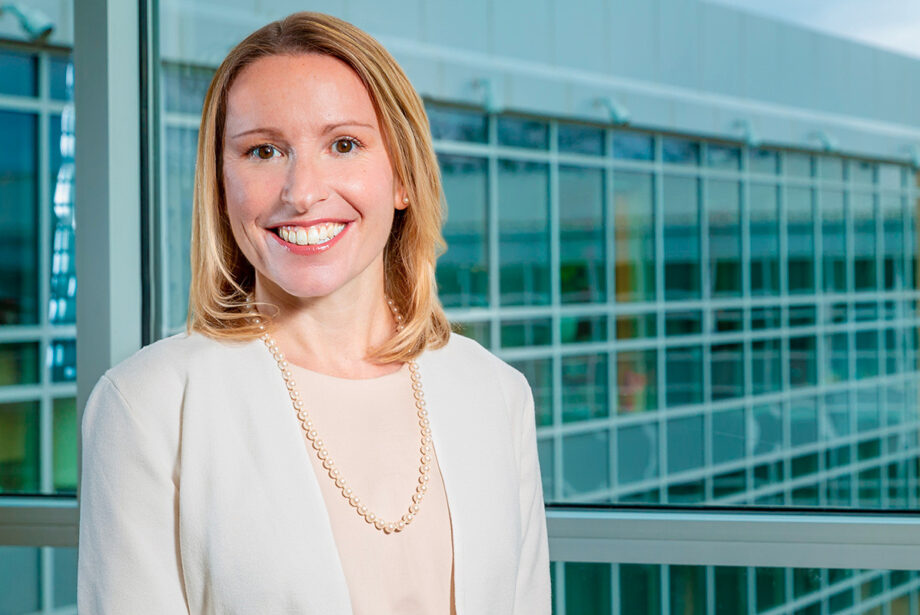
Margaret Sova McCabe, the new dean of the University of Arkansas School of Law, wants to help law students who want to help others.
McCabe has started a public service fellowship program, which allows students to receive up to a $5,000 scholarship for 10 weeks of full-time work at a public service employer, such as a nonprofit or government organization.
“As a public law school and part of a land-grant institution, I feel it’s very important we have a robust and strong public service initiative,” said McCabe, who replaced Dean Stacy Leeds. McCabe started work in July.
Seven students have accepted the full-time fellowship positions and will work at places such as the U.S. Department of Justice and Arkansas Advocates for Children & Families.
“My focus in the next few years will be building that program so that any student who comes through the Fayetteville law school will have the opportunity to be exposed to public service work,” McCabe said.
In addition to the public service fellowship, McCabe will focus on making sure students are trained to contribute in business and corporate law. The law school is near the headquarters of some of the world’s largest publicly traded companies — Walmart, Tyson Foods Inc. and J.B. Hunt Transport Services Inc. — “which really gives our students tremendous opportunities to be exposed to cutting-edge legal operations,” she said.
The law school already has a “robust externship program and good relationships” with those companies, McCabe said. But she plans to develop curriculum and coaching for students to help them when they start their first jobs in business and corporate law.
And she would like for the students to see the law school’s corporate connections as a strong suit. Tyson’s general counsel is Amy Tu, who graduated from the law school.
“For a while we’ve been producing great corporate counsel, but we haven’t really thought about making sure that students really see that as a strength of ours,” said McCabe, who had been a professor at the University of New Hampshire School of Law before coming to Fayetteville.
McCabe attended Walmart’s orientation for the law school’s externs last fall, and she said her first reaction “as somebody who’s new to this part of the world was I can’t believe our law students get to have these placements.”
The law school has about 370 students and expects to have between 115 and 125 new students in the fall of 2019.
“We hope to be able to be a source for firms and corporations over time for students who are really well prepared to join a corporate law practice, whether that’s in-house or with a firm,” McCabe said.
Food & Agriculture Law
McCabe said she also wants to expand the law school’s LLM program in agricultural and food law by collaborating with the school’s Walton College of Business and the Bumpers College of Agricultural, Food & Life Sciences.
She said that she would like for the three colleges to work together on projects that put “the businesspeople together with the scientists together with the lawyers to figure out how to solve some of the problems that we face in the food system.”
One emerging issue involves cell-cultured meat, which is meat grown in a lab. In March, the U.S. Department of Agriculture and the Food & Drug Administration entered into an agreement on how they will regulate those products when they come to market.
McCabe said there are still a lot of questions involving the products, and the three schools can work together to present a seminar or write an interdisciplinary paper to be published in a journal or other publication on the cell-cultured meat topic.
“That, again, just helps people see the university as a really national influence in what happens in our food system,” McCabe said.
 Sign up for Daily E-news