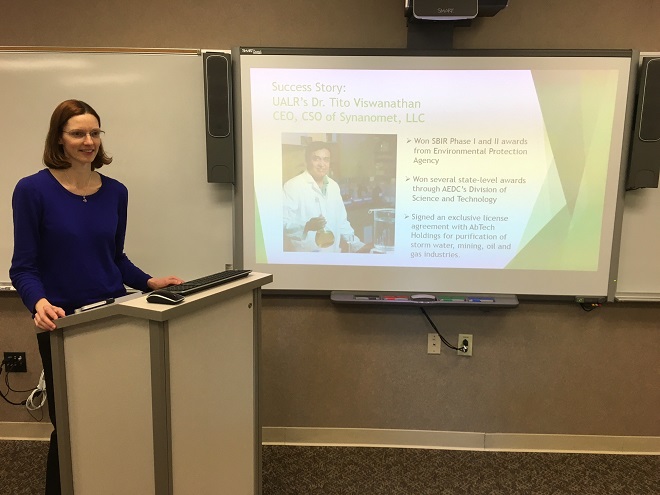
ASBTDC's Rebecca Norman leads a session on commercialization as part of Global Entrepreneurship Week on the UALR campus.
Determining the commercial viability of research ideas should be an easy process that need not intimidate university students and researchers who harbor hopes of taking those ideas to market, Rebecca Norman told students and researchers Thursday.
Norman, an innovation consultant with the Arkansas Small Business & Technology Development Center at the University of Arkansas at Little Rock, guided students and researchers through the commercialization process involved in bringing an idea that was hatched on campus to market.
Norman led a session on commercializing university research at UALR’s Reynolds Business Center as part of the school’s “Lunch & Learn” series to promote Global Entrepreneurship Week. The ASBTDC office at UALR scheduled sessions for each day this week on a different topic related to entrepreneurship on the college campus.
Norman discussed the step-by-step process involved in determining if a research or business idea has commercialization potential. It starts, she said, with identifying the problem one’s idea or service is designed to fix. That includes determining if anyone else is solving the problem and if so, who; what solutions are being used to solve the problem; and who the industry’s top players are.
Next: engaging the customer. That includes approaching potential customers with your idea, assessing interest, requesting feedback and encouraging discussion.
“This is a great time to see if they’re interested in at least part of your idea and if they’d like to be involved in any way,” Norman said.
Norman said it also helps to ask potential customers about their ideal price points and how best to tailor your idea to fit their specifications. She also told students and researchers to be prepared to leave their comfort zones. Examples include attending conferences to network with potential partners and customers, and talking with researchers and entrepreneurs in similar fields who’ve successfully commercialized their ideas.
“Entrepreneurs are usually very open to helping those coming up,” she said. “They have the entrepreneurial spirit and will make time to talk to aspiring entrepreneurs.
The next step in the process is determining whether to form a startup around an idea and identifying long-term partners. Norman said if a patent is involved, the university might decide to fund it and grant the student or researcher commercial license to form a startup separate from the university.
Starting up doesn’t man you have to “leave your day job,” Norman said, but it does require regular engagement with business and scientific experts who are willing to serve on an advisory board and engagement of resources and mentors available through state and private sources.
Plus, founders must have the motivation to apply for state and federal funding opportunities specific to research-based small businesses, she said.
Norman recommended a business model rather than a business plan once a startup is up and running and used the business model canvas from the Kauffman Founders School as an example. It uses the lean startup method to teach how to progress from a business idea to pitching a validated business model and value proposition.
Norman said it’s becoming more common for entrepreneurs to ditch the traditional business plan for the business model.
“It offers a fluid way for tech-based companies to move fast,” she said. “It can replace a business plan especially if you’re not going to a bank for a loan. With business plans, you’re just projecting what’s going to happen. With a business model, you’re continuously updating and allowing for evolution to take place. And it helps that the business model is all interconnected.”
When an idea reaches the point of becoming intellectual property, Norman recommended going through the proper channels on campus, including talking with appropriate department chairs and, in the case of UALR, talking to the TechLaunch office about options.
“You need to know what the university’s expectations are if it funds your patent and grants you commercial license,” she said. “Be clear up front with your expectations.”
Norman noted state and federal funding options available through the Arkansas Economic Development Commission, the Arkansas Development Finance Authority and the federal SBIR/STTR program.
She also cited a “UALR success story,” Dr. Tito Viswanathan, who launched UALR startup Synanomet based on his research into nano-materials used for removing heavy materials from storm run-off water.
Viswanathan sought and received state and federal grants and currently is close to market, Norman said.
 Sign up for Daily E-news