
Southwest Power Pool’s primary job is keeping the lights on in its 14-state footprint, but one of its many other missions these days is marching that footprint west.
SPP, based in Little Rock, is a nonprofit regional transmission organization. Its mandate from the Federal Energy Regulatory Commission is to manage the electric grid, oversee power markets and balance electricity generation and use across a chunk of middle America that’s home to 18 million people.
It is extending its reach into the western interconnection of the U.S. grid with two major projects: expanding the RTO itself and developing a wholesale electricity market called Markets+ (see sidebar).
This western march comes at a critical juncture, as extreme weather and emerging stressors, like the proliferation of data centers, test the power grid like never before.
The plan anticipates a future with a more diversified generation and transmission portfolio designed to bring cost and reliability benefits to SPP members in the new western territory as well as those in the organization’s current footprint. That territory includes part of Arkansas and much of the Midwest.
SPP, with about 800 employees, will soon be the only transmission organization spanning the eastern and western interconnections of the U.S. grid.
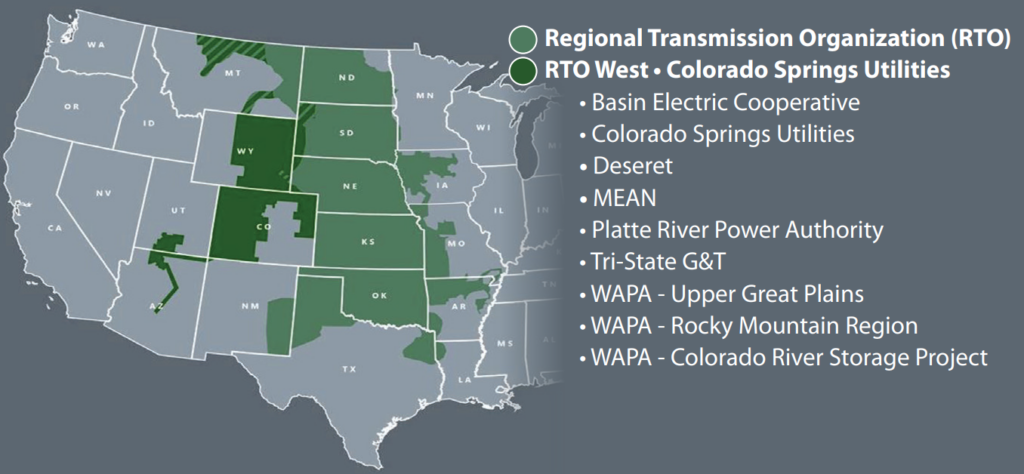
“We have nine entities that participate with SPP in the West in an energy imbalance-only market,” said Bruce Rew, SPP’s senior vice president of operations who is leading the RTO’s western expansion. “Several years ago, they began pursuing full membership in SPP.”
Membership would add the utilities to SPP’s day-ahead and real-time wholesale electricity markets. They would also get access to SPP’s transmission planning and operational functions.
“Last year, [the nine entities] made a commitment to begin moving forward with that,” Rew said. Preparations include modifying SPP’s tariff, or outline of rates and conditions, and updating systems on both sides. “We are currently on schedule to go live April 1, 2026.”
The Continental Divide, where the Rocky Mountains split the nation’s eastward and westward-running rivers, has traditionally also split the U.S. electric system. Running transmission lines across mountains is a costly proposition in a land of few people.
But SPP’s access to wind power in the Midwest and the growth of solar power in the Southwest have made interconnection more palatable. Both interconnections use alternating current in for-now incompatible systems, SPP can move power across the divide through direct-current transmission ties.
The expansion “will give us and our member utilities the opportunity to optimize the use of the DC ties to enhance reliability and create economic opportunities by transferring power east-to-west and west-to-east between the two regions as needed,” said Derek Wingfield, SPP manager, communications and external affairs.
Challenging Times
SPP’s expansion efforts come at a crucial time for the nation’s aging power grid. Electricity demand is at record levels and extreme weather regularly tests the system’s resiliency. Directing power from the cheapest generation sources and getting it to the utilities that need it is trickier than ever. And baseload power sources like coal generation plants are shutting down in favor of renewable resources, making the balancing act yet more difficult.
All of those challenges add up to a costly commitment in new infrastructure.
Lanny Nickell, SPP’s executive vice president and chief operating officer, told Arkansas Business that the company’s latest transmission planning study anticipates a portfolio of infrastructure projects that could exceed $3 billion. “We are in the process of completing that study in October, and those projects could exceed $3 billion with just one planning portfolio,” Nickell said.
That amount is about a quarter of the entire $12 billion in transmission infrastructure spending that SPP has invested since becoming an RTO in 2004. The new power lines, generating plants and substations are crucial as data centers, artificial intelligence facilities and EV charging infrastructure pushes the grid to its limit.
SPP has not publicly announced any of the transmission projects the planning study envisions, but details will be available later this year.
The need to move power from hundreds of generation sources to scores of utilities is more urgent than ever, Nickell said. “We’re seeing really unprecedented risk in terms of our ability to continuously supply power. Those risks have been driven by a transition in the fleet of generating resources that exist all over the country.”
Nickell cited the shift from “thermal generation,” primarily coal and gas-fueled resources, to solar and wind generation. “We sit in an area of really rich supply in wind, and that has really motivated the development of wind generation in our footprint.”
Wide Reach
SPP’s member utilities own and operate 967 generating plants, all at the RTO’s disposal as it serves region-wide demand for electricity. “We also coordinate the use of 72,820 miles of extra high-voltage transmission lines in moving electricity from where it’s generated to more than 5,000 substations from which local utilities deliver it” to homes and businesses, said Wingfield, the communications manager.
For reliability’s sake, power that can be dispatched at any time — even when the wind isn’t blowing and the sun isn’t shining — is absolutely essential. “At the same time, we’ve seen tremendous growth in demand from consumers during the summer.”
One answer for baseline power is adding more natural gas-fired generators, and Nickell expects that to come. But extreme cold weather events are also increasing. Gas generators can lose efficiency in extreme cold, and wind turbines can freeze up.
“We’ve seen extreme winter events in three of our last four winters, and the summer heat dome we experienced in August caused a five-and-a-half percent increase in our summer peak demand, which is actually about 10% higher than we saw two summers prior to last summer.”
Winter power consumption is also spiking as homes add electric heat pumps, Nickell said. “That, combined with data warehouses, artificial intelligence, all of the businesses that are growing and using more electricity, has put us in a position we’ve not seen before.”
The answer will be “more transmission, more power lines, more generating resources and more coordination,” Nickell said. “Certain parts of the country are not very accepting of carbon-emitting resources, so they’re going to rely on more solar, battery resources and wind. We expect to see more wind developed, some solar generation, and we’re expecting to see more gas generation developed.”
The current SPP RTO covers 552,885 square miles including basically all of Oklahoma, Kansas, Nebraska, South Dakota, North Dakota and the Texas panhandle. In 2023, wind power provided 36.6% of the 284 trillion kilowatt-hours of electricity that SPP dispatched. Coal power and natural gas generation were next at 27.2% and 26.8%.
But the wind is, of course, intermittent.
On Feb. 18, available wind power in the SPP region experienced its quickest drop ever, falling by 14 gigawatts, the capacity of about 28 average-size coal plants combined. “SPP has served as much as 90.2% of the total instantaneous demand for electricity across its entire region with renewable energy,” Wingfield said. “By comparison, though, we’ve also experienced times when we could serve only 1% of our total demand with the wind energy available to us, illustrating the need for a diverse generating fleet that can respond to changing conditions on the grid.”
The Way West
The RTO West will add major hunks of Wyoming and Colorado, and parts of Utah and Arizona.
In September, seven western utilities committed to joining SPP. One of them, the Tri-State Generation & Transmission Association, is led by Duane Highley, who was president and CEO of Arkansas Electric Cooperative Corp. and Arkansas Electric Cooperatives Inc. of Little Rock from 2011 to 2019.
The incoming RTO members expect better reliability and economic benefits. Those include access to a larger generation fleet, greater geographic density and trading opportunities in SPP’s power markets.
“Creating multiple market options for new members will enable market designs that align with the unique needs of one or more geographic regions and provide opportunity for all to benefit,” Rew said.
He added that consolidating multiple western energy balancing authorities into a single authority will improve efficiency and bring lower costs, benefits that SPP brought to eastern interconnection members. SPP’s integrated marketplace for wholesale electricity, reservations on its bulk transmission system and more, settled more than $34 billion in transactions last year, Wingfield said. “Since the market was launched in 2014, it has produced more than $10 billion in benefits” for participants by giving them access to “the cheapest available wholesale electricity in the region.”
Markets+ to Connect Grid Supply and Demand
Southwest Power Pool of Little Rock is developing a new wholesale power market in western states, but the participants helping to design it won’t necessarily join the regional transmission organization.
“The people who participate in Markets+ are not required to be members of SPP and its RTO,” said Antoine Lucas, SPP’s vice president, markets. But Markets+ does give SPP a chance to broaden its market footprint and generate more commerce between markets. Lucas said it could become a gateway for full RTO membership in the future.
At present, 34 entities are helping to design the market, and those utilities helped write the terms and conditions presented for approval by the Federal Energy Regulatory Commission.
“The first big task was for the group to work together to draft a tariff, essentially the rules that govern the way the market would operate,” Lucas said in a telephone interview. When the Markets+ group sent documents to the FERC in March, it asked for an answer by July 31. “Getting that approved by the federal government will essentially complete that milestone,” he said.
Then will come phase two, the actual development and implementation of Markets+, whose expanded customer base could seize on economies of scale. That would spread overhead costs across a wider base and reduce service costs.
Prospective participants will formally execute agreements to join the market and take on cost obligations to fund it. “We anticipate having those commitments by the end of this year,” Lucas said, predicting that the market will go live in the second quarter of 2027.
The market would cover parts of Washington state, Oregon, Montana, Idaho, California, Nevada, Arizona, Colorado and Wyoming, according to an SPP map.
Lucas said the market will offer financial incentives to enhance grid system reliability by valuing and pricing power generation supply to meet demand. “Traditionally, each utility serves its own customers” with self-generated power, Lucas said.
The new market will connect those utilities with other asset owners to create a much larger pool of resources. “With that larger pool, the market can ensure the optimal production of generation to serve a bigger pool of customers, and ensure that they get the power for the lowest possible price.”
SPP, which has been planning the market since 2021, will use advanced software systems to analyze transmission trends and coordinate generation sources to meet demand.
“A great deal of communication and coordination will take place,” Lucas said.
 Sign up for Daily E-news