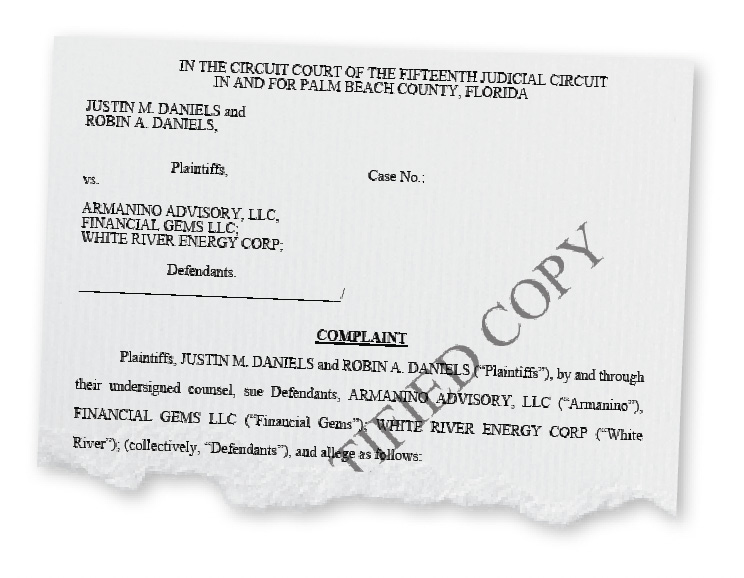
White River Energy Group of Fayetteville faces a nearly $2 million lawsuit in Florida that accuses the oil and gas company of fraud in the sale of “sovereign tribal tax credits” that the IRS doesn’t recognize.
And more lawsuits could be coming. Several law firms nationwide have posted alerts about what the Florida suit called a “sprawling scheme” that falsely claimed ties to Native American tribes and misrepresented facts to dupe investors.
“It’s quite a case,” said Florida lawyer Tina Garcia, who is representing plaintiffs Justin and Robin Daniels in Palm Beach County Circuit Court. The action, which Garcia’s firm Greenspoon Marder LLP called perhaps the first of its kind in the nation, hit the docket on May 29.
It accuses White River and two co-defendants — financial consultant Armanino Advisory LLC and Financial Gems LLC, the couple’s accounting firm — of advancing a scheme that lured investors to pay millions for tax credits that the IRS has said do not exist. The tax credits were purportedly related to tribal oil and gas projects and oilfield leases.
The Florida couple spent $1.62 million on credits represented to be worth $2.7 million, but the IRS rejected the credits in the Danielses’ 2023 tax return and assessed a $149,000 penalty. That led to the lawsuit, which seeks $1.77 million and other damages. An evidentiary hearing is set for Nov. 3 before Circuit Judge John J. Parnofiello.
White River’s attorney, Michael H. Nullman of Nason Yeager Gerson Harris & Fumero PA of Palm Beach Gardens, responded with an Aug. 15 motion to compel mediation or arbitration, or dismiss the lawsuit.
In a brief telephone interview in late August, Garcia told Arkansas Business that she couldn’t answer specific questions about the pending case. “But the docket is public record,” she said, urging a reporter to dig into the case filings.
White River and Nason Yeager Gerson Harris & Fumero did not reply to messages seeking comment.
The Repercussions

Several tribes have disavowed the credits, and the Cherokee Nation of Oklahoma issued a cease and desist letter demanding that White River stop using its name.
Tax professionals also seized on the credits as a cautionary tale. The American Institute of Certified Tax Planners placed an online post headlined “Tax Avoidance vs. Tax Evasion: Lessons From The Tribal Tax Credit Scheme.” The article included a long list of red flags and unanswered questions that investors should have noticed.
The Florida case also has political implications that run all the way to the White House. The tax credit dispute compounded the troubles of former Missouri Congressman Billy Long during his brief tenure as IRS commissioner. President Donald Trump dismissed Long on Aug. 8 after just seven weeks of atop the tax agency, then nominated him to be ambassador to Iceland.
Long faced fierce Democratic opposition in his IRS confirmation, with Sens. Ron Wyden, D-Oregon, and Catherine Cortez Masto, D-Nevada, accusing him of taking improper donations from White River and other promoters of the tribal credits.
In a responding news release, White River accused the senators of colluding with Bloomberg Tax reporter Erin Schilling, who broke the news about the disputed credits last year. The motive, the release said, was to damage Long’s reputation, along with the reputation of White River Chairman and CFO Jay Puchir.

Garcia attached Wyden’s and Cortez Masto’s April 14 letter to acting IRS Commissioner Melanie Cross as part of Exhibit A in the Danielses’ complaint.
The letter called for the IRS to investigate the tribal credits and noted that the agency “recently confirmed to Senate Finance Committee investigators” that the credits “do not exist” and that promoters “could face civil and criminal penalties.”
The letter went on to say that a review of regulatory filings and marketing documents found that “White River stated that it had made $24 million from the sale of tribal tax credits and that it had ‘received an additional $5,000,000,000 of United States federal income tax credits issued to a Native American tribe.’ White River also claimed on SEC filings that it obtained the rights to more than $64 billion worth of ‘tribal tax credits’ from Native American tribes.”
In another section, the letter says that Long’s financial disclosure report with the Office of Government Ethics listed “thousands of dollars in compensation” from White River “for his work as a referral agent for Capitol Edge Strategies LLC, a financial consulting firm specializing in tax credits.”
In its June 2 release, White River denied that contributors to Long’s unsuccessful campaign for U.S. Senate were involved in a tax credit scheme. “There was no scheme, and no promises were made,” the company said. “No White River representatives or executives have ever met with, communicated with, or corresponded with Billy Long.”
The company also said it had no contact or business relationship with Capitol Edge, and that any campaign contributions to Long from White River representatives or employees were “fully legal” and in compliance with campaign finance law limits and disclosure requirements.
The Fayetteville company also argued that the tax credits do exist, and that more than 100 taxpayers had used them successfully.
Recorded Call
White River also said the senators mischaracterized an investors call from Dec. 19, 2024, in which Puchir tried to reassure investors. The company called it a “general informational session targeted toward third parties interested” in the tax credits.
The senators obtained a recording of the call, however, and a transcript quotes one worried investment executive saying this: “We’ve probably sold, I don’t know how many, $30 million in credits, and every single one of them is getting rejected.”
Another caller asked if White River could point to any official of the U.S. Treasury who could verify the credits. “There’s no one there?” the caller asked. Puchir replied, according to the transcript: “We have had outreach from the Treasury in the past, but I don’t have a specific contact right now that will take my call based on the current [Biden] administration and the changes in the administration. I will on Feb. 1.”
The Danielses’ lawsuit accuses White River of unjust enrichment, rescission and fraudulent misrepresentation. It accuses Armanino of professional negligence/malpractice, and Armanino and Financial Gems of breach of fiduciary duty.
The complaint accuses White River of misleading the Danielses about the legitimacy of the tax credits and providing a purchase receipt and tribal credit acknowledgement letter that proved useless with the IRS. Those documents are among the exhibits attached to the complaint.
The acknowledgement letter was signed by Puchir and Henry Wilson, CEO of White River’s partner in selling the credits to the Danielses, Logistical Concepts LLC of Houston.
It says that in November 2024, “White River Native CDFI purchased a portfolio of oil and gas mineral leases and working interests in various production oil wells and drilling projects for $51,900,000.”
The letter acknowledged that the Danielses “received $2,700,000 in the amount of refundable sovereignty tribal trust fund tax credits related to the aforementioned project for our communities. Please provide this acknowledgment letter to your tax preparer and the IRS for you to submit these credits … .”
The Danielses did just that. But then, “to their surprise and disappointment, the IRS rejected the Tax Credits and instead imposed a penalty of $149,009.86,” the complaint says.
The lawsuit seeks actual damages of about $1.77 million plus other damages, court costs “and such other relief as this Court deems proper.”
Tax Credit Controversy: How It Evolved
The following is a timeline of the White River Energy Group’s tribal tax credit controversy.
► July 2023: White River Energy Group of Fayetteville says it and its advisers reached out with self-disclosure to federal agencies about its offering of tax credits issued under the Indian Self-Determination & Education Assistance Act of 1975. The oil and gas company says it wanted questions answered about the credits and a legal opinion from the U.S. Treasury Department, but never got a response.
► October 2023: White River Energy’s CEO at the time, Randy May, announces the launch of White River Private Capital Management as “an avenue for growth for our company [and] a commitment to generating value in a non-dilutive manner for our common stockholders while providing the opportunity for tax optimization and investment returns for our private investor partners.”
► November 2023: White River Energy reaches a joint venture agreement with a partner that sold the company $500 million worth of federal income tax credits, according to a filing with the Securities & Exchange Commission. The credits, the document says, had been “issued to a Native American tribe …”
► March 2024: The company announces it has received registration numbers from the Treasury for additional tranches of tribal credits, bringing the total to $64 billion.
► October 2024: A Florida couple, Justin and Robin Daniels, pay White River $1.62 million for what they were told were tribal tax credits worth $2.7 million, according to a lawsuit they filed later. The couple’s financial consultancy, Armanino Advisory, advises them to proceed with the investment.
► December 2024: A Bloomberg Tax article reports that the tax credits are fraudulent, adding that the Treasury Department has declared that the credits “don’t exist.” White River Chairman CFO Jay Puchir holds a call the same day, reassuring investors that the credits are valid. One caller says his firm has sold $30 million worth of the credits, and that the IRS has rejected them all.

► January 2025: Bloomberg reports that Billy Long, Donald Trump’s nominee to be IRS commissioner, had ties to White River and received compensation for referring people to the tax credits.
► April 2025: White River Energy releases a statement denying the senators’ allegations, claiming the credits are legitimate and that the IRS has accepted some of them. It also accuses the senators of colluding with Bloomberg reporter Erin Schilling to sully the reputation of White River, Long and Puchir.
► April 2025: U.S. Sens. Ron Wyden and Catherine Cortez Masto write a letter to the acting IRS commissioner requesting an investigation into White River’s tribal tax credits, quoting an IRS senior investigator. “We can confirm that these tax credits do not exist. Taxpayers who claim credits that don’t exist may be subject to civil or criminal penalties,” the investigator says.
► May 2025: Wyden and Cortez Masto send a letter to White River, saying they have a recording of Puchir’s investor call from the previous December. The letter says the recording exposes a “corrupt lobbying scheme” to win approval for the tax credits from the Trump administration.
► June 2025: White River denies the allegations, dismissing them as political and part of a coordinated smear campaign.
► June 15, 2025: The Florida couple, who had their 2023 tax credit claim denied by the IRS, sues White River and other parties involved. The lawsuit seeks to recover at least $1.77 million.
The lawsuit is pending, and a hearing is scheduled in Palm Beach County Circuit Court for Nov. 3.
 Sign up for Daily E-news