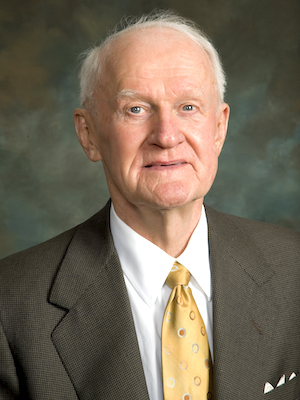
William H. Bowen in 2009.
William H. Bowen — lawyer, banker and political adviser — died Wednesday at age 91.
Visitation will be from 4-6 p.m. on Sunday at Ruebel Funeral Home in Little Rock. The Memorial Service will be at 10 a.m. Monday at First United Methodist Church in Little Rock. The service will also be streamed live here.
Born in the Jefferson County town of Altheimer on May 6, 1923, Bowen was the son of Robert James Bowen and Ruth Falls Bowen. He graduated from high school in 1941 and attended Henderson State University at Arkadelphia when the attack on Pearl Harbor dragged the United States into World War II.
In December 1942, two months after his older brother was swept out to sea off the Aleutian Islands, Bowen enlisted the Navy. He was called to active duty in August 1943 and trained as a fighter pilot. He was the sole survivor of a crash that killed four members of his training squadron, but never flew a mission.
“I was carrier qualified, assigned to a replacement squadron and just ready to go out as a replacement pilot,” he said in a 1999 interview with Arkansas Business. “And they dropped two bombs: one at Hiroshima, one at Nagasaki, and the war ended four days later.”
Bowen returned to the states, attended law school and commenced the practice of law at Mahaffey Smith & Williams. The firm was renamed Mahaffey Smith Friday & Bowen in 1962 and is today known as Friday Eldredge & Clark.
His specialties were tax and corporate law, and he began to do work for banks. He represented existing banks and organized a bank. He was on retainer for the Arkansas Bankers Association from 1964 until 1971, when he caved in to the entreaties of Richard C. Butler, a lawyer who was president of Commercial National Bank.
“Dick Butler recruited me weekly for four months. And I said, ‘No, thank you’ every week for four months,” Bowen said in the 1999 interview.
Finally, Butler wore him down.
“My wife thought I was insane and my partners thought I was insane, and I took a 55 percent salary cut — I’d had a marvelous practice, you see.”
Bowen became president of Commercial National in an era of relatively small banks.
“This little bank was a $100 million bank on the corner of Second and Main that was very personal in its relationship with customers and borrowers,” he said.
Bowen began growing the bank. He created a holding company, Commercial Bankstock Corp., and began acquiring smaller banks throughout the state. By 1980, Commercial Bankstock had assets exceeding $350 million.
In 1983, Bowen’s year-long effort to merge Commercial National with First National came to fruition. It was truly a merger of equals: Commercial’s assets were $409 million, First National’s were $405 million. The holding company that resulted was named First Commercial Corp. to reflect the legacy of both predecessors, and the sheer size of the resulting institution rocked the banking industry in Little Rock.
Bowen remained as chairman of First Commercial and continued an active program of acquisition, even crossing state lines to do it. He retired at the end of 1990, but was still on the board of First Commercial when it was sold to Regions Financial Corp. of Birmingham, Alabama, for more than four times book value in 1998.
In the meantime, he filled the role of chief of staff for Gov. Bill Clinton in 1991 and 1992, as Clinton made his successful run for president of the United States.
In the foreword to Bowen’s 2006 autobiography, “The Boy From Altheimer,” Clinton said that Bowen had “always been there when I needed him. Starting with my very first campaign, Bill provided invaluable contributions of advice, financial support, and friendship.”
Clinton issued a statement Thursday evening on Bowen:
“I was saddened to hear of the death of my good friend Bill Bowen, whose fascinating life was a serial Arkansas success story. From his humble beginnings in Altheimer to his service as a Naval fighter pilot in World War II, to his distinguished career in law and banking, to his public service as a tireless advocate for education and economic development, and as chief of staff in the governor’s office when I ran for president, something I couldn’t have done without him,” Clinton said. “Arkansas is a better place because of Bill Bowen’s fine mind, larger-than-life spirit, and true service. My thoughts and prayers are with Connie, his children, and his entire family.”
Bowen also served as dean of the University of Arkansas at Little Rock’s law school from 1995-97, and donated more than $3 million to the school that was renamed the William H. Bowen School of Law in 2000.
 Sign up for Daily E-news