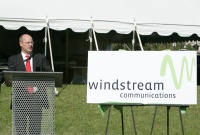
Moving boxes are stacked outside Jeffery Gardner’s Alltel Corp. office in Riverdale. He’s eager to move on to his next job leading Arkansas’ newest public company, though the deal that put him in that role still is not complete.
Analysts believe that Alltel’s $9.1 billion wireline spinoff and merger with Valor Communications, announced last December, probably will not go through until sometime in July. But on Tuesday, Gardner and some 700 other employees plan to move into the west Little Rock offices of Windstream Communications, the new public company to be created by Alltel’s spinoff.
Gardner, who is transitioning from Alltel’s executive vice president and chief financial officer to Windstream’s president and CEO, is not the patient type.
He and his peers describe him as an aggressive, forward-thinker who does not like to play Monday morning quarterback.
So there’s no dwelling on the fact that the wireline segment he inherits has lost customers each of the past three years.
“Some people may think of the landline business as a mature or slowing business; we have a completely different point of view,” Gardner said.
“This business has to morph from a voice-based business to one that is more focused on broadband and entertainment. That’s really where our future lies.”
Gardner foresees more than just organic growth for what will be the country’s largest Rural Local Exchange Carrier. In fact, some industry insiders believe Gardner was chosen to lead Windstream because of his ample experience with mergers and acquisitions at Alltel. He has more than hinted that his new company will make some purchases of its own.
Some analysts, however, believe regulatory issues and the capital structures of prospective acquisition targets might make it more prudent to wait a couple of years before starting to deal
They should be reminded that Gardner is not always a patient man, or at least not the kind that likes to sit still.
Run, Don’t Walk
When Gardner, 46, is not helping run one of the country’s largest telecom companies, he likes to run marathons. Injuries have kept him from running one since the 2004 Boston Marathon, but he plans to be in Chicago’s marathon this October and has his eye on running Little Rock’s at some point. (Gardner already has participated on a Little Rock Marathon relay team.)
“Running is just like business in that the harder you work, the better you do,” he said.
It’s also a test of endurance. And while Gardner’s career has found fast-moving industries, his high-energy personality has kept him near the head of the pack.
At Alltel, his never-give-up attitude and watchful eye on the company books earned Gardner the nickname “Gard Dog.” “He’s as tenacious as all get out,” said Kevin Beebe, Alltel’s group president of operations. “Jeff’s the kind of leader that makes a decision then works hard to make it the right one.”
There has been no shortage of tough decisions in Gardner’s corporate life, as several of his employers have found themselves at critical crossroads.
Even at his first job, a yearlong stint with at the Deerfield, Ill., corporate offices of Walgreen Co., he was with a business at the onset of its boom.
From one promising operation to another, in 1985 Gardner was one of the first 20 employees of the recently formed Centel Corp. of Chicago, a precursor to the current Alltel wireless business.
Originally, Gardner ran the finance and accounting group there, but because it was a small company he also got some operations experience. He advanced to vice president and general manager of the company’s Las Vegas wireless market, which was the company’s largest, and later became president of the company’s mid-Atlantic region.
Gardner stayed with Centel when it was acquired by Sprint Corp. in 1993. Then in 1996 Sprint spun off its cellular business and formed 360 Com-munications.
Gardner went with 360, and in 1997 he moved back to the financial side of the business. A year later Alltel paid $4.3 billion for 360 Communi-cations, and shortly thereafter Gardner became the corporation’s CFO.
Last year, when Alltel decided it would split its two businesses, wireless and wireline, Gardner was chosen to run the latter.
On the surface it seems that Gardner, for once, will be left behind from the advancing business to run the one with its foot on the brakes. While Alltel’s wireless business continues to grow its revenue, the wireline side has gone the opposite direction in recent years. Since 2003 annual wireline revenue has fallen from $2.44 billion to $2.42 billion to $2.38 billion last year.
But that’s only half the story, Gardner insists.
Windstream’s Direction
When Alltel’s wireline spinoff and merger is complete — the deal still needs approval in five states — Windstream will have 3.4 million access lines in 16 states with $3.4 billion in annual revenue.
The merger between Alltel’s former wireline business and Valor will net $40 million annual savings from synergies, or a net present value worth more than $300 million.
Industry analysts do not doubt Windstream will make plenty of cash and attract investors with high dividends. Though the stock is expected to initially trade at about $12 to $14, Gardner said it will pay about a $1 annual dividend.
The real question surrounding Windstream is “Can it grow?” Gard-ner certainly thinks so.
While Alltel’s wireline business has lost many landline phone customers in recent years, it has gone the other way with high-speed Internet connections. Just fewer than 18 percent of its customers have broadband.
“We think that number can grow to 50 percent over the next several years,” Gardner said.
Alltel achieved a similar feat when it signed up 60 percent of its customers to long-distance service within just five years of its introduction.
Satellite TV also is going to be an area where Windstream focuses its growth.
Analysts say Windstream has several advantages offering both services in rural markets.
Donna Jaegers, an analyst with Janco Partners Inc. of Denver, highlighted three key benefits.
• A lot of people in rural areas do not already have DSL or high-speed Internet access available;
• Wireless signals are often not dependable in rural areas, making the substitution of landlines with wireless less prevalent; and
• One of Windstream’s biggest cable competitors will be Charter Communi-cations Inc. of St. Louis, which Jaegers said is one of the weaker cable players and has been slow to roll out a lot of the newer technologies to rural markets.
Gardner also likes his company’s place in rural markets, where he said Windstream can offer a product that “sort of insulates us from competition.”
Possible Windstream mergers and acquisitions would also focus on rural markets, ones that are cash accretive, Gardner said.
But there are a handful of reasons why Windstream might not immediately dive into the M&A game. Jaegers explained that even an aggressive Gardner might have reasons to be patient with purchases.
“I think he’ll definitely be looking at opportunities, but right now a lot of the smaller rural companies, what they’ve done to prop up their stock prices is to pay out very high dividends,” Jaegers said. “So the valuations are pretty high right now. I would think if Jeff waits a few years he might get some better opportunities.”
There is also the issue of the Universal Service Fund, which, among other things, subsidizes advanced telecom services in rural areas.
Windstream, for example, is expected to pull in about $200 million this year in Universal Service Fund money.
Sometime in the next year or two, Congress is expected to rework the Universal Service Fund, and that could reduce the amount of money rural wireline companies receive from it.
But Gardner said possible changes in the fund are not going to hinder possible Windstream moves. “I wouldn’t ever say we’d put our strategic aspirations on hold directly related to a regulatory issue,” he said.
And so two months before the Windstream spinoff and merger is expected to be complete, Gardner’s boxes are already packed and ready to go.
• For a look at Windstream’s new management team, click here.
 Sign up for Daily E-news