THIS IS AN OPINION
We'd also like to hear yours.
Tweet us @ArkBusiness or email us
John Venn. Remember him? Can’t say I do, but I recognize what he created.
John Venn was an English mathematician who, in 1866, published a book on what he described as the frequency of probability, providing an alternative to informed assumptions. Venn also discussed logic in another late-1880’s work proposing what would come to be known as the Venn diagram. You’ve seen them. They are multiple circles of different sets that intersect, and where they do, they reveal commonality or logical probability.
I guess you could say a Venn diagram discovers relationships among two or more ideas. And where those ideas can come together or work together to produce a more powerful thought. Pretty heady stuff for simple circles.
Now, I have read and been told that difficult times and tough situations don’t necessarily build character, they reveal it. That may be true of the current health crisis. When it comes to consumers, and consumer brands, many are now hard pressed to find what they need — or what some are wont to hoard — to try and achieve what one 1920 candidate for president called “a return to normalcy.” It will be a while.
In a March 16 Adweek article titled “3 Elements of Your Brand That Can Shine Through in These Harrowing Times,” authors Elina Tang and Lei Wang posit how a brand’s choices may reveal its true character, thus attracting a consumer’s choice or disdain. As we have previously droned on in this space, brands — particularly big brands — can have a distinct advantage when discriminating decisions are forced on consumers, if the brands strategically work to achieve those advantages. It’s called “brand behavior.”
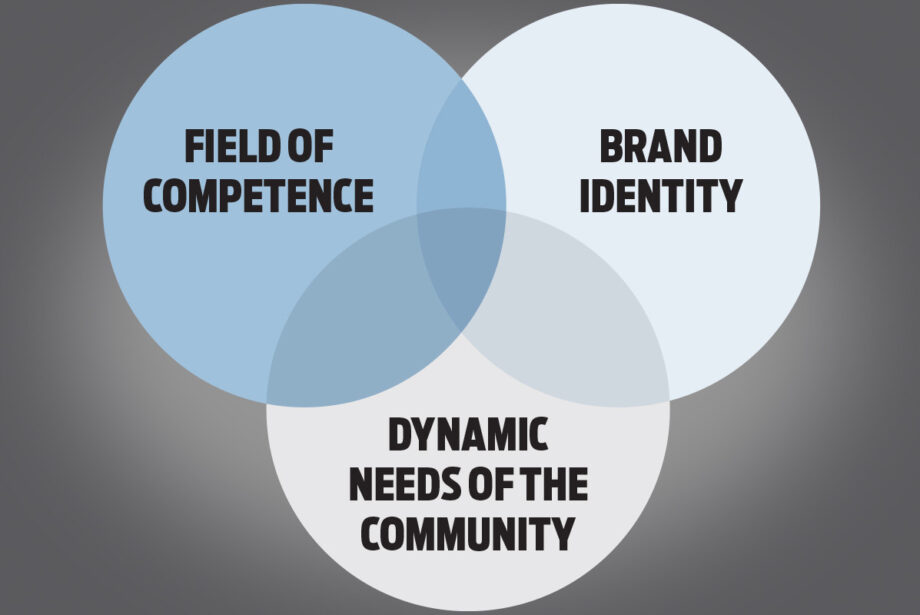
Brands have a responsibility to consumers. The accompanying Venn diagram illustrates the point.
The dynamic needs of the community are where brands — pervasive, well-known, preferred — come into play. Think about Ford partnering with another company to make medical ventilators. Ford didn’t partner with XYZ Inc.; it partnered with GE, General Electric, one of the best-known brands in the country.
In order for brands to perform in times like these, and to come out on the other side stronger and more resilient, three brand behaviors are suggested.
First is authenticity. We have noted before, the true self of a brand reflects who the brand is, what it stands for and how it goes about its creation, promise, promotion and treatment of the people who support it. Authentic brands are genuine, from the boardroom to the retail shelf to the customer experience.
The second behavior is agility. Possessing a bias for action, particularly when needed most. The authors cite Southwest Airlines. Although travel has been greatly curtailed, Southwest was the first to communicate the steps they are immediately taking to ensure their planes are clean because they are cleaned and disinfected before and after every flight.
Ingenuity is the third behavioral trait for successful and relevant brands. Coming up with new ways to respond to perceived consumer needs help a brand stand out. Take Google. Understanding truthful and credible information about the virus is critical for individuals to understand personal responsibility, Google established itself as a “curator of the latest and most accurate information” regarding the virus.
Smart brands adapt, just as we as consumers have to adapt — if we’re smart.
Our own Venn diagram during this critical period in our national and personal lives could bring together three circles titled, “Truth,” “Knowledge” and “Action.” The intersecting circles would reveal “Responsibility.” It could very well be a diagram for our survival.

Craig Douglass serves as executive director of the Regional Recycling & Waste Reduction District in Pulaski County.
 Sign up for Daily E-news