As retail sales plummeted in March because of the coronavirus, some sporting goods stores saw a surge in sales from customers stocking up on handguns and ammunition while others struggled to sell balls and bats.
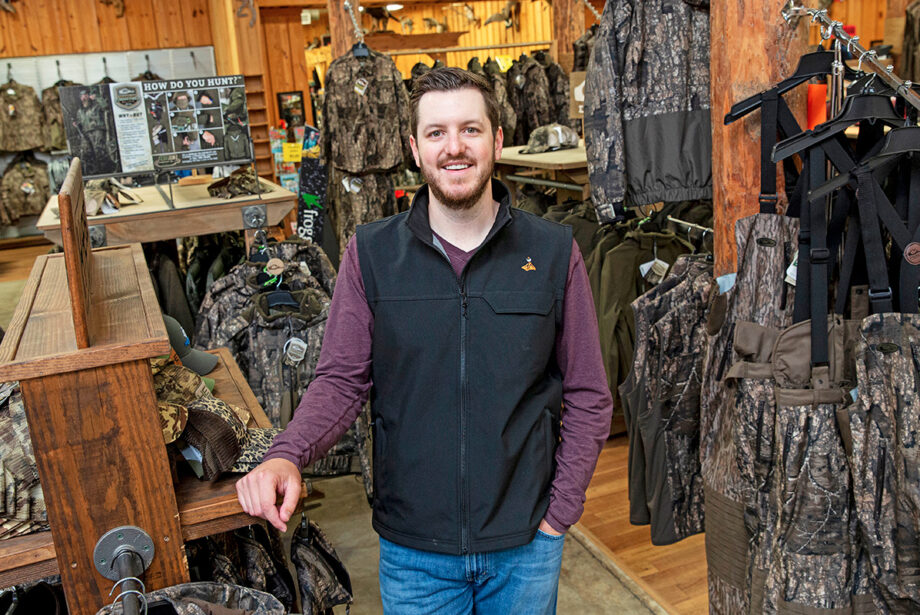
When stores and schools started closing in the middle of March, “we had a busy week,” said Taylor Denniston, who operates Fort Thompson Sporting Goods Inc. of Sherwood.
He said the 30,000-SF store, which sells outdoor apparel and firearms, had several new customers who were buying self-defense items.
“There hasn’t been a person look at any of our clothes … since this all started, but we have sold a little more ammo and handguns than normal right now,” he said.
Also boosting Fort Thompson’s sales are hunters buying items for turkey season, which started April 13 and runs through April 28.
“I’m not sure if it’s people who aren’t working or maybe they have some extra time off, … but we are selling [items] for people to go outside and go hunting,” Denniston said.
Since that mid-March spike, Fort Thompson’s sales have slowed, but are on pace with last year, Denniston said. He said the store hasn’t furloughed any employees, but it has trimmed its hours from 9 a.m. to 6 p.m. Monday through Saturday to 10 a.m. to 5 p.m.
Other sporting goods stores have seen a drop in sales because of the coronavirus.
U.S. retail sales dropped 8.7% in March, as the spread of COVID-19 shut down retailers, the Commerce Department said Wednesday.
The COVID-19 pandemic shut down all sports leagues, from youth to professional. As a result, consumers aren’t buying team-related items, said Marty Maciaszek, director of communications for the National Sporting Goods Association of Mount Prospect, Illinois. The association’s members operate more than 21,000 sporting goods stores in the United States.
While consumers are buying home fitness products because gyms are closed, orders for team sports, such as uniforms and equipment, have come to a halt “because there just isn’t a demand or need for it,” he said.
Still, he said none of the association’s members had closed their stores.
Dick’s Sporting Goods, a big-box retailer, doesn’t allow customers in its more than 800 locations, but welcomes curbside pickup or online sales. Academy Sports & Outdoors has kept most of its stores open, but has furloughed a number of its employees, the company said.
The sales outlook for sporting goods retailers this year is hard to predict because of the uncertainty surrounding the coronavirus, Maciaszek said. “It’s just something that’s so unprecedented,” he said.
Even during the Great Recession, people participated in sports.
But with the virus, too many unknowns remain, such as when shelter-in-place orders will be lifted, he said.
“When the fall comes are kids going to be back in session in schools or are they still going to be learning online?” Maciaszek said. “And if you’re learning online, then you’re not going to be able to practice as a team.”
Sportstop Inc. of Little Rock, which touts itself as the leading athletic supplier in Arkansas, said at the start of the year that it was expecting a 5%-10% increase in sales. But that’s changed.
“Our business is very seasonal so our spring sports have obviously been impacted,” James Rogers, vice president of the company, said via email. “We are hopeful the youth leagues will still have a shortened season in the summer and the shutdown doesn’t linger too long.”
‘Pivot, not Panic’
Maciaszek said several of the association’s members have applied for the Paycheck Protection Program, which encourages businesses with fewer than 500 employees to retain workers and maintain wages through forgivable loans.
Sportstop said it received its PPP money through Simmons Bank of Pine Bluff. “So from a financial standpoint we should be well-positioned as soon as things open up,” Rogers said.
He said its salesmen have been able to handle most of their business through video meetings or other remote methods.
Its customers — the coaches, parents and players who participate in sports — “understand the measures they must take now, but they will certainly be ready to get back to their sports when this is over,” Rogers said. “Part of our strategy has been to remind ourselves that in a time like this we need to pivot, not panic.”
 Sign up for Daily E-news