St. Vincent Medical Group faced a half-billion dollars in damages early last year, accused of violating a state law requiring health companies to inform patients where their doctors go after leaving a practice.
Then the state Legislature stepped in.
The Arkansas General Assembly, in its 2023 regular session, amended the Patient Right-to-Know Act, originally passed in 2017, to cap damages at $500,000. And it made the amendment apply retroactively to all pending cases.
At the time, St. Vincent Medical Group faced two lawsuits involving Dr. Leslie Anderson of Lonoke, who was terminated without cause from the practice in 2019 and claimed he wasn’t able to notify his patients about the change.
St. Vincent Medical Group ignored Anderson’s request to notify his patients of his new practice location for eight months, violating the right-to-know law, Anderson’s suit says.
Anderson claimed his former employer also failed to hand over a list of patients so he could reach out to them on his own.
The patients also filed a class-action complaint against the medical group, and Pulaski County Circuit Judge Chip Welch certified the class — which included 2,143 patients — in 2022. At $1,000 a day for about 250 days for each patient, the total damages could have been more than $500 million.
St. Vincent Medical Group appealed the class certification to the Arkansas Supreme Court, which overturned it. The lead plaintiff, Ford Baldwin of Lonoke County, then asked that the case be dismissed in December 2023, and it was.
“After we passed the law, these cases popped up,” said David Wroten, executive vice president of the Arkansas Medical Society, which lobbied for the original law. “It was never, ever our intent when we passed that law to create a situation where an employer, be it a hospital or a clinic, would be facing something like half a billion dollars in penalties.”

A Pulaski County jury eventually awarded Anderson $246,000 in August, finding that St. Vincent Medical Group violated the Patient Right-to-Know Act.
The jury’s verdict “is an important milestone” for the law, attorney Kendel Grooms of Campbell & Grooms of Little Rock said in an email to Arkansas Business.
Grooms was one of the attorneys who represented Anderson and his patients. “It was important for the jury to tell hospitals, clinics, and other medical entities that continuity of care and the relationship between doctors and their patients are of paramount importance in providing medical care.”
He said the legislation should be complied with to ensure that patients have continuous access to their doctors regardless of whether a doctor leaves to work for another hospital or clinic.
He also said it was “unfortunate” that the Arkansas Legislature capped the amount of damages available to doctors and patients.
“This could certainly impact future claims by doctors and patients for violations of the Act, and it is undetermined how the changes will affect such claims,” Grooms wrote. “It is likely the changes will undermine the importance and effect of the Act as it relates to the health and safety of Arkansans.”
The case is on appeal to the Arkansas Court of Appeals.
One of St. Vincent Medical Group’s attorneys, Zachary Hill of Munson Rowlett Moore & Boone of Little Rock, declined to comment on the case because it is in litigation.
Robert Steinbuch, a professor at the University of Arkansas at Little Rock William H. Bowen School of Law, said a law can be retroactively changed.
“There are certain circumstances in which that might give rise to certain claims by the person affected,” he said. “Essentially, if they can claim that they had already garnered a right that was now removed from them, they may have some claim.”
But he said changing a law retroactively doesn’t happen that often because it’s not often that an issue warrants it.
‘It’s Big Business’
The Arkansas Medical Society had heard anecdotal stories of patients being unable to locate their doctor after the doctor left the practice for a new one. The doctor’s former employer might mislead patients by telling them the doctor had moved away or lost their license in an effort to keep the patients with the clinic.
“That was why we passed the law in the first place,” Wroten told Arkansas Business.
The Medical Society wanted to make sure there was continuity of care for patients when their doctors changed practices, and the right-to-know legislation was introduced and passed in 2017.
The act allows for damages of $1,000 per day per violation.
Attorney Don Chaney of Arkadelphia told Arkansas Business that patients have a right to choose their health care provider.
“This is of the utmost public policy concerns here,” said Chaney. “In this day and time, there are a lot of corporate medical clinics and hospitals. It’s big business, and their attitude is that they own the patients.”
Chaney represents medical providers who sued their former employer, Arkansas Pain Centers of North Little Rock, over allegations that included violating the patient-right-to-know law. While the providers didn’t win on the right-to-know allegation, they won on another allegation involving interference with business expectancy. The ruling stemming from a May bench trial in front of Pulaski County Circuit Court Judge Patricia James is being appealed by the providers and APC.
The attorney for APC, Richard Worsham of Little Rock, declined to comment because the case is on appeal.
New Practice
The passage of the right-to-know legislation came at the right time for Anderson, a family medicine doctor who has been in practice for 52 years.
While working for St. Vincent entities, Anderson served more than 13,000 patients in the Lonoke County area, according to his lawsuit.
Anderson’s court filings said that in September 2019, St. Vincent terminated Anderson without cause.
After leaving St. Vincent, Anderson began practicing at ARcare in Lonoke. Grooms, Anderson’s attorney, sent a Feb. 3, 2020, letter to St. Vincent Medical Group, asking it to provide a list of Anderson’s patients’ names and address or send a notice to all his existing patients with his new practice information.
But it wasn’t until Oct. 30, 2020, that St. Vincent complied with the right-to-know legislation, according to Anderson’s complaint. Anderson’s damages were calculated at $1,000 a day for 246 days.

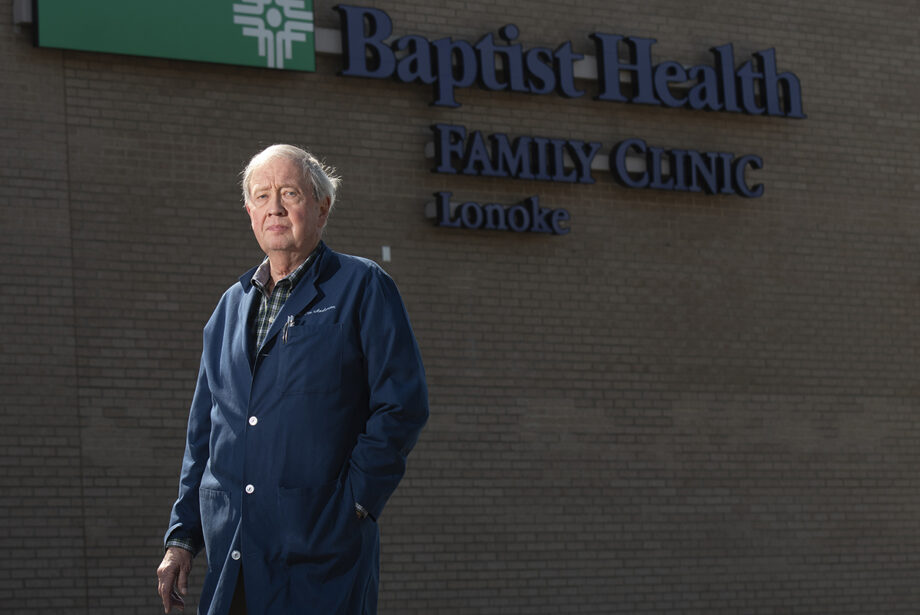
Anderson now is affiliated with Baptist Health and practices out of its family clinic in Lonoke.
Anderson, who just turned 80, told Arkansas Business that he still enjoys practicing medicine. “Fortunately, my health has been good. I still have most of my faculties,” Anderson said.
He said that people ask him why he’s still practicing. “Well, I don’t know what else to do.”
Capping the Fines
Arkansas Rep. Lee Johnson, R-Greenwood, was the lead sponsor of the amendment to the legislation. Johnson is an emergency medicine physician in Fort Smith.
He recently told Arkansas Business that he didn’t know why the cap on damages was placed at $500,000.
“The goal of the cap was to limit the fines on the entities that might be breaking the statute,” he said. “Because I don’t think anyone intended with that law to create a situation where you could have virtually unlimited fines.”
The Arkansas Hospital Association agreed that the patient right-to-know law passed in 2017 had problems.
In a July 2023 friend of the court brief in the class-action appeal to the state Supreme Court, the AHA said that the statute provides “inconsistent and harsh penalties” no matter whether the patient ever requested the provider’s new information.
The AHA said in the filing that if the class action was allowed to proceed based on the incorrect interpretation of the Right-to-Know Act, health care “entities across the state will be automatically exposed to an entirely new risk of significant liability.”
Wroten, of the Arkansas Medical Society, said that enactment of the cap and making the amendment retroactive were done because “we were hearing stories about class-action lawsuits and things that we just never envisioned when we originally crafted that bill. And so we felt like it was only right to go back and amend it to make it more reasonable.”
He said that $500,000 is still a large penalty. “You can avoid any penalties just by simply complying with the law,” Wroten said.
No one in the state House or Senate voted against the amendment.
Wroten said “by and large” the law is being complied with now. “But … if everybody was complying with doing what was right, then we wouldn’t have needed to pass the law in the first place,” he said.
 Sign up for Daily E-news