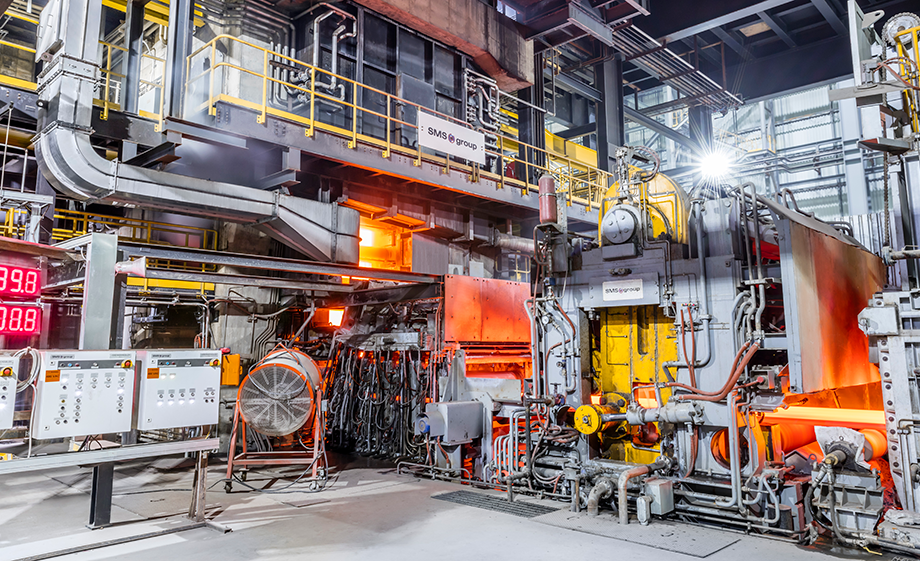
Steel executives across Arkansas remain optimistic despite the recent volatility surrounding steel tariffs, even while they’re closely monitoring policy changes for guidance on future investments.
Dave Stickler, CEO of Hybar LLC of Osceola, told Arkansas Business that steel companies will benefit from a “fair trading environment” under the tariffs.
“All we’re really looking for is a fair playing field,” Stickler said. “In other words, one country doesn’t have an advantage over the U.S. because of federal government subsidies or large support for their steel industry.”

Stickler said Hybar, which is currently building a billion-dollar rebar steel project in northeast Arkansas, won’t be too affected by the tariffs because of a Federal Highway Administration “Buy America” policy. It requires a domestic manufacturing process for all steel or iron products that are permanently incorporated in a Federal-aid highway construction project.
The policy makes it so that “anytime a federal highway dollar is involved in a project, the rebar has to be produced in the United States,” Stickler said. As a rebar mill, Hybar will largely produce product for those highway projects.
Flat-rolled steel, used for things like automobiles, appliances and pipes, will see the most import pressures.
Stickler believes temporary market disruptions from the tariffs will eventually stabilize. And he doesn’t anticipate the U.S. becoming “steel short,” either.
“My own belief is that ultimately the U.S. and Canada will get back to a place where steel can flow and move between [them],” Stickler said. “Oftentimes, when there’s new events that occur in a marketplace, there might be an overzealous move or concern that people have, and over time, things tend to settle back out in the in the middle.”
Grady Harvell, president and chief operating officer of W&W/AFCO Steel in Little Rock, agrees that the tariffs will benefit the industry.
“For a long time, mill steel has been shipped from China to Mexico, fabricated into the final product in Mexico and shipped to the U.S., avoiding tariffs completely,” Harvell said over an email. “This was harmful to both steel mills and fabricators in the U.S. The tariffs being imposed this time will close that loophole.”
For Patrick Schueck, CEO of Lexicon Inc. of Little Rock, the tariffs present both challenges and opportunities.
“Is there the potential that prices could rise? Yes, there’s the potential, especially on the short term, but American markets are going to recover,” Schueck said. “There are products that are made in China right now that are not made in the United States. And those are things that we’re going to have to figure out. That’s when you’re going to see more and more reshoring.”
Since President Donald Trump announced the 25% tariffs on foreign steel and aluminum on Feb. 10, steel prices have indeed jumped, according to a report released Wednesday by SteelBenchmarker, a widely used pricing system for buyers and sellers of steel. The domestic price for a net ton of hot-rolled steel was up by 25.5% to $893. A net ton of cold-rolled steel was up by 19.1% to $1,040.
Big River Steel of Osceola, a major producer of flat-rolled steel, did not respond to requests for comment. Big River’s parent company, U.S. Steel, also declined to comment, though it has expressed support for Trump’s tariffs. The company is still pursuing a $14.1 billion sale to Japanese steel maker Nippon Steel.
Nucor Steel in Blytheville declined to comment.
Fabrication loophole
Steel fabricators like AFCO and Lexicon, which transform raw steel into finished products, don’t expect as big of an impact from the tariffs as steel manufacturers.
“When we look at tariffs, we look at two different sides of the coin,” Schueck said. “From the fabrication perspective, there’s not a lot there. We buy most of our steel American-made, so we see the impact to us as being far less.”
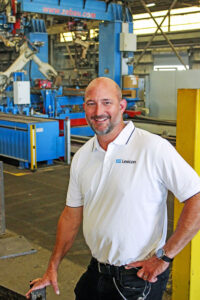
However, Schueck said there’s a major loophole in the administration’s current policy when it comes to fabrication imports. Current language leaves fabrication out of the tariffs. What this means, Schueck said, is that foreign fabricators can use American steel to fabricate their products and ship them back into the U.S. without any tariffs.
“We’re constantly under pressure from Mexico, and especially Canada, as they come into the U.S. and try to sell fabricated structural steel at a depressed rate because of currency manipulation and government subsidies,” Schueck said. “So right now, what we’re seeing is a lot of product made the U.S., made in Arkansas, being shipped to Mexico and Canada for them to be able to use in their facilities and sell back to the U.S. [at a lower cost].”
Schueck said this loophole leaves more jobs in other countries that could be in the U.S.
“It’s going to cause us to lose projects here in the United States that companies out of Canada and Mexico are are bidding on,” Schueck said. “If the U.S. government really wanted to make change, if they really wanted to help all iron workers, they would make those tariffs applicable to all steel coming onto our shore, whether being produced domestically or not.”
The U.S. steel industry employed about 83,600 workers in 2023, far below the highs recorded in the 1980s. By comparison, Walmart Inc. of Bentonville currently employs 1.6 million people in the U.S.
On the construction side of Lexicon’s business, Schueck said he’s watching to see how steel producers respond to the changing policies.
“We are anxiously awaiting to see what the repercussions will be,” Schueck said. “Number one, the backlash of it. And then number two, what spending these steel mills are going to do to be able to increase production, increase efficiency and increase their capacity to be able to produce clean steel.”
But overall, Schueck also believes the tariffs will have a positive effect on Arkansas’ steel industry, stating that “long term,” the tariffs will allow for the reshoring of more plants.
Dealing with uncertainty
Nations around the world have responded to the tariffs with retaliatory levies. And with Trump repeatedly altering his stance on the tariffs, volatility in federal policy remains a point of concern for industry leaders.
Schueck, Stickler and Harvell all agreed that unknown or shifting federal policies create uncertainty regarding future business decisions. But they also all believe conditions will stabilize.
“Part of life and business is to adjust to them, both good and bad,” Harvell said.

Even with policy uncertainties, Arkansas’ steel companies continue to expand. Lexicon recently announced a $37.6 million expansion that will add 46,000 SF of shop space and create about 60 new jobs in central Arkansas.
And Stickler told Arkansas Business that he was “actively considering” building two more rebar mills, one of which could be in Arkansas, but that he won’t make any decisions until the tariff policy is clear.
“Without greater certainty on the overall business environment, including what the ultimate tariff positions will be, we’re unlikely to move forward with either one of those investments until we have clarity,” Stickler said. He believes the industry will have more information in the summer or early fall.
“What we do here is focus,” Schueck said. “We have to be extremely focused on our day to day work. But at the same time, as we look into the future, we have to look at it from the standpoint understanding that these things can go one of a million different directions, and we have to categorize those directions and understand which position is best for us as a company, because there’s a lot more to this than just making steel.”
Environmental edge
Schueck said the “biggest thing” on tariffs is that clean steel made in America is worth the extra money “to not pollute our atmosphere.”
Chinese steel is often produced at a faster rate than American steel and is not held to the same quality or environmental compliance standards. China’s steel plants are still heavily reliant on coal-fired blast furnaces and electricity supplies. Its steelmakers generate an average of 2.3 metric tons of carbon dioxide per ton of steel, higher than the global average of 1.4 tons, according to an Asia Research & Engagement report published in December.
“The level of pollution that comes out of steel mills in China, in some reports that I’ve read, are four to five times greater than anything coming out of a U.S. plant,” he said. “We cannot consistently buy cheap, polluted steel from China. We’re polluting the atmosphere more by buying that steel, and we’re taking away good, high-paying American jobs while we do it.”
Hybar is set to be the greenest steelmaking facility in the world, Stickler said. It will use solar power from a connected solar field to power the plant, as well as many other green initiatives.
“I have an extremely positive outlook for the steel industry in northeast Arkansas, with or without the tariffs, and with tariffs, it’s marginally improved,” Stickler said. “Mills [here] don’t depend on tariffs to survive or thrive, but they’re certainly going to do better with a level playing field where countries that are subsidizing their steel industry are limited in their ability to dump steel into the U.S. If you have a fair playing field, may the best man win, both domestically and globally.”
 Sign up for Daily E-news