With wind and solar projects under policy pressure in a world that’s shunning “clean, wonderful coal,” could nuclear power rebound as a fuel for generating electricity?
Arkansas lawmakers have appropriated more than $300,000 to find out.
The General Assembly’s Joint Energy Committee approved a contract last month to hire a consultant to investigate whether new nuclear capacity might help meet a growing demand for power that experts describe as unprecedented.
EXCEL Services Corp. of Rockville, Maryland, will conduct the three-year study, financed with $305,000 from the Bureau of Legislative Research.
Since 1996, only two new nuclear plants have begun producing power in the U.S.: Units 3 and 4 of Plant Vogtle in Burke County, Georgia, and Unit 2 of the Watts Bar Nuclear Power Plant in Rhea County, Tennessee.
Construction of the new Vogtle units, which came online in 2023 and 2024, began in 2013. They comprise the only new U.S. nuclear generation built in the 21st century. In fact, the country saw no nuclear plant groundbreakings from January 1978 until 2023.
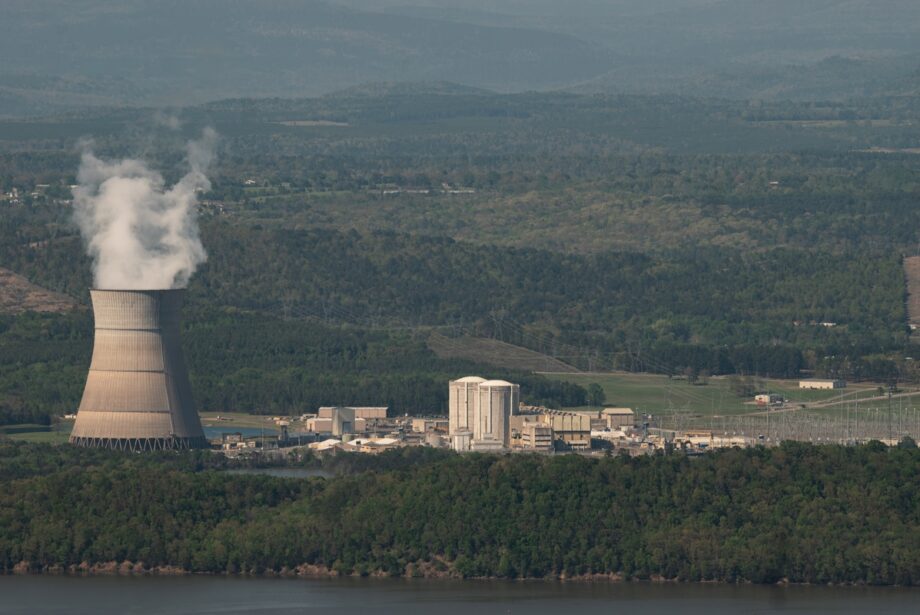
Arkansas Nuclear One near Russellville, the state’s only nuclear plant, has been a workhorse for Entergy Arkansas since Unit 1 came online in 1974. Unit 2 followed in 1978, and the 50-year-old powerhouse still creates enough electricity to supply 56% of its 730,000 customers’ demand. And ANO has decades of lifespan to go.
The EXCEL study will look at the economic and environmental effects of nuclear expansion and make suggestions on future plant designs, location and tax and supply chain implications.
Buddy Hasten, the CEO of Arkansas Electric Cooperative Corp., spent more than half his career in the nuclear Navy before winding up as AECC’s boss in 2019.
While he wasn’t privy to lawmakers’ conversations, Hasten happily discussed the logic of investigating a more nuclear future.
“As America continues to close coal [plants], more and more of our electric reliability is dependent on natural gas,” Hasten said in a telephone interview. “As a risk manager, a strategist and a planner, someone who has spent his life in this work, I know that any time you rely on one resource, you can have a big problem. If that one thing goes wrong, you’re ruined.”
Natural gas is generally a cost-efficient generation fuel, and AECC is planning to build a new gas-fired power plant near Texarkana. But Hasten says the grid must be ready when natural gas prices spike in extreme cold weather. The new plant, for example, can burn diesel as an alternative.
“Coal, nuclear and gas are the only three baseload power fuels that we have now,” he said. “I saw the other day that the [Tennessee Valley Authority] was going to try a fusion plant. Man, that would be amazing. But it’s all in the future. Arkansas wants to make sure we’ve got a good power supply to meet demand over the next few years.
“I always get asked why am I building gas and not nuclear,” Hasten said. “Well, I have to have new generation online by 2028 and 2030 [when two coal plants co-owned by AECC must stop burning coal]. If I was going to build a nuclear plant, it would be 2040 before it came online.”
More nuclear power looms in America’s future if smaller, less expensive modular units prove competitive.
In May, President Donald Trump signed four executive orders to rapidly expand nuclear power. One orders the Army to start running a nuclear reactor at a domestic military base by September 2028. This month, the Army unveiled its Janus Program, which intends to power certain installations with 20-megawatt nuclear microreactors in the near future.
The new nuclear race is on.
 Sign up for Daily E-news