


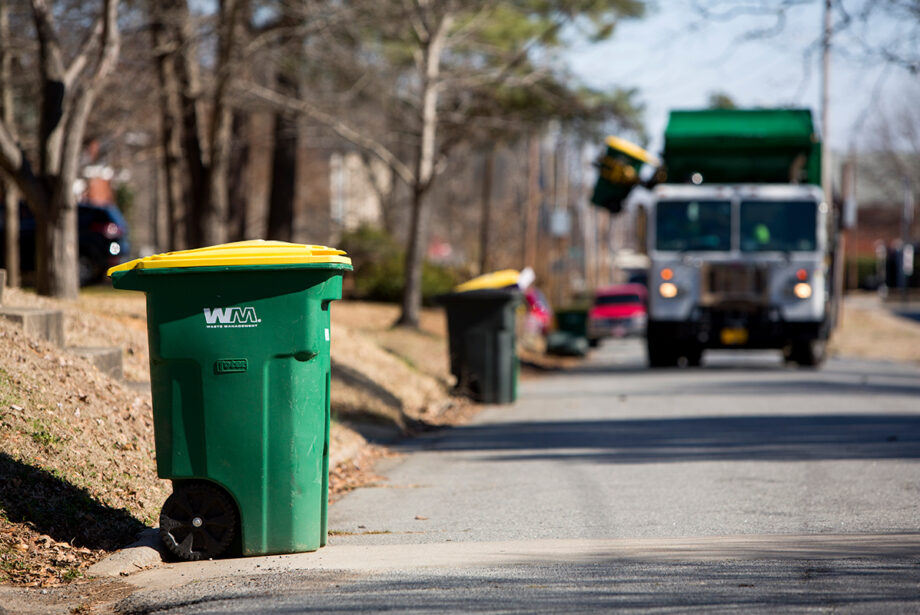
A Waste Management truck picks up waste for recycling in North Little Rock.
THIS IS AN OPINION
We'd also like to hear yours.
Tweet us @ArkBusiness or email us
Where does it all go? Good question. When it comes to the material you put in your residential recycling cart — you know, the green cart with the yellow top — where it goes is quite a journey before it reaches its destination.
Just like any other product, recyclable material has to find a buyer to complete the journey, the transaction.
The ultimate sale of this material, for remanufacturing or other beneficial uses, completes a process that starts with consumers: residential customers of a recycling district, municipality, county or a combination of all three. This process partners with a service that collects and processes discarded but recyclable products into marketable bundles or bales.
The bales — segregated by commodity like paper, plastic or aluminum — are the recycled product.
For recycling to work, the bales must be sold. If the bales can’t be sold, recycling is no longer viable as an environmental, public health and business enterprise. Everything will go to the landfill.
The future of recycling can be summed up in one word: quality. Industries, indeed whole countries that use recycled materials, are more and more demanding quality. And that means the recycled commodity bales coming out of recycling facilities, using raw materials provided by residential consumers, have to be less and less contaminated with nonrecyclable material to be sold. It’s that simple.
What is not simple is the current situation with China. China? Yep. China consumes — buys — upwards of 40 percent of recycled commodities from the U.S. Around the globe, China buys 55 percent of the world’s scrap paper and 45 percent of waste plastic. But no longer.
Over the past year, China has instituted a “quality control” policy that states that any recycled bales of fiber (mixed paper) and plastic (bottles and jugs) have to be no more than one-half of 1 percent contaminated (0.5 percent). Problem is, right here in Pulaski County, the contamination rate of residential curbside recycling carts is running, on average, around 38 percent. And we’re not alone in that dismal statistic.
So as I write this, China is currently banning all imports of “trash plastic,” and sticking to its contamination rate limit on paper. (China needs paper because the country’s ecology is not conducive to the growth of pulpwood, which is the most economically sustainable natural source for paper.)
The result is that recycled material is stacking up on the West Coast, and commodity pricing is going through the floor for lack of demand from our biggest buyer. It’s elementary supply and demand.
Research is clear that most residential consumers want to recycle, and want to do it right. However, what goes in the recycling cart, and what should be left out, has become more and more confusing. And the confusion is of our own making.
When recycling began, consumers were asked to separate at home paper, plastic, bottles and cans. You kept these items separate, and the recycling contractor picked them up fully separated. Then the industry went to what is called single-stream recycling.
Single-stream recycling means consumers no longer have to separate recyclable material. It all should go in the cart loose. The sorting and separating are now done at a materials recycling facility. Easier for the consumer. More difficult for the industry.
With single-stream, participation in recycling increased. But so did contamination. You know, out of sight, out of mind. Just throw it — whatever it is — in the cart. “They’ll take care of it.”
Well, now we’re all in a fix. And while the industry will attempt to further inform and educate residential consumers about how to do recycling right, changes will have to be made to clean up the system. And we will all need to help.
Pay attention to what goes in the cart: paper, plastic bottles and jugs, empty aluminum, tin or steel cans. But not plastic bags or wrap, and not hoses, cords or wire, or food scraps or clothing. Keep it simple. And when in doubt, leave it out.
We’ve got lots (bales and bales) of recycling for sale. We need buyers.
 |
Craig Douglass of Little Rock is an advertising agency owner and research and marketing consultant. He also is executive director of the Regional Recycling District in Pulaski County. Email him at Craig@CraigDouglass.com. |
 Sign up for Daily E-news










