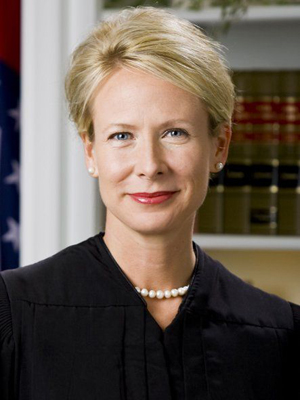
Courtney Goodson
Just months after the U.S. Supreme Court shut down a class-action strategy that had been wildly lucrative for Keil & Goodson of Texarkana, a ruling by the Arkansas Supreme Court opened up a new business opportunity.
The state’s highest court ruled in November 2013 that insurance companies can’t depreciate labor costs when paying claims on property losses. With that opinion in hand, Keil & Goodson and other law firms filed about two dozen lawsuits in Arkansas state courts seeking class-action status against insurance companies.
The insurance companies promptly moved the cases to federal court, something that Keil & Goodson’s previous legal strategy had made very difficult.
By stipulating the maximum value of the cases, Keil & Goodson had been able to keep their cases in front of friendly and slow-moving elected state-court judges. Defense attorneys involved in class-action cases in Miller County Circuit Court had called it a “judicial hellhole,” and the U.S. Supreme Court shut down the strategy in a unanimous ruling in March 2013.
Since then, the Keil & Goodson firm and other attorneys have taken a different approach to keep federal court judges from approving their class-action settlements: Strike a deal with the defendants to return the cases to state court for quick settlement.
A vocal critic of class-action settlements blasted the removal from federal court to state court for settlement purposes.
“They presumably found a friendly judge who will do whatever the parties tell him to do and may not realize the court’s responsibility to protect the absent class members from these sorts of rip-offs,” Ted Frank, the director of the Center for Class Action Fairness in Washington, told Arkansas Business. “I think it’s very unethical when attorneys do that, and I think the state bar association should punish attorneys who do this, but until that happens, it’s going to keep happening.”
Neither of the partners in Keil & Goodson, Matt Keil and John Goodson, responded to requests for interviews about the settlements. Goodson is the husband of Arkansas Supreme Court Justice Courtney Goodson.
Legal Question
Keil & Goodson’s new class-action strategy has roots in a 2012 lawsuit that was brought by its frequent co-counsel, W.H. Taylor and other members of Taylor Law Partners of Fayetteville.
Taylor Law Partners filed a lawsuit in U.S. District Court in Fort Smith seeking class-action status in August 2012 on behalf of Mark and Kathy Adams in Mena.
The Adamses are the same plaintiffs who are leading another class-action lawsuit that has a hearing for a final review on Wednesday in Polk County Circuit Court. In that case the defendant is United Services Automobile Association (see story, Page 1).
The case Taylor filed for the Adamses in federal court had similar set of facts. In 2009, one of their properties was damaged during a tornado. The Adamses’ insurance carrier, Cameron Mutual Insurance Co., determined the loss to their home was nearly $50,000. But the couple received about $40,000 after Cameron Mutual depreciated not only the costs associated with the materials, but also the labor, which the Adamses’ attorneys claimed the insurer could not do legally. The law was unclear on that issue at the time.
In October 2012, attorney William Putman of the Taylor firm asked that the federal court case be put on hold while he posed this legal question to the Arkansas Supreme Court: Can an insurance company that provides payment for the “actual cash value” of a property depreciate the labor costs of repair when the term “actual cash value” is not defined in the policy?
Chief U.S. District Judge P.K. Holmes III granted the stay in May 2013, and the state Supreme Court agreed the next month to consider the question.
Justice Goodson recused herself from the case, as she promised she would from any case involving Taylor since she, as a sitting justice, accepted a $12,000 Caribbean cruise from him in 2011 and a $50,000 trip to Italy from him in 2012.
Taylor didn’t return messages seeking comment. Justice Goodson, who is running for chief justice of the Arkansas Supreme Court, didn’t return an email sent through her campaign website.
Ruling Comes Down
Arkansas Supreme Court Associate Justice Paul Danielson delivered the court’s opinion, with no dissents, on Nov. 21, 2013. The court ruled that insurance companies can’t depreciate the costs of labor when the term “actual cash value” is not defined by the policy.
The ramifications were immediately clear to industry observers.
“Arkansas has been a ‘hot’ jurisdiction for class actions, so I would expect to see more class action filings on this issue in Arkansas,” attorney Wystan Ackerman of Robinson & Cole LLP of Hartford, Connecticut, wrote on his firm’s website the day the ruling was issued.
He was right. By the end of the day, seven lawsuits seeking class-action status were filed in Miller County Circuit Court. Four of the lawsuits were filed by attorney Jason Roselius of Oklahoma City. The Taylor firm filed two, and one was filed jointly by Taylor, Keil & Goodson and Crowley Norman LLP of Houston.
By January 2014, Keil & Goodson was involved in all of those lawsuits and more.
Settlements
Two of the labor depreciation class-action suits that started in Miller County Circuit Court and were transferred to federal court by the defendants were ultimately returned to Miller County for settlement purposes.
On Jan. 5, Miller County Circuit Judge Brent Haltom approved a settlement against Lloyd’s of London underwriters. The attorneys in that case — Keil & Goodson, Taylor Law Partners, Crowley Norman and Roselius — split $800,000. The amount available to pay the class members — that is, the victims — was $1.1 million. How many class members filed the claim forms necessary to receive their share of the settlement is not known. The insurance company gets to keep any money that is not claimed.
Circuit Judge Haltom approved another class-action settlement on Aug. 12 against Shelter Mutual Insurance Co. and awarded the class counsel a total of $1.06 million in attorneys’ fees and costs. The class counsel included the four firms in the Lloyd’s case plus four additional firms.
There was $2.65 million set aside for the class members.
In an affidavit, Matt Keil assured the court that there was “not even a hint of collusion” in the settlement negotiations, and Haltom noted that no one objected to the settlement.
“The Court is of the opinion that the Proposed Settlement is a fair, reasonable and adequate compromise of the claims against Shelter,” Haltom wrote in the order on Aug. 12, identical to the Lloyd’s order except for the name of the defendant.
Haltom didn’t return a call from Arkansas Business.
The Adamses’ case against Cameron Mutual also reached a settlement, but it remained in U.S. District Court in Fort Smith.
Keil & Goodson wasn’t a part of that case, however. The class counsel of attorneys from Taylor Law Partners, Crowley Norman and Roselius asked for and received $332,000 for attorneys’ fees and costs.
Cameron agreed to set aside a little more than $1 million to pay claims. Unlike settlements in state court, which typically require class members to seek out their share of the money, the federal court settlement required Cameron Mutual to identify class members and mail them their checks.
“The Court finds that the Proposed Settlement is a fair, reasonable and adequate compromise of the claims against Cameron,” Judge P.K. Holmes wrote in his order on Aug. 27.
No ‘Hint of Collusion’
Matt Keil, a partner in the Keil & Goodson firm, gave some insight into the Shelter Insurance case, in an Aug. 5 affidavit he filed as part of the case.
Keil said the case was taken on a contingency fee basis. “In other words, Class Counsel would receive nothing unless the litigation was successful and, even then, only upon approval of the court.”
Still, the plaintiffs’ attorneys were committed to the case without knowing how long it would take “or if it would ever resolve,” he said in the statement.
Keil also said that various attorneys in the class counsel participated in all aspects of the case from pre-suit investigation to settlement negotiations. He said plaintiffs’ attorneys spent more than $71,000 on the case.
The parties didn’t discuss what the attorneys’ fees should be until after they reached an agreement on all of the substantive issues.
“Based upon my review of the evidence and my personal involvement in the negotiation process, it is my opinion that there is not even a hint of collusion,” he wrote.
 Sign up for Daily E-news