On Feb. 17, 1945, the USS Gamble — a minelayer destroyer — arrived at Iwo Jima in the South Pacific to explode floating mines. The next day, Japanese planes dropped two, 250-pound bombs on the USS Gamble at midnight. Six American sailors were killed, and many were wounded.
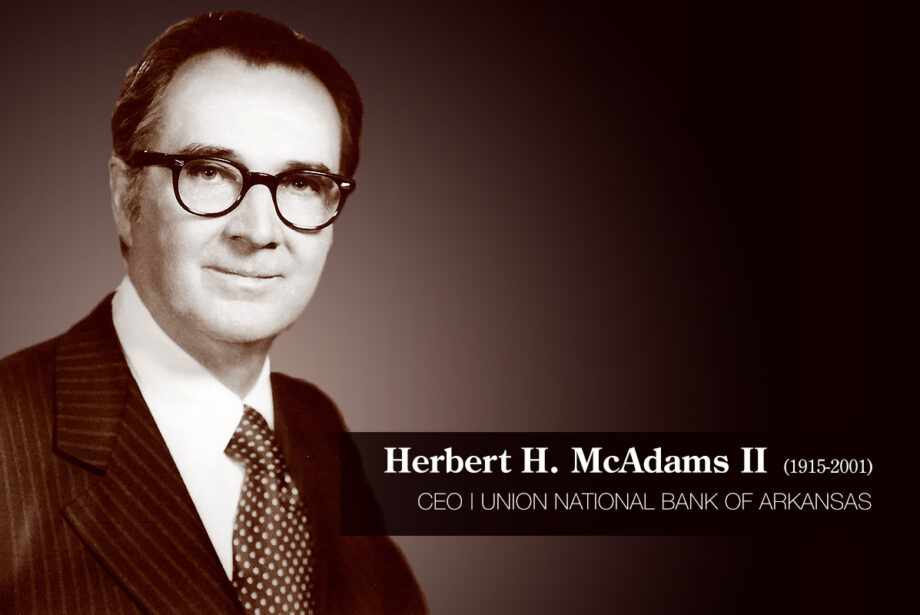
For Ensign Herbert H. McAdams, life would never be the same. He emerged from the attack with 65 percent of his body covered in burns. He was evacuated to Honolulu where doctors assumed he would die. The Navy even sent telegrams to his family to inform them of his death. One week later, his family received a second telegram that he in fact had survived.
McAdams, a young lawyer from Jonesboro, Arkansas, joined the Navy as a volunteer in 1943. The bombing of the USS Gamble was a horrid attack, but one that led to lifelong friendships and McAdams’ many commitments to community.
Born in 1915 to Dr. H. H. McAdams and Stella Patrick McAdams in Jonesboro, Arkansas, Herbert McAdams attended public schools there. After high school graduation, his father encouraged him to pursue a profession, but not in the medical field. McAdams received a basketball scholarship at Northwestern University in Evanston, Illinois, where he earned a bachelor’s degree in 1937. At Northwestern, McAdams was an avid member of the debate team and Sigma Nu social fraternity where he served as “commander” his senior year. His love of debate led him to pursue a law degree at Harvard. After his first year at Harvard, he transferred to Chicago where he attended Loyola School of Law at night and worked at Montgomery Ward during the day.
But McAdams loved Arkansas and eventually transferred to the University of Arkansas School of Law, graduating with honors in 1940. It was there that he met Robert A. Leflar, who would later become the legendary dean of the law school and a mentor and lifelong friend for McAdams.
McAdams was admitted to practice: U.S. Supreme Court (1944), Eighth Circuit Court of Appeals (1944), U.S. Court of Claims (1944), U.S. Court of Customs and Patent Appeals (1944), The Interstate Commerce Commission, the U.S. District Courts and the Supreme Court of the State of Arkansas. He was a member of the Board of Bar Examiners, State of Arkansas (1950-55).
After graduating, McAdams practiced law, but soon military service beckoned. He signed up with the U.S. Navy in 1943 as an ensign, joking that at age 28 he was the oldest ensign in the Navy.
After being stabilized for his burns in Honolulu, McAdams was transferred to the Bethesda Naval Hospital outside of Washington, D.C., where he befriended Arkansas Senator John L. McClellan, a friendship that was deep and enduring.
After extensive grafting and extended hospitalization, he was able to return to Jonesboro to a hero’s welcome. To recognize his military service and sacrifice, the town bestowed to McAdams the title of president of the board of education, an unpaid civic post. Other veterans were welcomed home with similar honors.
Unbeknownst to McAdams, the schools in Jonesboro were struggling to maintain their facilities, pay decent wages and create an income flow from millage taxes or federal aid. A volunteer position became more than the occasional meeting. It began a transformation in the Jonesboro school system.
Led by McAdams, veterans began to search for solutions and rallied the Jonesboro community to donate $1 per month for a school building fund. At times the process was contentious, but it created a more modern school district with well-paid teachers.
McAdams turned his attention to banking when he and a friend purchased the Farmers State Bank of Lake City, soon relocating its charter to Jonesboro. In the early 1960s, Witt Stephens approached McAdams about buying the Citizens Bank of Jonesboro, which McAdams purchased and merged Farmers State under the Citizens Bank umbrella. In the mid-1960s, McAdams bought Security Bank of Paragould and the Bank of Nettleton, which he sold after moving to Little Rock. McAdams also managed Home Federal Savings and Loan of Jonesboro.
In 1970, the board of the Union National Bank of Arkansas approached McAdams about buying the struggling financial institution. He did so and moved his family to Little Rock to oversee Union National Bank. In the late 1980s, Union acquired banks in Texas, Oklahoma and Magnolia, Arkansas. In 1993, Union was sold to Worthen National Bank of Arkansas, creating the largest bank in the state at the time.
McAdams sold Citizens Bank of Jones-boro to Boatmen’s Bancshares Inc. in 1996.
Worthen was purchased by Boatmen’s Bancshares of St. Louis, which later merged with NationsBank Corporation of Charlotte, North Carolina. NationsBank purchased BankAmerica in 1998. The new entity changed names to Bank of America, now one of the largest financial institutions in the world.
McAdams’ business acumen extended to several corporate, educational and nonprofit boards, and he also supported several charities.
He was married to Ruth Noyes McAdams from 1937 to 1970. They had four children: Judy McAdams DeRoeck-deceased (husband Wally) of Austin, Texas; Sandra McAdams Connor (husband Bob) of Dallas; Herbert Hall McAdams III (wife Letty) of Dallas; and Penny McAdams Hodges (husband Tim) of Little Rock.
He married Shelia Wallace McAdams who had two daughters: Kara McAdams Kratzer (husband John) of Rancho Santa Fe, California, and Anne McAdams Dyke (husband Merritt) of Atlanta. He and Shelia had a daughter: Nicole McAdams Groth (husband Dallas) of Dallas, Texas.
McAdams died in 2001 at 86 years of age.
See more of the Arkansas Business Hall of Fame.
 Sign up for Daily E-news