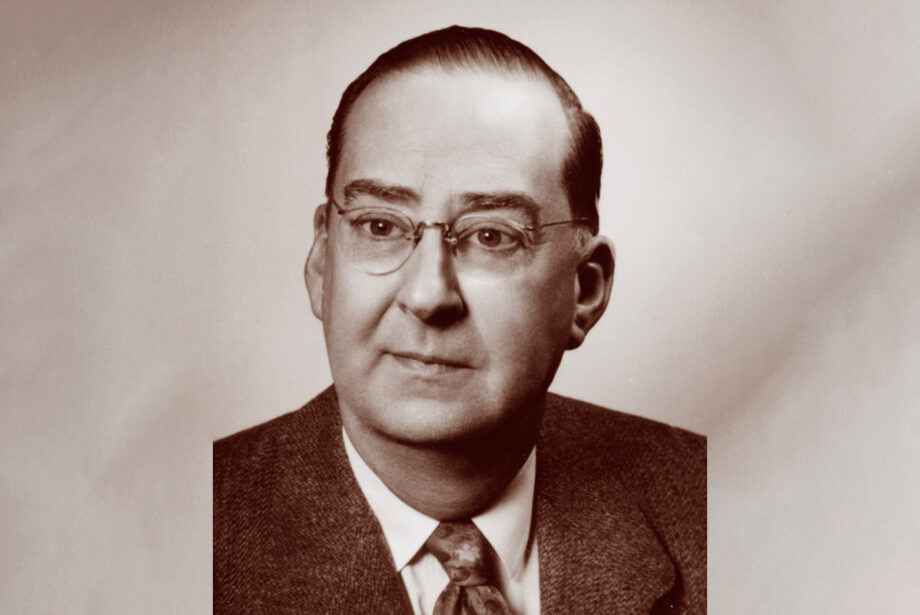
Co-Founder | Steele Canning Company and Springdale Canning Company
Founding Director | Beaver Water District
Today Beaver Lake and its abundant water supplies are often taken for granted, yet water has been critical to the economic miracle of Northwest Arkansas.
But getting fresh water to flow to Northwest Arkansas hasn’t always been easy.
In the 1950s, several business leaders saw the need for a reliable source of water for Northwest Arkansas. One innovative trailblazer – Joseph Marion Steele – led the charge to secure a large water source for the residents and industry in Benton and Washington counties. His work was critical to the transformation of Northwest Arkansas and has had a lasting impact.
While the battle for water and construction of Beaver Lake occurred in the 1950s and ’60s, the journey began several decades before, with a few tomatoes and the need for a summer job.
Early Life
Joseph Marion Steele was born on April 1, 1905, to James Cooper and Sarah Anna Hudson Steele in Elm Springs. When Joe was four, the family moved to a farm south of Tontitown. As a teen, Joe attended Springdale High School and then set his sights on the University of Arkansas. He knew he needed money for school, so he decided to can tomatoes to pay for his education.
It was a summer job that would shape a career.
Joe Steele studied engineering at the University of Arkansas from 1924-26, but he left as a junior to devote his time to his business. Joe positioned his first full-time canning operation near a large spring on the family farm. The Steele Canning Company was born.
He started with what he knew best – canning tomatoes. Soon the operation expanded to include spinach, lima beans, green beans, field peas, sweet potatoes and more.
Steele married twice. First in 1927, he married Nancy “Nannie” Lee Webster, and they had two daughters, Nancy Jo and Marjorie Lee. Steele created the canned vegetable brands Nancy Jo and Marjorie Lee to honor them. In 1938, Steele married Gretchen Gilliland Broyles, who had a three-year-old son, Phillip Wayne.
Work and Water
In the early 1930s, Steele Canning relocated to Springdale. By 1935 and on into the 1940s, canning operations thrived and grew.
Joe and his cousin Luther Johnson bought the Springdale Canning Company in 1937. By this point, Steele either owned or co-owned five canneries, as well as hatcheries, poultry farms and feed mills. That same year, Steele Canning shipped the first trainload – 28 cars – of canned foods ever shipped in the United States. In 1938, Steele purchased a full trainload of fertilizer – another railroad first – for local farms, his agricultural suppliers.
During World War II, 70 percent of Steele’s canning products were diverted to the armed forces. Because of its production achievements, the Steele Canning Company received an Achievement “A” Food for Freedom Award in 1945 to recognize its role in the war effort.
In 1954, Johnson passed away and the poultry division was sold to Springdale entrepreneur John W. Tyson. Steele retained the canning companies and purchased Johnson’s banking interest in the First State Bank.
By the early 1960s, Steele Canning encompassed seven plants and more than 50 different products making it the largest cannery in the state. In 1957, Joe’s son Phillip joined Steele Canning and the father/son duo were instrumental in several innovative marketing initiatives including sponsoring the Beatles 1964 tour with Wagon Master Beans and increasing in-store spinach sales with the addition of Popeye on its label in 1965.
By 1972, the company operated 16 plants and was one of the largest canning companies in the nation. Due to health concerns, Steele sold Steele Canning Company to Pioneer Food Industries. Joe created Steele Enterprises and focused on his banking interests via First State Bank.
Steele’s first operation was located near a spring on the family farm. But as production grew, so did the need for water.
In 1922, Springdale’s water system served about 50 people. By 1950, the population had grown to nearly 6,000 people and the original water source could no longer support the community. Nearby Fayetteville, Rogers and Bentonville were experiencing similar water challenges.
During dry summers, Steele’s canneries were sometimes asked to close down and shift production to other plants due to water shortages. In 1959, the Beaver Water District was organized, a first for Arkansas, with Steele as a founding board member.
In 1960, the four cities joined forces to pay for water storage in the proposed Beaver Reservoir and signed contracts with the U.S. Corps of Engineers to underwrite initial water allocations. In 1963, the district was required to pay a $700,000 matching fee to secure federal funding to underwrite construction for the new water plant.
Joe had gone to Boston for eye surgery. While recuperating, he received a phone call to alert him to the immediate need for a $700,000 local match requirement. Time was of the essence. Joe called First State Bank with instructions to fund the construction and personally guaranteed the loan so the project could move forward. The project was initially built and operated by the Springdale Water and Sewer Department of which Steele was chairman. It was later turned over to the district at cost as the other cities came online.
In honor of his longtime work and financial support of the project, the Beaver Water District named the water treatment facility the Joe M. Steele Water Plant.
Community Servant
Steele served on the Springdale’s City Council, Water and Sewer Commission and Industrial Park Commission, Arkansas Industrial Development Commission, State Police Commission, State Fair and Livestock Show Association board, Springdale Memorial hospital board of trustees, Springdale Rotary Club, Chamber of Commerce and Ozark Canners and Freezers Association. He served on the First United Methodist Church board and was its finance committee chairman.
He chaired the Springdale’s Chamber of Commerce Industrial Committee for 20 years and the West-Ark Area Boy Scout Council. On a national level, Steele served as the National Canners Association director for 20 years.
Joseph Marion Steele died on June 18, 1976. He was 71 years old.
See more of the Arkansas Business Hall of Fame.
 Sign up for Daily E-news