It’s just the first step, and an expensive one at that, but the Arkansas Department of Transportation is tackling the uncompleted stretch of Interstate 49 in the River Valley.
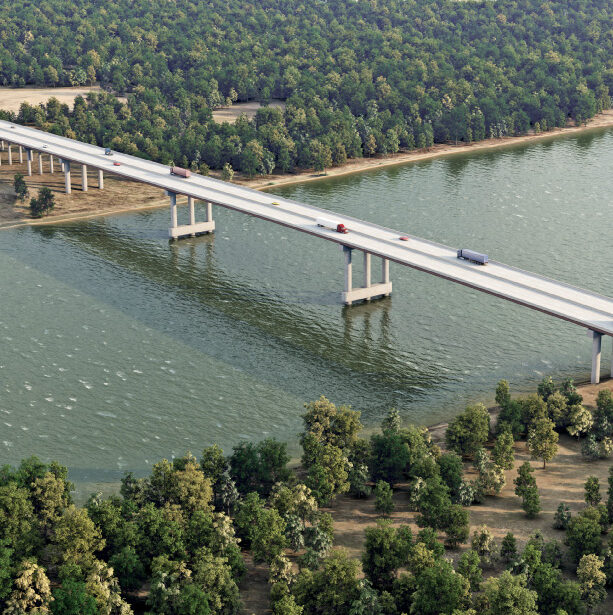
The department awarded a $282.5 million contract to Manhattan Road & Bridge of Tulsa in October to build a 3.1-mile stretch of road near Fort Smith that includes a bridge over the Arkansas River at Barling. The project is the first of four with an overall price tag of $1.3 billion for a 13.7-mile stretch of I-49 that will connect Interstate 40 in Alma to Highway 22 south of Fort Smith.
Officials and community leaders hope the four-part construction series will finally get momentum behind the goal of extending I-49 from Fort Smith to Texarkana, the only unfinished part of the interstate that otherwise runs from south Louisiana to the Canadian border.
“This is the first of four major projects to help us connect the south side of Fort Smith up with 49 and having that direct link from that city up to northwest Arkansas, Kansas City and points beyond,” said ARDOT Director Jared Wiley. “It has been a process. This project we just awarded was the largest project on record that we’ve taken bids on. We’ve been working a long time on getting funding secured for that segment.”

The project has long been planned but received a financing boost when Arkansas voters approved the permanent half-cent sales tax dedicated to highways in 2020. The stabilization of funding — the sales tax had been temporary until the 2020 vote — allowed the state to move forward with some much needed projects.
“We have no shortage of needs, and with the appropriate amount of funding, we can really do great things,” Wiley said. “Our construction program is about $1 billion per year. When you consider that the replacement value of our transportation network in the state is $140 billion, it really underscores how we do our best to use that $1 billion to take care of a $140 billion system each year.
“Any investment in transportation infrastructure is an investment in the economy and the future of our state.”
Design & Planning
ARDOT did a lot of specialty planning on the Arkansas River bridge.
Wiley said the department partnered with Seamen’s Church Institute of New York, a company that used computer simulations to determine the best way to pair a bridge with the topography and river traffic. Wiley said the simulation allowed ARDOT to design a shorter bridge by using a constructed embankment on the north side of the river.
The design will save ARDOT as much as $50 million in construction costs. That’s 5% of the department’s annual construction budget, Wiley said.
“To accommodate that barge traffic, the U.S. Army Corps [of Engineers] wanted a certain span length,” Wiley said. “We were thinking if we could reduce that, it would allow us to build our standard plate girder-style bridge. We also were able to work with the National Guard and the Department of the Interior to clear some vegetation on the banks of the river, and that allowed us to help reduce some of the heights and clearance needed there.
“It’s beneficial to the taxpayers because we save money on the construction of the project.”
Any savings is useful. Wiley said the I-40 section of the expansion — building interchanges for I-40 traffic to eventually head south to the bridge and beyond — is expected to cost nearly $300 million.
Currently, ARDOT has approximately $50 million of that funding set aside.
“We’re working again to secure funding for the remainder,” Wiley said. “We have funding set aside to start the dirt work coming south from 40. We hope to start that project sometime next year, and then we’re still working to secure the necessary funding for the Interstate 40 interchange.
“We’re seeking earmarks and other major transportation grants to try to bridge that gap. As soon as we get the funding, we’ll be ready to go to construction.”
Miles to Go
The groundbreaking for the bridge project is Aug. 22, and construction is expected to take four years.
The rest of the series will take years after that, and funding for only the second project has been secured. Wiley said ARDOT is still moving forward, researching and designing for the true jewel: the completion of the 162 miles of I-49 between Fort Smith and Texarkana.
That will be years, if not decades, down the road. The price tag for that long stretch down the western edge of Arkansas is approximately $5 billion.
“While this bridge is being built, we’re working on securing funding to get us all the way to the I-40 interchange, but at the same time, we’ll begin surveys soon on the piece between Fort Smith and Y City,” Wiley said. “We’ve got funding set aside through 2028 to help us do the survey preliminary design work. Our goal is to go ahead and get to that point to where we have that right of way acquired, so that when the federal government comes through with some additional funding for that piece, we’ll be ready to build it.
“We have momentum, and we’re carrying it forward, but you know, we’re looking at about a $5 billion price tag for that segment between Fort Smith and Texarkana.”
Along those lines, Wiley and members of the Arkansas Highway Commission went to Washington, D.C., to meet Transportation Secretary Sean Duffy. Wiley lobbied for funds for Arkansas.
“We talked about the importance of I-49 to the part of the nation, and the importance of big investments in large infrastructure projects,” Wiley said. “We are doing our best to advocate and make sure that folks at a national scale understand the importance of this corridor. We need to keep pushing forward so that when the funding is available, we can go ahead and build something meaningful.”
This story has been updated to clarify that the new Interstate 49 bridge over the Arkansas River will be built over the river at Barling.
 Sign up for Daily E-news