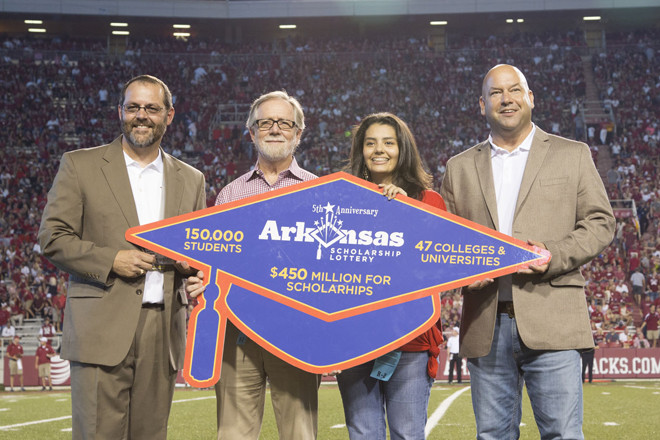
A $300,000 investment by the Arkansas Scholarship Lottery to promote scholarship beneficiaries, including on-field promotions at college football games this fall, appears to have had little impact on sales.
Instant ticket sales got a slight boost during the first two months of the campaign, but it wasn’t enough to prevent a slide in total sales, which continued to be hampered by struggling jackpot games such as Powerball.
The marketing campaign included the game day check presentations, where legislators and educators joined lottery officials on-field, as well as radio spots and print advertising in the game programs. It was part of a $5 million marketing budget awarded to Mitchell Communications Group of Fayetteville and Mangan Holcomb Partners of Little Rock.
Craig Douglass, president of Craig Douglass Communications in Little Rock, who has been critical of some of the lottery’s marketing, said it would be unlikely that the campaign “moved the needle” on ticket sales once all the numbers come in. He said that while a beneficiary campaign is good for the lottery’s image, it should have been part of a bigger strategy that targeted improving ticket sales by getting people excited about playing.
“Any public relations effort has to be part of an overall marketing and communications plan. This seemed to be kind of in addition to the marketing effort and not a strategic part of it,” Douglass said. (Douglass writes a monthly column for Arkansas Business, “On Consumers.”)
Douglass said it would be smart for the lottery to embrace more of the marketing advice from a Camelot Global Services report released this month. Camelot found the lottery was impaired by negative publicity and that it offered too many games and paid its vendors more than other states. The report included several recommendations, including creating a brand identity, using consistent messaging and “instill[ing] marketing effectiveness and a Return On Investment … process within Senior Management.”
Douglass said he agreed with those points and noted that he didn’t think the lottery was currently practicing most of the recommendations. “More effort needs to be focused on the fun and the excitement and chance of winning from the consumer’s point of view,” Douglass said.
The lottery touted its beneficiaries campaign earlier this year as a way for people playing the lottery to put a face on those who benefited from the games. The campaign was the first time the lottery advertised with higher education.
The on-field check presentations and advertising on the stadium video board were regular sights at the University of Arkansas’ home football games, where the lottery spent $75,000 on the promotion. The lottery also spent $20,000 at Arkansas State University, $10,000 at the University of Central Arkansas and $9,000 at the University of Arkansas at Pine Bluff.
According to reports from the first full two months of the football season, total sales continued to lag behind last year’s numbers, despite the additional advertising.
In September, the first full month of the season, total sales were down 3.6 percent from $31.86 million to $30.71 million. The next month, sales were down about 1 percent from the same month last year from $33.27 million to $32.96 million.
The drop in sales was largely attributed to losses in so-called online games, which includes Powerball.
The lottery did see increases in instant ticket sales during both months, including a 6.7 percent jump in September. But Douglass said those sales were likely influenced by falling gas prices.
Patrick Ralston, the director of public relations and legislative liaison at the lottery, said he thought the campaign was successful because it brought more attention to the lottery’s beneficiaries and the feedback they received was “tremendously positive.”
“This is not a retail effort. This is an effort to connect with the people who really benefit from the lottery and what the lottery does,” Ralston said.
Ralston said in an email that he didn’t have any additional comments on the recommendations from the Camelot report beyond what the director said at the commission’s meeting earlier this month.
“As he stated in the meeting, a great deal of these recommendations are in place or are in the process of being put into place. Beyond that, we will review the consultant agreement and proceed as needed in conjunction with the commission and the [legislative oversight committee],” Ralston said.
 Sign up for Daily E-news