THIS IS AN OPINION
We'd also like to hear yours.
Tweet us @ArkBusiness or email us
June was a big month for commercial transportation and its benefits to consumers. On June 29, the Interstate Highway System turned 60. And on June 26, the expansion of the Panama Canal was completed, more than doubling the ship-board container capacity of the canal, which was built in 1914.
Panamax ships are those ships constructed with the original size of the canal in mind. They have a container capacity of 5,000 TEUs. (That’s a twenty-foot-equivalent unit, for those of you believing size matters.) The New Panamax ships built for the expanded canal have a container capacity of 13,000 TEUs. Never mind the terms or the definitions: Going from 5,000 of something to 13,000 of the same thing is a major increase. And it will affect Arkansas consumers.
Likewise, the general economic and direct consumer impact of the Interstate Highway System, which was initiated during the Eisenhower Administration to create civil defense evacuation routes, has increased the ease of travel for Americans, as well as the ability to move manufactured goods and raw materials more efficiently, cutting the cost of distribution and, ultimately, retail costs to consumers.
Plus, the interstate system itself, particularly when two or more interstates intersect, creates economic activity and job creation through commercial development, connectivity among cities and their agricultural and manufacturing bases, and ease of access for regional and national tourism.
Arkansas interstates and the expansion of the Panama Canal are very much related to one another. For our comparison purposes here, we will attempt to make the case for continued interstate rehabilitation and increased capacity, where needed, and for the construction of new interstates and, in the case of I-49 between Fort Smith and Texarkana, the completion of an existing interstate in Arkansas.
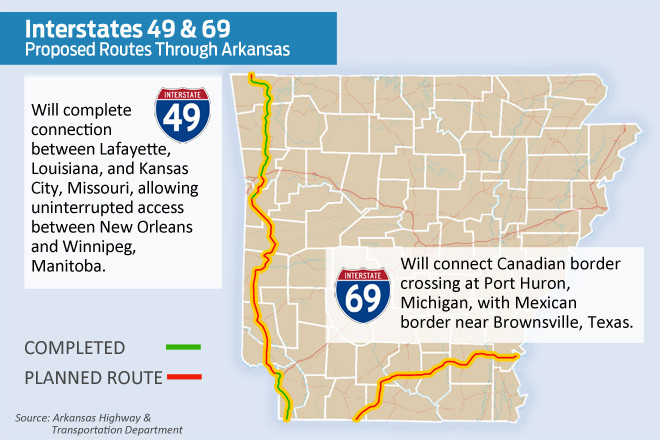
I-49 and I-69 are critical paths for southeast, south, southwest, west, and northwest Arkansas. And, thus, for the total Arkansas economy.
I-69 would run east to west from the Arkansas River at Arkansas City and McGehee, to Monticello (where construction of the eastern part of a bypass is underway), and then south of Warren, to north of El Dorado and south of Magnolia, turning south to the Louisiana line. While the “missing link” of I-49 from Fort Smith to Texarkana would be the last leg of the high-priority corridor connecting Kansas City and New Orleans, creating an uninterrupted 1,700-mile highway from Winnipeg, Canada, through the heart of America to New Orleans. This consummation construction would also include the Bella Vista bypass at the Missouri border. Connectivity.
Here’s the thing: When more international container shipments passing through the newly expanded Panama Canal reach, for example, the Port of Houston, the distribution of those materials and products will begin to dramatically increase commercial truck traffic from I-45 out of Houston to I-30 in Arkansas. Without a completed I-49, which would effectively absorb some of the new commercial traffic, I-30 becomes much more congested in and around Texarkana and through southwest Arkansas to Little Rock. Plus, a completed I-49 would benefit the economies and job-creation opportunities in western Arkansas from Bella Vista to Texarkana, and in other Arkansas communities to the east of the corridor.
Arkansas has over 16,000 miles of state-supported highways. Both rural and urban. Our primary and auxiliary interstates include more than 750 miles. Ask any Arkansan using these miles and you will quickly discover that none of the miles are seen as expendable. Nor are there any highways to nowhere. They all count for someone, somewhere in Arkansas. And the maintenance of what we have, and the construction of what we need to safely connect Arkansans to one another, and Arkansas to the nation and the world, is an economic development priority, as well as a consumer necessity.
The Panama Canal is over 3,000 miles from here. Locally, however, its expansion and the resulting increase in commercial distribution create a paradox. Consumers should benefit from reduced cost from the more efficient international distribution of raw materials and finished goods. But the added stress to our national and state highway systems, unless properly enhanced through increased funding, would surely mitigate the coming benefits.
June rhymes with soon.
 |
Craig Douglass is an advertising agency owner, and marketing and research consultant. He is president of Craig Douglass Communications Inc. of Little Rock. Email him at Craig@CraigDouglass.com. |
 Sign up for Daily E-news