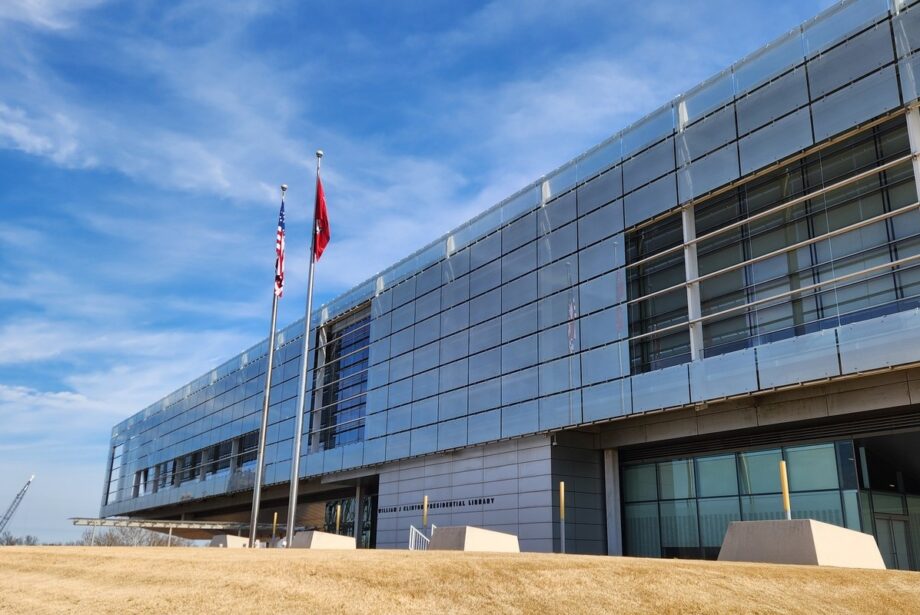
Several downtown Little Rock buildings will soon be in the loop: a “literally cool” and environmentally friendly loop worth at least $30 million.
The Clinton Presidential Library, the former Heifer International headquarters and up to a dozen city-owned structures expect to be sharing efficient and environmentally sustainable heating and cooling by 2028.
Designers expect millions of dollars in savings and a net-zero carbon footprint on paper through the Clinton Sustainable Energy District, an engineering endeavor driven by a big, cutting-edge heat pump and connected by underground pipes.
ENFRA, formerly Bernhard, is leading work on the district, a partnership with the Clinton Foundation and the city of Little Rock. The Clinton Presidential Center will anchor the centralized low-carbon heating and cooling network on its main campus, and will benefit from a new 5-megawatt off-site solar array.

“There’s been a lot of activity on the Clinton campus” since 2023, said Jordan Tinsley, ENFRA’s vice president of development. “They acquired the Heifer building, and the opportunity [for the sustainability project] arose while we were in due diligence with them around this concept.”
Tinsley noted that the Clinton Center was the first LEED-certified presidential library in the country. The Heifer campus, soon to be renamed One World, “is one of the most sustainable buildings in the state, potentially in the Southeast,” he said.
ENFRA saw “a lot of synergy” in an energy-as-a-service partnership with the foundation, Tinsley said. “Once we all kind of agreed upon that, we started doing outreach with other stakeholders and got some momentum with the city of Little Rock as a potential partner, and so that’s allowed us to really pursue a larger vision for the sustainable energy district and expand its footprint. Although, to be clear, we’re still in due diligence with the city of Little Rock, so the level of its participation is yet to be determined.”
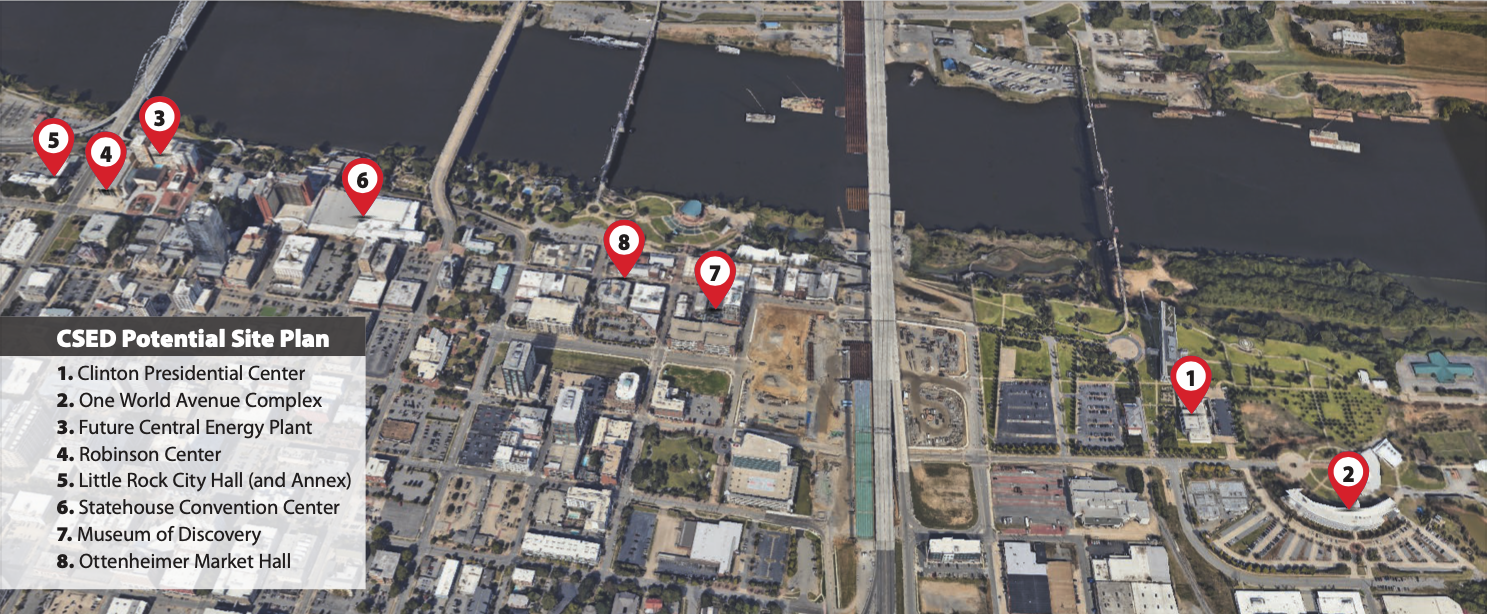
Ultimately, ENFRA and the foundation hope that the district will run along West Markham Street and the Broadway corridor, where City Hall and its annex stand, to Robinson Center, the Statehouse Convention Center, the River Market, the Arkansas Museum of Discovery and east to the Clinton Center and the former Heifer campus.
Mayor’s Perspective
Little Rock Mayor Frank Scott Jr. said the city announced a memorandum of understanding on the project in September, and he’s excited about how it fits into the city’s long-term sustainability goals.
“We are all going through the due diligence phase, considering all the city’s assets combined with the Clinton assets on how we can be most energy efficient and sustainable,” he said.
Scott hopes for an agreement by summer or early fall. Construction is expected to take about 18 months.
He expects the project to encompass “all of our city-owned buildings downtown, from City Hall to Public Works, our building and planning department, district courts, police headquarters and several others,” including Robinson Center and the Convention Center.
All of the connected buildings will benefit from sharing chilled water and heating resources rather than continuing to run independent HVAC systems. ENFRA expects the energy district to cut utility costs by about 40%.
The project goal was to save money, aid the environment and re-emphasize the Clinton Foundation’s global leadership on sustainability, Tinsley said.
Heart of the Savings
The heart of the circulation system on the Clinton campus will be a “heat pump chiller heater,” said Chris Galloway, ENFRA’s mechanical engineer for the project. “It extracts the heat from the filled water system and transfers it into the end of the heating water system. … So when we can transfer the heat between these cooling sinks and the heating sinks, that creates a unique opportunity for significant energy savings.”

The system will cut energy use by recovering and reusing heat that other systems would throw away, by pooling and sharing HVAC capacity over multiple buildings, and by eliminating some auxiliary loads like cooling-tower replacement water and associated pumps. The combined effect is to reduce electricity use, water consumption and operating costs associated with maintenance.
“The amount of heat transfer is 17,000 BTUs of heat, but you’ve only paid for about 5,500,” Galloway said. “So simple math from that perspective would tell you you’re about 300% efficient. With this heat pump, for every 1 kWh of input that it provides, you get 3 kWh of output. So there’s tremendous savings in regards to that. But the savings actually go beyond that.”
Tinsley said ENFRA’s fabrication shop in Long Beach, Mississippi, will put together the heat pump chiller heater, along with piping and components on a skid that’s 8 feet by 13 feet and 9 feet tall.
“It’s going to be transported here to the CPC, and we’ll be able to install it very simply and efficiently, because we’re doing all the work in that controlled environment at the fab shop,” Tinsley said. “Then it’s just a matter of sliding that skid in and hooking up the pipes and everything.” Then comes testing.
“We’re really excited about this being one of our first opportunities to do this modular heat pump chiller heater construction at our fab shop in Mississippi, and then bring that component here and install it very efficiently and safely,” Tinsley said. “ENFRA anticipates doing more of this as we start to maximize the utilization of the fabrication shop.”
The Solar Piece
The entire project involves over $30 million in energy infrastructure upgrades, including the solar array, with long-term maintenance by ENFRA.
The site of the new solar array hasn’t been disclosed because the permitting process is unfinished, but the project is authorized under the Public Utilities Regulatory Policies Act of 1978, which promotes energy conservation, efficiency and renewable energy. The law basically created the independent power production industry, and was key to allowing small-scale projects to connect to the grid.
“It’s 5 megawatts, AC, and it’s structured as a qualified facility under PURPA, because we see some advantages to having it under FERC jurisdiction,” Tinsley said. “It’s intended to be an array to supply enough renewable energy to the same grid from which the Clinton Foundation takes service to more than offset the carbon impact of the foundation’s operations in Little Rock. And in addition to that, there’s going to be enough renewable energy certificates from the output of the facility to offset the carbon footprint of the whole sustainable energy district.”
The district’s twofold goal is to fully decarbonize the foundation’s operations and “to at least make net zero” the energy district itself, Tinsley said.
Under PURPA, Entergy Arkansas will pay for the solar power at a price equal to what it would have paid to generate the power itself.
Ben Thielemier, the Clinton Foundation’s director of communications and marketing, noted that the Clinton School of Public Service announced that it’s moving into the four-story office building at One World Avenue. “Heifer International, of course, is still in the building as well. And we anticipate moving more of our Clinton Foundation staff over there in the future.”
Thielemier said sustainability has long been at the core of the foundation’s philosophy.
“This whole campus has been built around sustainability,” he said. “It was one of the first federal buildings to be LEED certified, and we’ve maintained that certification over the years, including the historic Choctaw building,” the repurposed 1899 railroad passenger depot that serves as the Clinton School’s Sturgis Hall.
“The Heifer International building was also LEED certified when it was constructed, and as we explored the addition of the One World buildings into this whole campus, we wanted to find a way to continue that,” Thielemier said.
“It’s a win-win for us, an investment in the future, and it is also going to come with utility savings and reduced environmental impact. It’s also a model, if you will, for other municipalities and organizations to follow.”
 Sign up for Daily E-news